
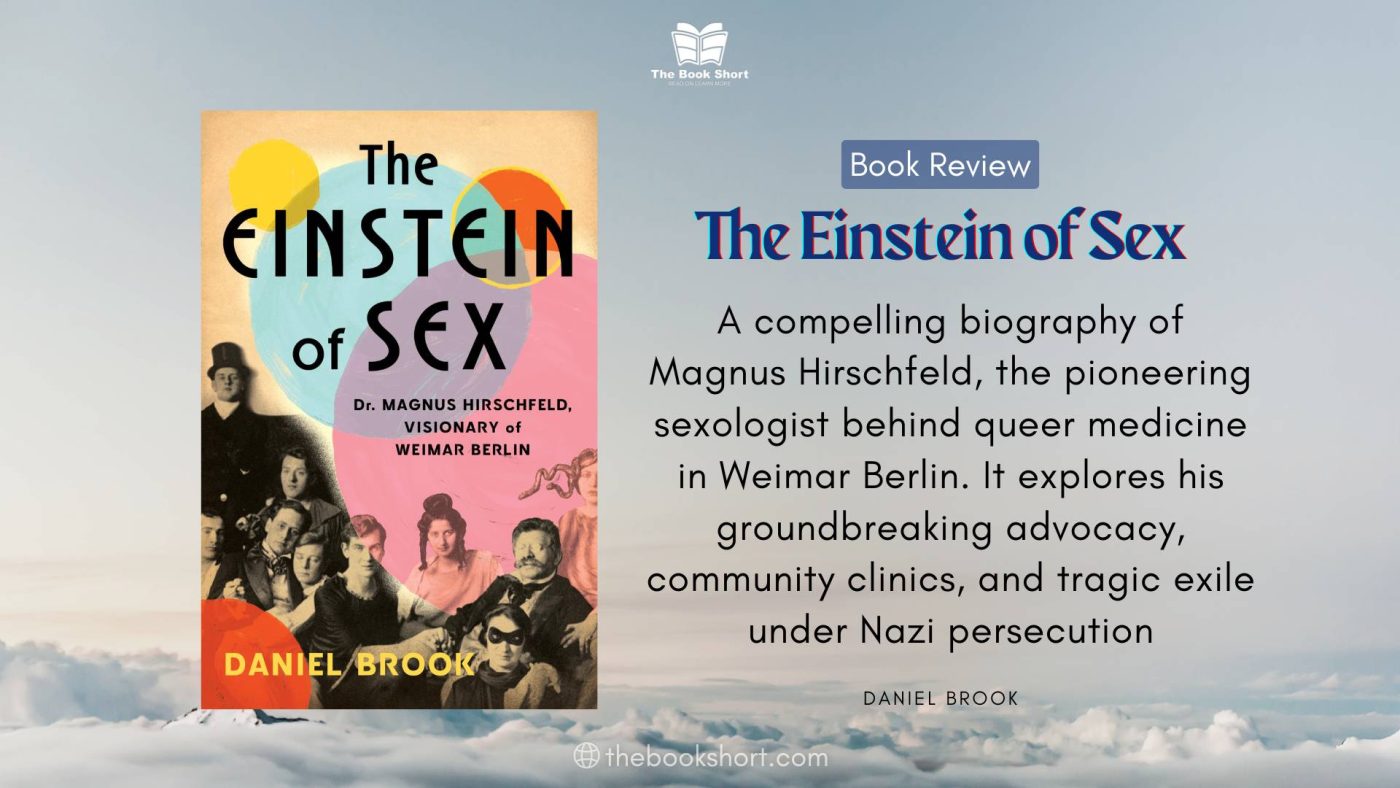
Explore the revolutionary history of sex science and LGBTQ+ rights in Daniel Brook’s “The Einstein of Sex.” A vital read on a forgotten pioneer.
Daniel Brook’s The Einstein of Sex offers a captivating and deeply necessary journey into the life and groundbreaking work of Magnus Hirschfeld, a visionary German physician and sexologist. Operating at the turn of the 20th century, Hirschfeld’s research fearlessly challenged entrenched societal norms around sexuality and gender, laying crucial groundwork for the modern understanding of these complex facets of human identity. I chose this book for review because it masterfully resurrects a figure of immense historical significance, one whose contributions to sexual science and the nascent movement for LGBTQ+ rights were not merely revolutionary for his era but were actively suppressed and nearly erased by the dark forces of fascism. Its profound value lies in tracing the origins of scientific inquiry into human sexuality, the fierce opposition it faced, and how Hirschfeld’s radical legacy continues to resonate, shaping contemporary discussions. This makes it an indispensable read for anyone seeking to understand the interwoven histories of science, medicine, social justice, and the enduring fight for sexual liberation.
Basic Information About The Einstein of Sex Book
- Title: The Einstein of Sex: The Sensational Life and Tragic Fall of Magnus Hirschfeld, Father of Sex Science
- Author: Daniel Brook
- Year of publication: 2017
- Genre: Non-fiction, Biography, History (specifically History of Science, History of Medicine, German History), LGBTQ+ Studies
- Number of pages: Approximately 336 pages (note that page count can vary slightly across different editions)
- Target audience: Readers interested in the history of sexology, the origins of LGBTQ+ rights advocacy, Weimar Republic culture, the impact of Nazism on science and society, and compelling historical biographies.
Main Content Summary of The Einstein of Sex
Daniel Brook’s The Einstein of Sex vividly recounts the extraordinary story of Magnus Hirschfeld, a Jewish physician from Germany who rose to become a pivotal figure in the burgeoning field of sexology around the turn of the 20th century. Brook compellingly positions Hirschfeld as a radical, albeit tragically overlooked, pioneer who sought to apply scientific rigor to the study of human sexuality, bravely confronting the rigid moralistic and legalistic views that dominated his time. The narrative intricately traces Hirschfeld’s path from his early medical career through his ascent as a globally recognized sex researcher, the establishment of his utterly unique institute, and his eventual catastrophic downfall at the hands of the Nazi regime.
The book unfolds in a largely chronological manner, guiding the reader through Hirschfeld’s life journey and the evolution of his groundbreaking ideas and work.
Part 1: The Making of a Sex Scientist
The book opens by setting the stage, introducing Magnus Hirschfeld against the backdrop of late 19th and early 20th-century Germany. Brook paints a compelling picture of an era where discussions about sex were heavily taboo, laws were brutally punitive (especially against homosexuality, epitomized by the infamous Paragraph 175), and scientific understanding was virtually nonexistent.
- Early Life and Catalysts: Brook details Hirschfeld’s upbringing, his medical training, and the early experiences that profoundly shaped his perspective, leading him to confront the immense suffering caused by societal ignorance and prejudice surrounding sexuality. A deeply impactful event was the suicide of a young military officer driven to despair by the threat of exposure and prosecution for his homosexuality. This tragedy galvanized Hirschfeld, solidifying his lifelong commitment to studying and advocating for sexual minorities.
- Pioneering Sexology: Hirschfeld began his work quietly but resolutely, publishing early pamphlets and articles that argued for a more humane, science-based understanding of sexuality. He famously coined the term “sexual intermediary types” (later simplified as “Third Sex”) to describe individuals who didn’t fit neatly into strict male/female or heterosexual/homosexual binaries, positing these variations as natural biological phenomena rather than diseases or moral failings.
- Founding the Scientific-Humanitarian Committee: In a truly groundbreaking move in 1897, Hirschfeld co-founded the Scientific-Humanitarian Committee, widely recognized as the world’s first organization dedicated to homosexual rights. Their audacious goal was to achieve the repeal of Paragraph 175 by educating the public and lawmakers about the natural spectrum of human sexual variation, arguing that homosexual individuals were simply a distinct type of human being, inherently different but not criminal or pathological. This organization marked the dawn of organized activism for LGBTQ+ rights.
Part 2: The Institute for Sexual Science
This section delves into Hirschfeld’s most ambitious and revolutionary undertaking: the Institute for Sexual Science (Institut für Sexualwissenschaft) in Berlin, established in 1919. Brook portrays the Institute not just as an academic center but as a dynamic, multifaceted institution – a vibrant hub for pioneering research, public education, and compassionate clinical care.
- A Center for Comprehensive Research: The Institute housed an unparalleled library and archive, meticulously collecting data and materials on all aspects of human sexuality, spanning diverse cultures, historical periods, and biological perspectives. Its mission was to forge a truly comprehensive science of sex, conducting groundbreaking studies on sexual behavior, gender identity, and sexual health.
- Championing Education and Outreach: Hirschfeld firmly believed that knowledge was the most powerful weapon against prejudice. The Institute actively engaged the public through lectures, published influential journals, and worked with the media to disseminate accurate information, challenging entrenched ignorance and misinformation. It quickly became a recognized international authority on sexual matters.
- Innovative Clinical Services: Crucially, the Institute wasn’t confined to academia; it offered vital medical and psychological services. It provided therapy for sexual difficulties, offered advice on contraception, performed some of the earliest documented gender-affirming procedures (though the understanding and terminology were rudimentary by modern standards), and offered a lifeline of support for sexual minorities in an era when they had nowhere else to turn. This combination of research and practical, compassionate care made the Institute uniquely visionary.
- Hirschfeld’s Enduring Theories: Brook explores Hirschfeld’s core theories, including his concept of a ‘sexual intermediate’ scale (foreshadowing later ideas of a spectrum rather than rigid categories) and his early attempts to understand the biological underpinnings of sexuality and gender. While some of his specific biological hypotheses were later revised by science, his fundamental, radical insight that variations in sex, gender, and sexuality represented natural human diversity – not moral failings or mental illness – was profoundly influential and far ahead of its time.
Part 3: Navigating Weimar Germany
The book masterfully places Hirschfeld and the Institute within the complex, vibrant, yet ultimately fragile context of Weimar Germany.
- Cultural Impact: The Institute and Hirschfeld himself became prominent figures within Berlin’s relatively liberal and culturally adventurous environment of the 1920s. He consulted on films, advised writers and artists, and actively contributed to a more open public discourse on sexuality. His pioneering work on “transvestism” (cross-dressing) and “transsexuality,” while using the terminology of the era, was revolutionary in recognizing these identities as distinct from homosexuality, offering early medical support and understanding.
- Political Undercurrents: Despite the pockets of cultural openness, the political climate of the Weimar Republic was inherently volatile. Hirschfeld, a prominent Jewish intellectual, openly identified with or was perceived as part of sexual minorities, was a leading sexologist, and a vocal social liberal – a combination that made him a lightning rod for fierce opposition from conservative, nationalist, and increasingly right-wing elements who viewed his work as decadent, dangerous, and a threat to traditional German values.
Part 4: The Rise of Nazism and The Fall
This part recounts the tragic and inevitable culmination of Hirschfeld’s story as the forces he fought against seized power.
- Targeted by the Regime: With the rapid ascent of the Nazi party, Hirschfeld and his Institute were immediately marked for destruction. The Nazis embodied everything Hirschfeld stood against: ignorance, prejudice, virulent nationalism, and the brutal repression of individual freedom and scientific inquiry.
- The Infamous Book Burning: One of the most chilling and symbolic acts of the early Nazi regime was the public book burning on May 10, 1933. The Institute for Sexual Science was raided, its invaluable library and archives – decades of painstakingly collected research on human sexuality – were systematically destroyed, and many of its staff were persecuted. The iconic, horrifying images of Nazi students burning books and a bust of Hirschfeld became a potent international symbol of the deliberate destruction of knowledge and the violent suppression of dissent, specifically targeting scientific understanding of sexuality and the rights of sexual minorities.
- Exile and Final Years: Providentially, Hirschfeld was on a global lecture tour when the Nazis consolidated power and was unable to return to Germany. He spent his remaining years in exile, first in Switzerland and then France, desperately attempting to continue his work, preserve remnants of his research, and warn the world about the escalating dangers of Nazism. However, his influence waned as his resources dwindled and his base was destroyed. He died in Nice, France, in 1935, his life’s work in ruins.
Part 5: Legacy and Rediscovery
The book concludes by carefully examining Hirschfeld’s complex and layered legacy and the reasons for his relative obscurity in the decades following his death.
- Suppression and Erasure: The devastating Nazi destruction of the Institute and its records, combined with the continued criminalization and profound stigmatization of homosexuality in post-war Germany (Paragraph 175 remained shamefully in force until 1994, albeit amended), effectively erased Hirschfeld’s work from academic history and collective memory for a significant period.
- Enduring Modern Relevance: Brook passionately argues for the vital importance of rediscovering Hirschfeld today. His pioneering work laid essential groundwork for countless later developments in sexology, gender studies, and LGBTQ+ rights movements. His scientific approach to understanding variations in sexuality and gender fundamentally challenged their pathologization and paved the way for rights advocacy rooted in the concept of natural human diversity. His Institute stands as an early, remarkable model of interdisciplinary research coupled with practical, compassionate support.
- A Nuanced Portrait: Brook avoids presenting Hirschfeld as a flawless icon, acknowledging aspects of his work that might be viewed differently through a contemporary lens (such as some of his biological essentialist theories or classification systems). However, the overall portrait is that of a remarkably courageous and visionary figure whose unwavering commitment to knowledge, tolerance, and human rights in the face of overwhelming opposition makes his story absolutely essential to understanding the complex history of sex, science, and the long road toward freedom.
In essence, The Einstein of Sex is a compelling, meticulously researched biography and historical account that successfully rescues Magnus Hirschfeld from decades of obscurity. It powerfully details his pioneering, often lonely, efforts to establish sexology as a legitimate scientific discipline, advocate for marginalized sexual minorities, and build a truly unique institution dedicated to understanding and improving human sexual life, only to witness his life’s monumental work systematically destroyed by the very forces of fascism he so presciently opposed. It is a deeply moving narrative of intellectual bravery, institutional innovation, significant cultural influence, and ultimately, tragic destruction.
In-depth Analysis of The Einstein of Sex Book
Daniel Brook’s The Einstein of Sex transcends a simple biography; it is a masterful work of historical reconstruction and insightful analysis, building a powerful case for Magnus Hirschfeld’s foundational importance in the interwoven histories of sexology and LGBTQ+ rights. Brook’s core argument is clear and persuasive: Hirschfeld was a revolutionary scientist and activist whose indispensable contributions were deliberately annihilated by fascism and subsequently overlooked for far too long. He contends that grasping the scope and impact of Hirschfeld’s work is crucial for understanding the modern landscape of sexual science, gender identity, and identity politics.
Brook effectively conveys this message through a compelling fusion of rigorous historical research, fluid and engaging narrative prose, and sharp, clear argumentation. He draws upon a wide array of primary sources – historical documents, Hirschfeld’s own extensive writings, and contemporary accounts – to construct a rich and comprehensive portrait of the man, his groundbreaking work, and the turbulent world he inhabited.
Characters / Structure / Key Arguments
- Central Character: The narrative is centered firmly on Magnus Hirschfeld. Brook presents him not as a simple hero, but as a complex, intensely driven, and sometimes contradictory figure – a visionary scientist with an astute understanding of public relations, an impassioned activist who believed profoundly in the power of empirical data, and a man who navigated periods of both immense international acclaim and violent, hateful opposition. Brook delves into his motivations, showing how personal tragedies and keen observations of societal suffering fueled his scientific curiosity and his unwavering political activism.
- Structure: The book employs a largely chronological structure, a wise choice that allows the reader to clearly trace Hirschfeld’s intellectual evolution and activist journey within the dynamically shifting socio-political context of Imperial and Weimar Germany, leading inexorably to the catastrophe of Nazism. This structure provides a clear, compelling arc to the narrative, highlighting the progressive nature of Hirschfeld’s work and the shocking, brutal abruptness of its destruction. Each section logically builds upon the last, illustrating how Hirschfeld’s early experiences and observations led to his foundational theories, which in turn culminated in the ambitious creation of the Institute, and how the Institute flourished as a beacon of knowledge before being violently targeted.
- Key Arguments: Brook articulates several compelling key arguments throughout the book:
- Magnus Hirschfeld was not merely a participant but a primary, foundational figure in the establishment of sexology as a legitimate scientific discipline.
- His radical concept of sexual and gender variation as natural biological types, rather than pathology, perversion, or moral failure, was profoundly revolutionary and formed the bedrock for the very first organized LGBTQ+ rights advocacy movements.
- The Institute for Sexual Science was a uniquely pioneering, interdisciplinary institution that seamlessly combined rigorous research, vital public education, and compassionate clinical care – decades ahead of its time as a holistic center for sexual health and knowledge.
- The Nazi destruction of the Institute and its irreplaceable archives was a deliberate, ideological act of cultural cleansing that represented a catastrophic setback for the scientific study of sex and the broader cause of sexual liberation globally.
- Hirschfeld’s monumental legacy has been unjustly neglected for too long, and his work remains remarkably relevant for understanding contemporary discussions surrounding sexuality, gender identity, and the continuing fight for human rights.
Writing Style & Content Quality
Brook’s writing is consistently accessible, intelligent, and engaging, successfully transforming potentially dense scientific and historical material into a compelling and highly readable narrative. He achieves a superb balance between detailed historical accuracy and flowing storytelling, crafting a truly human story out of academic research.
- Style: The prose is notably clear, concise, and often infused with a lively energy. Brook skillfully incorporates vivid anecdotes and biographical details that humanize Hirschfeld, his colleagues, and the individuals who sought help at the Institute. He masterfully contextualizes the scientific developments within the broader social, cultural, and political movements of the time, making the historical setting feel vibrant and immediate. He effectively avoids overly academic jargon, ensuring the book is approachable for a general audience while maintaining a high standard of scholarly rigor and historical accuracy.
- Content Quality: The research underpinning the book appears exceptionally thorough, drawing upon a rich variety of sources to reconstruct a complex historical period and resurrect a figure whose history was actively suppressed. Brook critically evaluates Hirschfeld’s various theories and methodologies, acknowledging their limitations or outdated aspects from a modern scientific perspective while always emphasizing their truly groundbreaking nature for their specific historical context. He provides essential background on the prevailing scientific understanding, legal frameworks, and deeply ingrained social attitudes of the era, which powerfully underscores just how radical and courageous Hirschfeld’s work truly was.
Notable Ideas and Themes from the Book
Rather than relying on discrete, easily quotable lines, the book’s power lies in Brook’s sustained analytical framing and his ability to distill complex ideas and historical significance into resonant themes. Key takeaways and perspectives that echo throughout the narrative include:
- Brook repeatedly emphasizes how Hirschfeld championed the view of “sexual variations as something naturally occurring, something biological, perhaps even hormonal, fundamentally part of human diversity,” offering a stark, life-affirming contrast to the dominant, cruel view of ‘perversion’ or moral degeneracy.
- The brutal destruction of the Institute is portrayed as symbolizing “the Nazis’ systematic campaign to eradicate not just people deemed undesirable, but knowledge itself,” specifically targeting scientific understanding that challenged their rigid, hateful ideology.
- Brook consistently highlights Hirschfeld’s core conviction that “ignorance was the ultimate enemy,” portraying this belief as the driving force behind his tireless efforts to educate the public, challenge lawmakers, and provide accurate, compassionate information.
What truly sets The Einstein of Sex apart from many other books in related genres is Brook’s compelling, focused argument for Hirschfeld as the foundational figure of sexology and early LGBTQ+ rights work, rather than simply an important contributor among many. He makes a powerful case for the moniker “Einstein of Sex” – a revolutionary who fundamentally altered the trajectory of his field, only to see his vital contributions tragically buried. While many general histories of sexuality or LGBTQ+ movements acknowledge Hirschfeld, few dedicate an entire, in-depth, and as emotionally resonant narrative specifically to his extraordinary life and the dramatic rise and fall of his Institute with such persuasive force regarding his centrality and tragic erasure. Brook’s work distinguishes itself by bringing this largely forgotten giant back into sharp focus, vividly demonstrating the direct, albeit interrupted, line from his pioneering scientific and activist work to contemporary understandings and social movements, presenting him as a crucial, previously missing piece in the popular historical narrative of sexual and gender liberation.
Evaluation & Personal Review of The Einstein of Sex
Reading The Einstein of Sex by Daniel Brook was a truly transformative and illuminating intellectual experience. My personal impression is that this book is an exceptionally valuable contribution to accessible historical literature, seamlessly blending meticulous scholarly research with a deeply moving and compelling narrative. The book’s greatest strength lies in its subject matter itself – it courageously unearths a vital, brilliant figure and institution whose impact was profound but whose legacy was devastatingly suppressed. Brook succeeds admirably in making a convincing, even urgent, case for Hirschfeld’s unparalleled importance, effectively filling a significant void in the histories of science, medicine, and social justice.
The book’s structure, moving chronologically through the extraordinary arc of Hirschfeld’s life and the dramatic rise and fall of his Institute, creates a clear, engaging, and inherently dramatic narrative. Brook’s writing style is both captivating and remarkably accessible; he possesses a rare ability to convey complex scientific concepts and intricate historical context without resorting to academic jargon, making the book a pleasure to read even for those new to the subject matter of sexology or Weimar Germany.
If I were to identify a minor drawback, perhaps it is that, in focusing so intensely and effectively on Hirschfeld himself, some of his contemporaries and their related contributions might feel less fully explored. However, this is an understandable and perhaps necessary consequence of the book’s specific focus and the need to provide sufficient depth on the central figure. Additionally, while Brook touches on the limitations of some of Hirschfeld’s earlier biological theories from a modern scientific standpoint, a slightly deeper exploration of how sexological thought evolved after Hirschfeld might have added another fascinating layer, though this might admittedly extend beyond the scope of a biography explicitly centered on him.
The readability level is excellent – high enough to be informative but accessible enough for a broad general adult audience with an interest in history, biography, science, or LGBTQ+ issues. You absolutely do not need to be an expert in any of these specific fields to fully grasp and deeply appreciate the book’s content and significance. It would be particularly relevant and valuable for students of history, sociology, gender studies, and the history of medicine.
The practical value of reading The Einstein of Sex extends far beyond academic interest.
- Profound Lessons: It offers a powerful, cautionary, and deeply relevant lesson about the fragility of knowledge, intellectual freedom, and social progress when confronted by ideological extremism and hate. The brutal destruction of the Institute stands as a stark, unforgettable reminder of how easily scientific inquiry, human rights, and historical memory can be targeted, suppressed, and even physically annihilated.
- Contemporary Relevance: The book provides essential historical context for contemporary discussions about sexuality, gender identity, and the ongoing struggle for LGBTQ+ rights globally. Understanding the earliest scientific origins of sexology and the very first organized advocacy efforts helps illuminate the long, arduous, and often dangerous path toward recognition, acceptance, and liberation.
- Transformative Mindset: Reading this book profoundly challenges simplistic or linear understandings of the past. It fosters a much deeper appreciation for the courage and vision of pioneers like Hirschfeld who dared to work and advocate in incredibly challenging, often hostile, environments. It encourages a more nuanced and empathetic appreciation for the diverse spectrum of human sexuality and gender, powerfully demonstrating that scientific and social efforts to understand, validate, and support this diversity have a long, complex, and tragically interrupted history. For me, personally, it significantly reshaped my perspective on how many concepts we consider “modern” regarding sexuality and gender identity are, in fact, deeply rooted in these early, courageous scientific efforts, not merely recent social or cultural phenomena. It underscores with urgency the critical importance of preserving historical memory and actively resisting the forces that seek to lose or suppress vital knowledge.
Overall, The Einstein of Sex is not merely a good book; it is an essential, compelling, and deeply important work of historical biography that absolutely deserves a wide readership. It succeeds brilliantly in resurrecting a crucial figure and institution, powerfully demonstrating their enduring relevance and tragically highlighting the devastating consequences of their destruction.
Comparison with Similar Books
The Einstein of Sex fits comfortably within the broader genre of historical biographies that focus on pioneering figures in science, medicine, or social reform, particularly those who operated at the dynamic and often contentious intersection of scientific inquiry, medical practice, and social change.
When compared to general histories of sexuality or LGBTQ+ history, Brook’s book distinguishes itself by its deep, singular focus on Magnus Hirschfeld and his specific, monumental contribution. While foundational texts like Jonathan Ned Katz’s The Invention of Heterosexuality or George Chauncey’s Gay New York offer crucial analyses of the social construction of sexual identities and the formation of LGBTQ+ communities, Brook’s work uniquely homes in on the scientific and medical attempt to understand these variations through systematic study and the institutional effort to provide both knowledge and care.
It shares thematic resonances with biographies of other figures who challenged rigid societal norms through scientific or psychological investigation, such as Deborah Blum’s Love at Goon Park: Harry Harlow and the Science of Affection (exploring pioneering, controversial psychological research) or even popular science histories by authors like Bill Bryson, in its ability to make complex historical scientific endeavors accessible and narratively engaging for a broad audience.
However, The Einstein of Sex possesses a unique historical tension and profound significance due to the specific, volatile nature of Hirschfeld’s chosen field. Sexology was highly stigmatized, his primary subjects (sexual minorities, gender variant individuals) were deeply marginalized and criminalized, and his visionary institution faced violent, ideological opposition on an unprecedented scale, culminating in its physical destruction. This direct, tragic conflict between early sex science, humanitarianism, and brutal oppressive political forces gives the book a singular, powerful narrative arc and places it in a crucial historical context regarding the vulnerability of knowledge and progress.
For readers who found The Einstein of Sex compelling for its blend of biography, the history of science, exploration of early LGBTQ+ history, and the tragic confrontation with fascism, they might also find the following books engaging:
- Stonewall: The Riots That Sparked the Gay Revolution by Martin Duberman: While focusing on a later period and a different crucial event, it explores another pivotal moment in the fight for LGBTQ+ rights and activism.
- Gay Berlin: Birthplace of a Modern Identity by Robert Beachy: Provides essential broader historical context for the vibrant, complex gay culture in Berlin during the period when Hirschfeld lived and worked, showing the social environment his Institute both influenced and served.
- The Gender Question: Science, Society, and Our Search for Answers by Debra Soh: Explores contemporary scientific and social debates around sex and gender, offering a modern counterpoint and demonstrating the continued evolution of the questions Hirschfeld first attempted to answer scientifically.
- The Medicalization of Deviance: From Badness to Sickness by Peter Conrad and Joseph W. Schneider: A sociological examination of how certain behaviors and identities, including homosexuality, were increasingly categorized within a medical framework over time, providing theoretical background for understanding the societal shift Hirschfeld was trying to accelerate through scientific inquiry.
Conclusion & Recommendations
Daniel Brook’s The Einstein of Sex stands as an exceptional work of historical biography and intellectual recovery. It not only resurrects the figure of Magnus Hirschfeld but argues with compelling force for his pivotal, foundational role in establishing sexology as a science and initiating the earliest organized struggle for LGBTQ+ rights. The book’s outstanding value lies in bringing to vivid light a crucial, often-ignored chapter in the history of understanding human sexuality and gender – a chapter that was actively and brutally suppressed by the forces of fascism. It serves as a powerful and necessary reminder of the courageous scientific and humanitarian efforts undertaken at the dawn of the 20th century and underscores the enduring vulnerability of knowledge, tolerance, and freedom in the face of ideological hatred.
Is it worth reading? Without question, yes. It is an absolutely essential book for anyone interested in the complex, intertwined histories of science, medicine, sexuality, gender, or social justice. It is meticulously researched, beautifully written, and tells a vitally important, profoundly moving, and ultimately tragic story that resonates deeply today.
Who specifically should consider picking up this book?
- Anyone with an interest in the history of sexuality, gender studies, or LGBTQ+ history and activism.
- Readers fascinated by the history of science and medicine, particularly early psychological, sociological, and biological approaches to human behavior.
- Those curious about the vibrant, tumultuous period of Weimar Germany and the chilling rise of Nazism, specifically exploring the cultural, intellectual, and social dimensions of that era.
- Readers who appreciate compelling biographies of overlooked historical figures who nevertheless had a significant, lasting impact on the world.
The Einstein of Sex is far more than just a historical account; it is a testament to intellectual courage, the relentless pursuit of knowledge in the face of adversity, and the enduring fight for human dignity, understanding, and liberation. It is a book that informs, inspires, and warns, making it a truly vital read for our times.
Have you read this book? Share your thoughts and reactions in the comments below!