
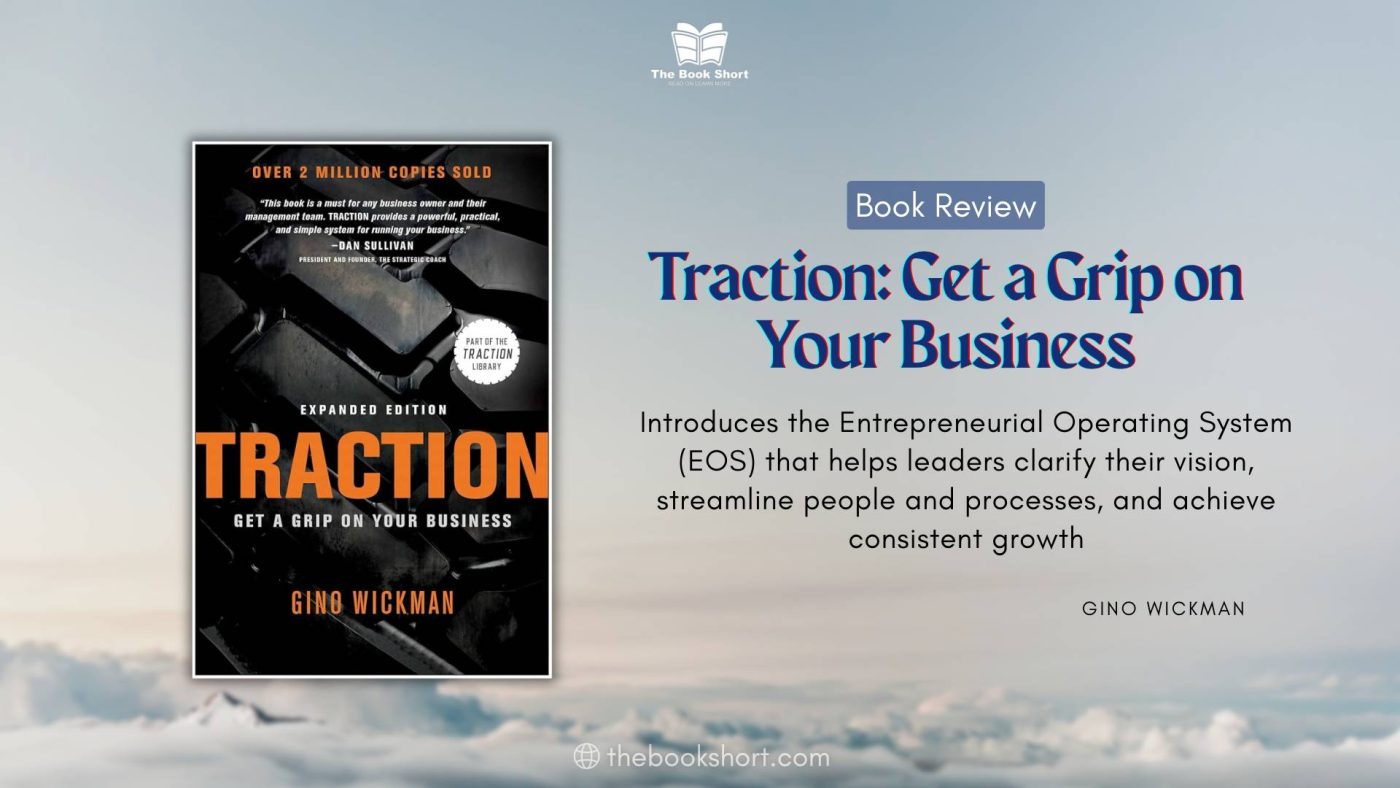
Struggling to control your business? This Traction book review unpacks Gino Wickman’s powerful framework for gaining focus, growth, and sanity.
For so many entrepreneurs, the dream of freedom becomes a nightmare of being overwhelmed. You’re hitting a growth ceiling, complexity is creeping in, and the methods that got you here are no longer working. You’re stuck. Gino Wickman’s Traction: Get a Grip on Your Business is the antidote to this chaos. Unlike books that offer fleeting inspiration, Traction provides something far more valuable: a complete, step-by-step business operating system. Its power lies in its elegant simplicity and all-encompassing nature, providing a clear, actionable path for leaders to align their entire organization and finally get a grip.
Traction by Gino Wickman: Key Book Details
- Title: Traction: Get a Grip on Your Business
- Author: Gino Wickman
- Year of publication: 2007
- Genre: Business, Entrepreneurship, Management
- Number of pages: 272
- Target audience: Designed for the leadership teams of entrepreneurial companies, typically with 10 to 250 employees, who are ready to trade chaos for a proven system of control and growth.

Traction: Get a Grip on Your Business
Traction Book Summary: The Entrepreneurial Operating System (EOS)
Traction is not a book of tips; it’s a manual for installing a complete business framework called the Entrepreneurial Operating System (EOS). Wickman’s central argument is that a business’s success is determined by its strength across six key components. By methodically strengthening each one, leaders can shatter growth ceilings, resolve nagging issues, and build a disciplined, accountable, and healthy organization that runs itself.
The book is built around these six components, offering lucid explanations and practical tools to master them.
The Vision Component: Getting Everyone on the Same Page
The Vision component is about achieving 100% alignment on where the business is going and how it will get there. Without a shared vision, the team is just a group of people rowing in different directions. Wickman provides a master tool to crystallize this vision: the Vision/Traction Organizer (V/TO).
The V/TO cuts through strategic complexity by forcing a leadership team to agree on the answers to eight simple questions:
- Core Values: What are the timeless, guiding principles of your organization?
- Core Focus: What is your company’s purpose or passion, and what is your specific business niche?
- 10-Year Target: What is your big, hairy, audacious goal (BHAG) for the long term?
- Marketing Strategy: A simple plan defining your target market, Three Uniques, Proven Process, and Guarantee.
- 3-Year Picture: A vivid picture of what the company will look, feel, and be like in three years (including revenue, profit, and key measurables).
- 1-Year Plan: What are the 3-7 most important goals for this year to make the 3-Year Picture a reality?
- Rocks: What are the 3-7 most critical priorities for the next 90 days to achieve the 1-Year Plan?
- Issues List: A comprehensive list of every problem, obstacle, and opportunity that needs to be addressed.
Once the leadership team is united around the V/TO, it must be shared with every single person in the company to create true organizational clarity.
The People Component: Right People in the Right Seats
Wickman’s philosophy is elegantly simple: “Right People, Right Seats.” You cannot achieve a great vision without great people.
- Right People: These are individuals who genuinely share your company’s core values. They are the people you love being around. The tool for this is the People Analyzer, which helps you objectively assess whether employees are a fit.
- Right Seats: This means every person in the organization is working in a role where they excel and thrive. They must GWC™ their job: they Get it (they truly understand the role), they Want it (they are motivated to do it), and they have the Capacity (the skills, time, and talent) to do it well. The key tool here is the Accountability Chart, a supercharged org chart that forces you to define the ideal structure first, then slot people into the seats where they belong.
The Data Component: Replacing Opinions with Facts
The Data component is about ending the reign of egos, subjective opinions, and “gut feelings” in decision-making. It involves managing the business with a handful of objective numbers that give you an unvarnished pulse on the company’s health. The cornerstone tool is the Scorecard, a weekly report of 5-15 key metrics. The Scorecard is predictive, allowing leaders to spot trouble on the horizon long before it becomes a catastrophe.
In an EOS company, every single person has at least one number they are responsible for, driving a culture of ownership and results from the front lines to the leadership team.
The Issues Component: Excelling at Problem Solving
Every business has problems; great businesses are brilliant at solving them. This component is about building the discipline to identify, discuss, and permanently resolve issues as they arise. EOS provides two essential tools: the Issues List and the Issues Solving Track™ (IDS).
The Issues List is the designated holding pen for all challenges and opportunities. The IDS process provides a simple, powerful framework for resolving them:
- Identify: Dig beneath the surface symptoms to uncover the true root cause of the issue.
- Discuss: Let all stakeholders weigh in with their perspectives in an open, honest debate.
- Solve: Conclude with a clear action item that ensures the problem is solved once and for all.
This discipline eradicates the “meeting-after-the-meeting” and stops teams from talking the same problems to death, week after week.
The Process Component: Systemizing Your Secret Sauce
The Process component focuses on systemizing your business by documenting the core processes that make you, you. This is the key to creating consistency, scalability, and efficiency. Wickman asserts that most businesses can be simplified by documenting and having everyone follow a handful of core processes (e.g., your HR process, marketing process, sales process, and operations process).
The goal isn’t to create a suffocating, bureaucratic manual. It’s to apply the 80/20 rule to documentation—capturing the 20% of steps that yield 80% of the results. This ensures your unique way of doing business is delivered consistently, creating predictable and positive experiences for customers and employees alike.
The Traction Component: Bringing the Vision to Life
This final component gives the book its name and is the engine of execution. It’s where the vision meets the pavement, powered by discipline and accountability. As Wickman famously says, “Vision without traction is just hallucination.” The two key disciplines are:
- Rocks: As first defined in the Vision component, Rocks are the 3-7 most important priorities for the company and each individual leader for the next 90 days. This “90-Day World” creates a powerful rhythm of focus and urgency, ensuring the company makes steady, meaningful progress toward its annual goals.
- Meeting Pulse™: This is a regular and disciplined meeting cadence that keeps the organization aligned and accountable. The linchpin is the Level 10 Meeting, a weekly 90-minute leadership team meeting with a strict, effective agenda. It includes reviewing the Scorecard, tracking Rocks, and solving key issues with IDS. This pulse keeps the entire organization healthy, connected, and focused on what truly matters.
In-Depth Book Analysis of Traction: Structure, Style, and Key Arguments
Gino Wickman’s Traction has become a modern business classic not by inventing radical new concepts, but by masterfully synthesizing proven principles into a single, cohesive, and stunningly practical system. An analysis of its structure, style, and arguments reveals exactly why it resonates so deeply with its audience.
Why the EOS Model Works: Structure and Core Arguments
The central argument of Traction is that businesses get stuck not from a lack of talent or vision, but from the absence of a true operating system. Wickman posits that passion can only carry a company so far before complexity and people-issues derail progress. The solution is the Entrepreneurial Operating System (EOS), a holistic framework designed to weave discipline, accountability, and focus into the fabric of the organization.
What sets Traction apart is its structure. It is not a buffet of disconnected ideas; it is a sequential, “how-to” manual. The book is meticulously organized around the EOS Model, with each of the Six Key Components receiving a dedicated section. This structure is brilliant because it mirrors the real-world implementation process. A reader can literally move chapter by chapter to install the system in their company.
The book’s core tenet is that all six components are interdependent and must be strong. A great vision with the wrong people will fail. The right people with no data are flying blind. A team that has data but can’t solve issues will stagnate. This systemic view is the book’s greatest strength. Unlike titles focused on a single slice like leadership or marketing, Traction compellingly argues that you must work on the business as a complete, integrated machine.
Direct, Actionable, and Deliberately Repetitive: Writing Style and Content
Wickman’s writing style is a primary reason for the book’s widespread adoption. It is:
- Direct and No-Nonsense: The prose is simple, declarative, and refreshingly free of academic jargon or bloated corporate-speak. Wickman writes like a seasoned coach who has seen every mistake in the book and wants to get you to the solution as quickly as possible.
- Action-Oriented: Every concept is immediately paired with a concrete tool or discipline. Wickman doesn’t just tell you to “create a vision”; he gives you the V/TO worksheet and walks you through filling it out. This makes every piece of advice immediately testable and useful.
- Repetitive by Design: The book intentionally repeats key terminology (e.g., “Right People, Right Seats,” “GWC,” “IDS”). This is not a flaw; it’s a powerful pedagogical choice. The repetition drills the EOS language into the reader’s mind, making it second nature—a crucial step for rolling out a new vocabulary and system across an entire company.
The content quality is exceptional because it is born from experience, not theory. Wickman refined EOS over thousands of sessions with real entrepreneurial leadership teams. The tools are not abstract concepts; they are battle-tested and forged in the fires of real business challenges. This authenticity lends the book immense credibility.
Notable Quotes from the Book
The book is packed with sticky, quotable lines that serve as powerful mantras for the EOS philosophy:
- “Vision without traction is merely hallucination.”
- “You can’t build a great organization on compromise. You’re either a 100 percent fit with the company’s core values, or you’re not.”
- “What gets measured gets done.”
- “When you ‘solve’ an issue, it should go away forever. If it comes back, you didn’t solve it; you only treated a symptom.”
- “Let your issues list be the place where problems go to die, not where they go to live.”
These are not just clever taglines; they are guiding principles that reinforce the daily discipline required to run a business on EOS.
Personal Review of Traction: Is It Worth Reading?
As someone who has navigated the trenches of business literature, Traction occupies a unique space. It is less a book to be read and more a toolkit to be wielded. My assessment is overwhelmingly positive, though it comes with critical caveats for any leader considering this path.
Advantages:
The supreme advantage of Traction is its holistic and actionable system. It provides a complete, A-to-Z playbook. You are never left wondering, “What do I do next?” The tools, from the V/TO to the Level 10 Meeting agenda, are provided with surgical clarity. This ruthlessly eliminates the guesswork that paralyzes so many entrepreneurs. The “90-Day World” created by Rocks establishes a powerful execution rhythm that prevents strategic plans from dying on a shelf. For any team trapped in a cycle of recurring frustrations, the IDS process for issue solving is a revelation.
Disadvantages:
The book’s greatest strength—its rigid, prescriptive system—is also its potential weakness. EOS demands absolute, unified buy-in from the entire leadership team. If even one key leader resists the process or refuses to be vulnerable, the system’s integrity is compromised, and it will fail. The prescriptive nature might also feel confining for highly unstructured or purely creative cultures. Furthermore, while its principles are universal, the EOS tools are specifically tailored for entrepreneurial companies with a dedicated leadership team. Solo-preneurs or massive, complex corporations will need to heavily adapt the model to find value.
Readability and Audience:
The book is exceptionally readable. Wickman’s direct style makes dense management concepts accessible to anyone. It’s a fast read but demands a slow, thoughtful implementation.
This book is an essential read for:
- Entrepreneurs who feel their business is running them.
- Leadership teams that are misaligned and talking past each other.
- Companies suffering from a lack of accountability where the same problems resurface endlessly.
- Leaders who are exhausted from constant firefighting and yearn to build a proactive, scalable organization.
Practical Value:
The practical value of Traction is immense. It provides a shared vocabulary and a unified toolkit that can align an entire company. Implementing even fragments of EOS—like Rocks and the Level 10 Meeting—can have an immediate, powerful impact on focus and productivity. Ultimately, Traction teaches that true entrepreneurial freedom comes from discipline, not from chaos. By installing the EOS framework, leaders are finally liberated from the daily grind to work on their business, not just in it. This is perhaps its most profound gift.
Traction vs. Other Business Books: A Comparison
Traction exists in a canon of foundational business texts, but it fills a very specific, practical role. Understanding its relationship to similar works clarifies its unique value proposition.
- The E-Myth Revisited by Michael E. Gerber: The E-Myth masterfully explains why a business needs systems to help the owner escape the “Technician” trap. It makes the profound philosophical case for working on your business. Traction is its practical successor; it provides the actual systems, tools, and meeting pulses—the how—to implement what Gerber preaches. If E-Myth is the diagnosis, Traction is the prescription.
- Scaling Up by Verne Harnish: As the evolution of Mastering the Rockefeller Habits, Scaling Up is Traction’s most direct competitor. Both offer comprehensive frameworks for running a business. However, Scaling Up is widely seen as more complex, granular, and data-intensive, making it a better fit for larger, more sophisticated companies. Traction’s EOS is intentionally simpler and more streamlined, offering a powerful but less cumbersome system that is more accessible to the small-to-midsize entrepreneurial company.
- Good to Great by Jim Collins: Good to Great is a landmark research book that identifies the timeless principles behind enduringly successful companies (e.g., Level 5 Leadership, The Hedgehog Concept, a Culture of Discipline). It is strategic and deeply inspirational. Traction is the operationalization of these concepts. For instance, Collins’ “Hedgehog Concept” is beautifully captured in the “Core Focus” section of the V/TO, and his “First Who, Then What” mantra is directly implemented through the “Right People, Right Seats” discipline. Traction provides the daily, weekly, and quarterly habits to actually live out the principles Collins identified.


If you found value in Traction, you might also enjoy:
- What the Heck is EOS? by Gino Wickman and Tom Bouwer: A simplified overview of Traction written specifically for employees, designed to accelerate company-wide adoption.
- The Five Dysfunctions of a Team by Patrick Lencioni: A classic that lays the groundwork for team health and vulnerability, which is a non-negotiable prerequisite for running on EOS effectively.
- Measure What Matters by John Doerr: A deep dive into the OKR (Objectives and Key Results) framework, which shares significant philosophical DNA with Traction’s concept of Rocks.
Conclusion: Final Thoughts on This Traction Book Review
Traction: Get a Grip on Your Business is a rare business book that delivers exactly what it promises. Its singular value lies in its power to transform abstract management theory into a simple, complete, and practical operating system. It provides a common language and a unified set of tools that demystify the art of management and align an entire company around a shared vision.
Is it worth reading? Without a doubt. For its intended audience, it’s not just another book—it’s a transformational business manual.
Who should read it? This book is a must-read for the founders, entrepreneurs, and leadership teams of companies with 10-250 employees who feel stuck, frustrated by a lack of control, and exhausted by poor accountability. If you are ready to trade chaos for clarity and commit to a disciplined path toward growth, Traction is the road map you’ve been searching for.
Have you read this book or implemented EOS in your business? Share your experience in the comments below.