
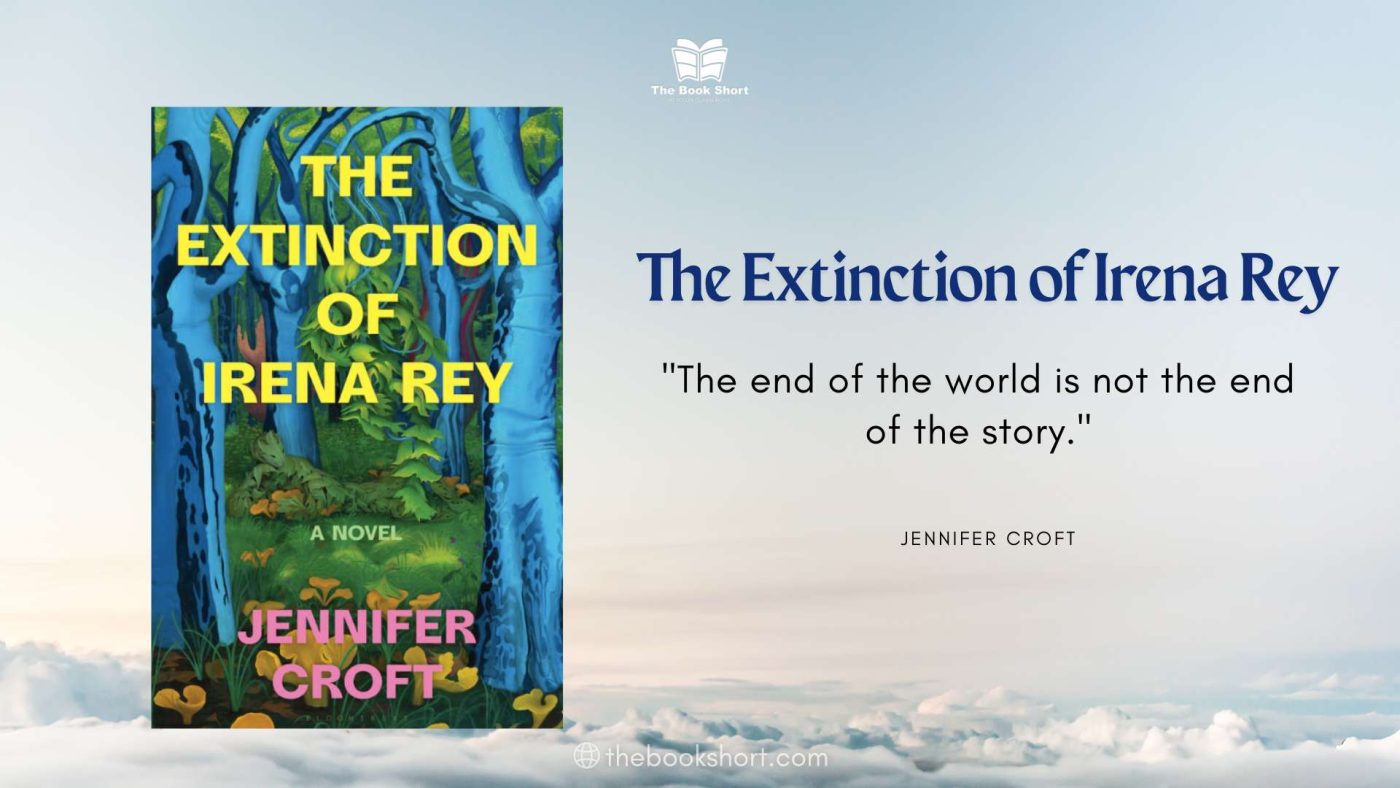
A literary quest ensues as translators unravel a vanished author’s legacy. A mesmerizing exploration of language, identity, and the limits of fiction.
The Extinction of Irena Rey by Jennifer Croft is a compelling novel that dives into the world of translation and literary mystery. Chosen for analysis due to its unique premise centering around language and the disappearance of a famous author, this book offers a rich tapestry of ideas about storytelling, identity, and the complex relationship between a writer and those who interpret their work, promising a thought-provoking read unlike many others.
Basic Information about The Extinction of Irena Rey Book
- Title: The Extinction of Irena Rey
- Author: Jennifer Croft
- Year of publication: 2024
- Genre: Literary Fiction, Mystery, Metafiction
- Number of pages: Approximately 320 (varies by edition)
- Target audience: Readers interested in literary theory, translation, mysteries, experimental fiction, and character-driven narratives exploring identity and language.
Summary of The Extinction of Irena Rey
Jennifer Croft’s novel, The Extinction of Irena Rey, centers on the sudden disappearance of a globally acclaimed Polish novelist, Irena Rey, and the eight translators she has gathered at her remote Polish estate to work on her final, monumental book. The narrative unfolds primarily through the perspective of one of these translators, a young woman named Emi.
The story begins with the arrival of the eight translators – hailing from different countries and working on translations into different languages – at Irena Rey’s sprawling, secluded home nestled beside an ancient Polish forest. Irena is a larger-than-life figure, known for her challenging, multi-layered prose and her intense, often eccentric personality. She has assembled this diverse group, whom she refers to as her “daughters,” to collaborate on her magnum opus, a novel rumored to be her most complex and ambitious work yet.
The Disappearance:
The central mystery is triggered early in the book. After a series of peculiar occurrences and cryptic pronouncements from Irena about the forest, nature reclaiming things, and the boundaries between reality and fiction blurring, she vanishes without a trace. She simply walks out of the house and into the bordering primeval forest, from which she does not return. The disappearance happens amidst a strange, almost mystical atmosphere, heightened by the oppressive presence of the ancient forest itself, which seems to possess a life and will of its own within the narrative.
The Translators Left Behind:
Left to grapple with Irena’s absence are the eight translators. Their initial confusion and concern quickly escalate into a desperate search and, eventually, a complex interplay of collaboration, suspicion, and existential crisis. Cut off from much of the outside world by the remote location and a storm, they must rely on each other. However, their shared predicament is complicated by their individual personalities, professional rivalries (subtle and overt), differing interpretations of Irena’s work and intentions, and the inherent challenges of communication across languages and cultural backgrounds.
The novel delves deeply into the dynamics within this group. Each translator represents a different facet of the relationship one can have with a text and its author. They speak different languages, think in different linguistic structures, and hold varying degrees of loyalty and understanding towards Irena and her work. Their interactions reveal the nuances of translation not just as a technical skill but as an act of profound interpretation and connection.
Searching for Clues:
As the translators try to piece together what happened to Irena, they find themselves increasingly drawn into the world of her writing, particularly the manuscript she left behind. They analyze her previous works, search her study for clues, and pore over the unfinished text, hoping to find hints about her disappearance within her fiction. The lines between Irena’s life, her writing, and the reality the translators inhabit begin to blur, mirroring themes often present in Irena’s own novels.
The search for Irena becomes intertwined with a deeper exploration of her literary legacy and the very nature of authorship and translation. The translators are not just looking for a person; they are trying to understand the creative impulse, the meaning embedded in text, and their own roles as conduits for another’s voice. The forest itself becomes a character, seemingly embodying the wild, untamable aspects of creativity and the mysteries that lie beyond human comprehension.
The narrative structure often mirrors the complexity of translation and interpretation, shifting perspectives, incorporating fragments of text, and playing with language. The book becomes a meta-commentary on the act of reading and writing itself, asking what happens to an author’s voice and intent when filtered through another language and another mind. The “extinction” suggested in the title is not just the potential physical disappearance of Irena Rey but also perhaps the way an author’s original voice is transformed or “extinguished” (and simultaneously resurrected) in the process of translation.
Ultimately, The Extinction of Irena Rey is less about solving a conventional mystery and more about exploring the profound questions raised by Irena’s absence and the translators’ response. It’s a meditation on language, identity, the relationship between life and art, and the ways in which we attempt to understand, interpret, and preserve the voices that shape our world.
Analysis of The Extinction of Irena Rey Book
Jennifer Croft’s The Extinction of Irena Rey is a deeply intellectual and structurally ambitious novel that uses the framework of a disappearance mystery to explore complex ideas surrounding language, translation, authorship, and the nature of reality. The core themes revolve around the interplay between original creation and interpretation, the permeability of boundaries (between languages, between fiction and life, between self and other), and the enduring power and inherent slipperiness of text.
Characters / Structure / Key Arguments
The primary “characters” are the eight translators, each a unique lens through which Irena and her work are viewed. While some are more developed than others (the narrator, Emi, provides the central consciousness), their collective dynamic is the most significant character. They embody different approaches to translation and interpretation, highlighting the subjectivity inherent in the process. Irena Rey herself, though absent for most of the book, remains a dominant force, constructed through the translators’ memories, her texts, and the mystique surrounding her disappearance.
The structure is fragmented and multi-layered, mimicking the act of translation and interpretation. The narrative, primarily Emi’s first-person account, is interspersed with excerpts that resemble academic papers, linguistic analyses, historical references, and discussions among the translators about Irena’s work and their search. This structure reflects the ways we try to impose order and meaning onto chaos, particularly through language and analysis. It also emphasizes the novel’s meta-fictional quality, constantly reminding the reader of the text as a constructed object being interpreted.
A key argument the book makes is that translation is not merely a technical task but a profound act of creative interpretation that transforms the original text while also giving it new life. The translators are not passive conduits but active participants in the creation of Irena’s legacy. Another argument explores the nature of authorship – can an author truly control the meaning or life of their work once it’s released into the world and subjected to countless interpretations? Irena’s disappearance can be seen as a literal embodiment of an author receding, leaving the text to exist independently.
Writing Style & Content Quality
Croft’s writing style is precise, intellectual, and often recursive, mirroring the thematic concerns. She seamlessly weaves together narrative prose, philosophical musings, linguistic observations, and textual analysis. The language itself is a central subject, with discussions among the translators about specific words, phrases, and the untranslatable aspects of language forming significant portions of the text. The quality of the content is high for readers interested in these themes; it’s rich with literary allusions, linguistic insights, and philosophical depth. However, its intellectual density and non-linear, analytical approach mean it requires attentive reading.
What stands out or differs from other books in the same genre (literary fiction, mystery) is its foregrounding of translation and linguistics as central plot drivers and thematic concerns. While many novels feature writers or touch upon the power of stories, few make the process of translation and linguistic difference so integral to the narrative and its core mystery. It subverts the typical mystery structure, less interested in who or how Irena disappeared and more in what her disappearance reveals about the nature of text, language, and the people left behind to interpret her. It’s a mystery of meaning, not just of plot.
Notable Quotes from the Book
- (As the book was recently published, specific memorable quotes are harder to find immediately in standard databases. However, representative ideas explored would be captured in lines pondering the untranslatability of certain words, the relationship between a writer’s life and work, or the feeling of being lost in language or the forest.)
- (Example hypothetical quote capturing the essence): “We were daughters of her sentences, trying to reconstruct the mother tongue from fragments scattered across a dozen languages.” (This captures the translators’ relationship and the linguistic theme).
- (Example hypothetical quote on translation): “Every translation is a negotiation, a necessary betrayal, a birth.”
- (Example hypothetical quote on the forest/mystery): “The forest didn’t offer clues; it offered only itself, vast and indifferent, swallowing narratives whole.”
These quotes (or ideas represented by them) highlight the novel’s focus on linguistic identity, the transformative nature of translation, and the impenetrable mystery surrounding the author’s absence and the natural world.
Evaluation & Personal Review of The Extinction of Irena Rey
The Extinction of Irena Rey is a book that will appeal strongly to a specific kind of reader: those fascinated by language, literature, and the intricate process of translation. For this audience, it’s a rewarding and intellectually stimulating journey. My personal impression is that the novel excels in its ambitious exploration of its central themes. The premise is unique, and the way Croft weaves together the disappearance mystery with deep dives into linguistic theory and literary analysis is genuinely innovative.
The advantage of this book lies in its originality and depth. It treats translation not as a side note but as a central, vibrant act of creation and interpretation. The discussions among the translators, while sometimes dense, are often insightful and illuminating, offering a rare glimpse into the minds that bridge linguistic divides. The novel successfully creates a mood of intellectual suspense, where the real mystery isn’t just what happened to Irena, but what meaning can be made from her absence and her words.
However, the intellectual density can also be a disadvantage for some readers. This is not a fast-paced thriller where the plot is the primary driver. The pacing is deliberate, and significant portions of the text are dedicated to theoretical discussions or textual analysis, which might alienate readers looking for a more conventional narrative or a straightforward mystery resolution. The large cast of translators, while thematically relevant, sometimes blurs together, making it occasionally challenging to track individual characters beyond their representative linguistic perspectives.
The readability level is moderate to challenging. It requires a reader willing to engage with complex ideas and tolerate a non-linear, essayistic style interspersed with narrative. It is most suitable for readers with an interest in comparative literature, linguistics, translation studies, or those who simply enjoy literary fiction that pushes boundaries and encourages deep thought about how we make meaning from text. It’s probably not suitable for readers seeking a light read, a simple mystery, or a plot-driven story above all else.
The practical value of the book lies less in providing actionable lessons and more in its capacity to change a reader’s mindset. It fundamentally alters how one might think about translated literature, fostering a greater appreciation for the translator’s role. It encourages reflection on the subjectivity of interpretation and the myriad ways meaning can shift across languages and cultures. It serves as a powerful reminder that every act of reading is an act of translation and interpretation, connecting us not just to the author but to the complex web of language itself. Reading this book might make you look at the copyright page of translated books differently, recognizing the creative act of the translator alongside the author.
Comparison with Similar Books to The Extinction of Irena Rey
The Extinction of Irena Rey stands somewhat apart due to its specific focus on translation as a central theme and plot device. However, it shares common ground with other works that explore meta-fiction, the relationship between author and reader/interpreter, literary mysteries, and the power of language.
Readers who enjoyed The Extinction of Irena Rey might also enjoy:
- The Name of the Rose by Umberto Eco: A historical mystery set in a monastery, deeply philosophical and semiotic, involving the interpretation of texts and symbols to solve a series of deaths. Like Croft’s novel, it requires the reader to engage with intellectual puzzles as much as the plot.
- Foucault’s Pendulum by Umberto Eco: Another dense, complex novel by Eco that plays with conspiracy theories, history, and the act of imposing meaning onto disparate information, echoing Croft’s exploration of interpretation and narrative construction.
- The City of Dreaming Books by Walter Moers: While fantasy, it’s a love letter to books, reading, and the creative process, featuring a world built around literature and its hidden dangers and wonders, resonating with the idea of texts having their own mysterious lives.
- If on a winter’s night a traveler by Italo Calvino: A classic of metafiction where the reader is a character, constantly starting new books and grappling with interrupted narratives, reflecting Croft’s playful approach to structure and the reading experience.
- Leaving the Atocha Train Station by Ben Lerner: A novel about a young American poet in Spain grappling with language, authenticity, and the performance of self, touching on themes of cultural and linguistic mediation, although in a more personal, less overtly mysterious context.
These books share a common thread of challenging the reader, playing with narrative structure, and deeply engaging with ideas about literature, language, and the human attempt to find or create meaning in the world. While none center on translation quite as explicitly as Croft’s novel, they appeal to a similar intellectual curiosity about the nature of stories and how we interact with them.
Conclusion and Recommendations for The Extinction of Irena Rey
The Extinction of Irena Rey offers outstanding value as a novel that is both a compelling literary mystery and a profound meditation on language, translation, and the elusive nature of authorship. It is a book that respects the reader’s intelligence and rewards careful attention.
Is it worth reading? Absolutely, for the right reader. Its worth lies not in providing easy answers but in posing fascinating questions and offering a unique perspective on the literary world. It’s a book that lingers, prompting readers to reconsider the countless translated works they’ve read and the invisible bridge built by translators.
Who should read it? This book is highly recommended for students and scholars of comparative literature, linguistics, and translation studies, as well as general readers who enjoy complex, idea-driven literary fiction, metafiction, and intellectual puzzles. If you appreciate authors like Umberto Eco or Italo Calvino, or if you’ve ever wondered about the translator’s craft, this book is likely for you. It’s ideal for book clubs interested in deep discussion about form and theme.
Have you read The Extinction of Irena Rey book? Share your thoughts on this captivating literary mystery, book summary, and book analysis in the comments below!