
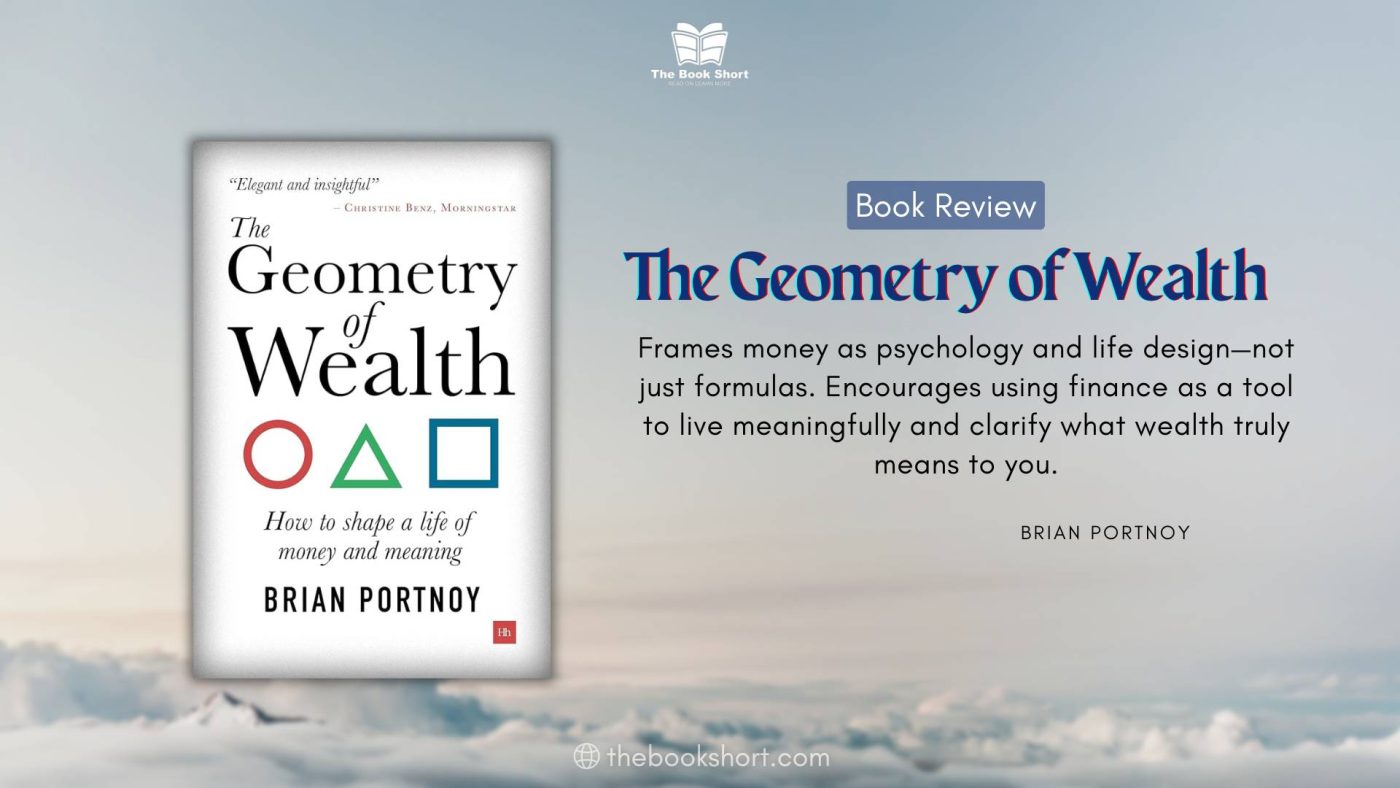
Tired of the endless race for a bigger number in your bank account? This book offers a radical and welcome alternative: reframing wealth not as a finish line, but as “funded contentment”—the alignment of your money with a life of purpose. It’s a practical guide to becoming truly, lastingly wealthy. I chose to review The Geometry of Wealth because it masterfully bridges the chasm between complex behavioral finance theory and the deeply personal quest for a well-lived life. Its unique geometric framework provides a refreshingly simple yet profound lens for viewing your finances, making it an essential read for anyone feeling overwhelmed by the noise of traditional money advice.
The Geometry of Wealth: Key Book Information
- Title: The Geometry of Wealth: How to Shape a Life of Money and Meaning
- Author: Brian Portnoy, PhD, CFA
- Year of Publication: 2018
- Genre: Personal Finance, Behavioral Economics, Self-Help
- Number of Pages: Approximately 208 pages
- Target Audience: Anyone seeking a philosophical yet practical guide to money, from investors tired of the quantitative rat race to beginners wanting to build a healthy financial life aligned with their personal values.

The Geometry of Wealth: How to shape a life of money and meaning
Main Content Summary of The Geometry of Wealth
Brian Portnoy’s The Geometry of Wealth shatters the mold of typical personal finance guides. It isn’t about picking hot stocks or timing the market. Instead, it’s a profound exploration of how to achieve “funded contentment”—the ability to underwrite a life rich in meaning. The book’s central argument is that true wealth isn’t about having more; it’s about having enough to live the life you truly desire. Portnoy brilliantly uses a three-part geometric metaphor—the Circle, the Triangle, and the Line—to guide readers from the abstract search for purpose to the concrete act of making better financial decisions.
Shape One: The Circle – Defining Your Purpose
The journey begins not with spreadsheets, but with the most fundamental shape: the circle. This entire section plunges you into the essential, introspective work of defining your life’s purpose, which becomes the unshakable foundation for all financial planning.
What is Funded Contentment?
Portnoy introduces his core concept of “funded contentment,” arguing that the ultimate goal of wealth is not to hit an arbitrary net worth, but to reach a state where your finances fully support a meaningful existence. This elegantly shifts the focus from an endless, anxiety-fueled pursuit of accumulation to a more satisfying and achievable peace of mind. He explains that beyond a certain threshold, more money fails to deliver more happiness due to hedonic adaptation—the human tendency to quickly get used to new levels of wealth, leaving us wanting more.
Finding Your “Why”
The circle represents the continuous, reflective process of discovering what a meaningful life looks like to you. Portnoy prompts readers to ask foundational questions:
- What activities and relationships bring you genuine joy and satisfaction?
- What are the core values that guide your life?
- What impact do you wish to have on your family, your community, and the world?
Without clear answers to these “why” questions, any financial strategy is merely an abstract and fragile exercise. The goal is to craft a personal mission statement for your money, ensuring every financial choice is a deliberate step toward your life’s purpose. This section is less about numbers and more about soul-searching, setting the stage for a truly human-centric approach to finance.
Shape Two: The Triangle – Setting Your Priorities
Once your purpose is clear, the next shape—the triangle—provides a powerful framework for decision-making. It represents the three critical priorities that help us balance our financial lives and navigate the inevitable trade-offs.
The Three Sides of the Financial Triangle
The triangle moves us from abstract purpose to concrete priorities. Its three sides are:
- Protect: Forming the stable base of the triangle, this priority is about securing a baseline of financial safety to shield you and your loved ones from catastrophic loss. This involves managing downside risk through insurance, building a robust emergency fund, and steering clear of ruinous financial gambles. The aim is to ensure you can withstand life’s inevitable shocks without derailing your entire plan.
- Grow: This side focuses on the prudent growth of your assets to meet future aspirations, like retirement, education, or other major life goals. Portnoy stresses that growth should be pursued reasonably, not speculatively. It’s about patiently harnessing the power of compounding, not chasing the latest market craze.
- Give: The final side of the triangle involves using your wealth to create an impact beyond yourself. This can mean charitable giving, supporting family and friends, or investing in causes you believe in. Portnoy powerfully argues that giving is not an afterthought but an integral component of a wealthy life, contributing deeply to our sense of purpose and contentment.
The genius of the triangle lies in the necessity of balance. An obsessive focus on growth without protection is a recipe for disaster, while a life lived only in protection leads to stagnation and unfulfilled dreams.
Shape Three: The Line – Making Better Decisions
The final shape, the line, represents the path forward—the tactical, ongoing process of making financial decisions over time. This is where purpose and priorities are translated into real-world action.
From A to B: A Noisy Journey
Portnoy realistically portrays the journey of investing and financial planning as a “noisy” line stretching from Point A (today) to Point B (your goals). This path is never straight; it is inevitably buffeted by market volatility, global uncertainty, and our own behavioral biases. The secret to success is not to predict the noise, but to develop the discipline to navigate it.
Key Principles for Better Decision-Making
Grounded in decades of behavioral economics research, this section offers timeless advice:
- Simplicity is Key: Resist the allure of complexity. Simple, diversified, low-cost portfolios are almost always more effective and easier to stick with.
- Set Expectations Appropriately: Internalize the fact that markets are unpredictable. Expecting smooth, linear returns is a fantasy. Realistic expectations are your best defense against panic and euphoria.
- Focus on Process, Not Outcome: You cannot control what the market does, but you can control your own behavior. A good process—disciplined, patient, and consistent—is the only thing you can rely on.
- Embrace Humility: Acknowledge the limits of your knowledge. Overconfidence is an investor’s greatest enemy; humility fosters learning and helps you avoid devastating mistakes.
- Patience is a Superpower: True wealth is built over decades, not days. The ability to sit still and let compounding work its magic is one of the most potent, yet underutilized, tools in finance.
Ultimately, the line is about executing your plan with discipline, armed with a clear-eyed view of both market realities and your own psychology. By integrating a clear purpose (the Circle), balanced priorities (the Triangle), and a disciplined process (the Line), you can successfully shape a life of both money and meaning.
In-depth Analysis of The Geometry of Wealth
In the crowded genre of personal finance, Brian Portnoy’s The Geometry of Wealth is a landmark book that boldly prioritizes philosophy over formulas. Its revolutionary thesis—that true wealth is simply a tool for “funded contentment”—is a direct challenge to the cult of relentless accumulation, offering a more humane and sustainable framework for managing your financial life.
Structure and Key Arguments
The book’s brilliance is anchored in its elegant structure, built around the three geometric shapes. This is far more than a clever gimmick; it’s a powerful mnemonic device that makes complex ideas intuitive, memorable, and actionable.
- The Circle (Purpose): By starting with “why,” Portnoy correctly diagnoses the most common point of failure in financial planning. Most guides leap directly to the “how” (budgeting, investing), but Portnoy argues that without a deeply felt purpose, any financial plan is built on sand, destined to crumble under the pressure of stress or temptation. This introspective start forces a crucial connection between money and life before connecting it to markets.
- The Triangle (Priorities): The “Protect, Grow, Give” framework is a masterclass in translating abstract goals into a tangible decision-making model. It transforms concepts like asset allocation and risk management from sterile calculations into a reflection of your life’s core priorities. This is a profound departure from generic risk tolerance questionnaires, framing risk not as a number but as a dynamic trade-off between securing your present, building your future, and shaping your legacy.
- The Line (Decisions): This final section forges the vital link between philosophy and action. Its core argument is that successful investing is primarily a behavioral challenge, not an intellectual one. Portnoy distills decades of behavioral finance research into simple, powerful rules: be patient, stay humble, keep it simple. He persuasively argues that mastering your own psychology is infinitely more valuable than attempting to master the market.
What makes this system so effective is its clear hierarchy. You cannot draw the Line (make good decisions) without first defining the Triangle (your priorities), and you can’t configure the Triangle without first clarifying your Circle (your purpose). This logical flow makes the book’s message both deeply resonant and remarkably easy to implement.
Writing Style and Content Quality
Portnoy, who holds both a PhD and the CFA charter, wields the rare talent of translating dense academic theory into crisp, accessible prose. His writing is engaging and empathetic, completely free of the intimidating jargon that plagues so much financial literature.
The style is a masterful blend of:
- Relatable Storytelling: He uses vivid anecdotes and powerful analogies that bring abstract concepts to life.
- Academic Rigor: His advice is firmly rooted in established research from behavioral economics and psychology, thoughtfully referencing giants like Daniel Kahneman.
- Philosophical Depth: The book reads as much like a guide to living well as it does a manual for investing, prompting reflection at every turn.
Unlike books that are either too philosophically abstract or too technically dry, The Geometry of Wealth inhabits a perfect middle ground. It provides a robust intellectual framework that feels both substantial and approachable, focusing on timeless human truths rather than fleeting market trends or specific financial products.
Notable Quotes from the Book
- On the definition of true wealth: “True wealth is the ability to underwrite a meaningful life—it’s funded contentment.” This single sentence brilliantly encapsulates the book’s entire philosophy.
- On the futility of chasing more: “We can adapt to nearly any level of material well-being, but we can never adapt to a life without meaning.” This powerfully highlights the importance of the “circle” and the trap of hedonic adaptation.
- On investment strategy: “Clarity of purpose is the starting point for a better-designed portfolio and, in turn, a better-funded life.” This quote directly connects the philosophical to the practical, reinforcing the book’s central structure.
- On navigating markets: “The investor’s challenge is not to find calm in the storm, but to find calm within herself.” This is a beautiful summation of the behavioral nature of investing and the critical importance of emotional discipline.
Evaluation & Personal Expert Review
The Geometry of Wealth is a vital breath of fresh air in the often-stale world of personal finance literature. It’s a book I find myself recommending constantly, particularly to those who feel anxious, alienated, or uninspired by conventional money advice.
Personal Impressions and Advantages:
The book’s greatest strength is its profound humanism. It succeeds in shifting the conversation about money from one dominated by fear, greed, and complexity to one of purpose, contentment, and elegant simplicity. The geometric framework is genuinely brilliant—a mental model that sticks with you long after the final page, providing a filter for every financial decision: “Does this honor my purpose? Does it balance my priorities? Am I following a disciplined process?”
Another key strength is its actionable philosophy. While deeply thoughtful, the book never feels impractical. The seamless transition from the “why” (Circle) to the “what” (Triangle) and the “how” (Line) creates a clear and durable roadmap. You walk away not with a hot stock tip, but with something far more valuable: a new way of thinking about money for the rest of your life.
If there is a perceived weakness, it is for the reader seeking hyper-specific, technical investment advice. This is not a book that will tell you what percentage of your portfolio to allocate to emerging market bonds. Its focus is on the foundational mindset and strategy behind those decisions. For a step-by-step “how-to” guide on opening a brokerage account or analyzing a P/E ratio, you’ll need to look elsewhere.
Readability and Target Audience:
The readability is exceptional. Portnoy’s writing is a model of clarity, empathy, and concision. He masterfully demystifies complex behavioral finance concepts, making the book perfect for a broad audience.
This book is ideal for:
- Beginners eager to build a healthy financial foundation from the very start.
- Experienced investors who are weary of the market-chasing rat race and crave a more meaningful approach.
- Financial advisors looking for a better framework to guide purpose-driven conversations with clients.
- Anyone who feels a troubling disconnect between their financial life and their personal values.
Practical Value and Impact:
The practical value of The Geometry of Wealth is immense, operating at the crucial level of mindset and strategy. Its most powerful lessons are:
- Redefining Success: It liberates you from the tyranny of chasing an ever-receding net worth, reframing the goal as “funded contentment”—a target that is both more achievable and infinitely more fulfilling.
- A Decision-Making Filter: The Circle-Triangle-Line framework becomes a powerful, intuitive tool for making coherent financial choices that are always aligned with your most important life goals.
- Behavioral Coaching: It serves as a superb primer on behavioral finance, equipping you to recognize and manage the common psychological biases that sabotage even the smartest investors.
Reading this book can fundamentally alter your relationship with money for the better. It empowers you to see money not as an end in itself, but as a powerful and versatile tool to design, build, and enjoy a better, more purposeful life.
Comparison with Similar Books
The Geometry of Wealth sits proudly alongside other modern classics of behavioral finance, yet it carves out its own distinct and valuable niche.


- If you liked The Geometry of Wealth, you might also enjoy The Psychology of Money by Morgan Housel. Both books are cornerstones of the idea that finance is more about human behavior than it is about spreadsheets. Housel’s book offers a brilliant collection of short, compelling stories that illustrate timeless truths about wealth and happiness. While Portnoy provides a structured, hierarchical framework (Circle, Triangle, Line), Housel offers a rich tapestry of interwoven lessons. Read together, they form a complete masterclass on the human side of money.
- Compared to Thinking, Fast and Slow by Daniel Kahneman: Kahneman’s Nobel Prize-winning work is the foundational academic text upon which much of Portnoy’s and Housel’s thinking is built. It is a deep, dense, and fascinating dive into the cognitive biases that shape all human decision-making. The Geometry of Wealth serves as the perfect application of Kahneman’s theories, translating them specifically for the world of personal finance and making them accessible and actionable for every reader.
- Compared to traditional finance books like The Intelligent Investor by Benjamin Graham: Graham’s masterpiece is the bible of value investing—a tactical, analytical guide to security analysis. It is a “how-to” manual for the serious investor. Portnoy’s book, in contrast, is the essential “why-to” guide that should be read before you even approach the tactics Graham describes. The Geometry of Wealth helps you build the unshakeable emotional and philosophical foundation required to successfully implement any long-term investment strategy.
Conclusion and Recommendations
The Geometry of Wealth is a rare and outstanding book that delivers profound value by reframing the entire purpose of financial planning. Its greatest contribution is its simple, elegant, and powerful framework for connecting your money to a life of meaning. By guiding readers through the essential work of defining their purpose, setting balanced priorities, and making disciplined decisions, Brian Portnoy has created a timeless roadmap to achieving “funded contentment.”
Is it worth reading? Absolutely. It is one of the most important and humane personal finance books written in the last decade, precisely because it places our humanity at the center of the financial equation.
Who should read it? Everyone who wants to build a healthier, more intentional, and less anxious relationship with their money. It is essential reading for young people just starting out, mid-career professionals feeling the pressure, and pre-retirees planning their next great chapter.
Have you read this book? Share your thoughts on its impact in the comments below.