
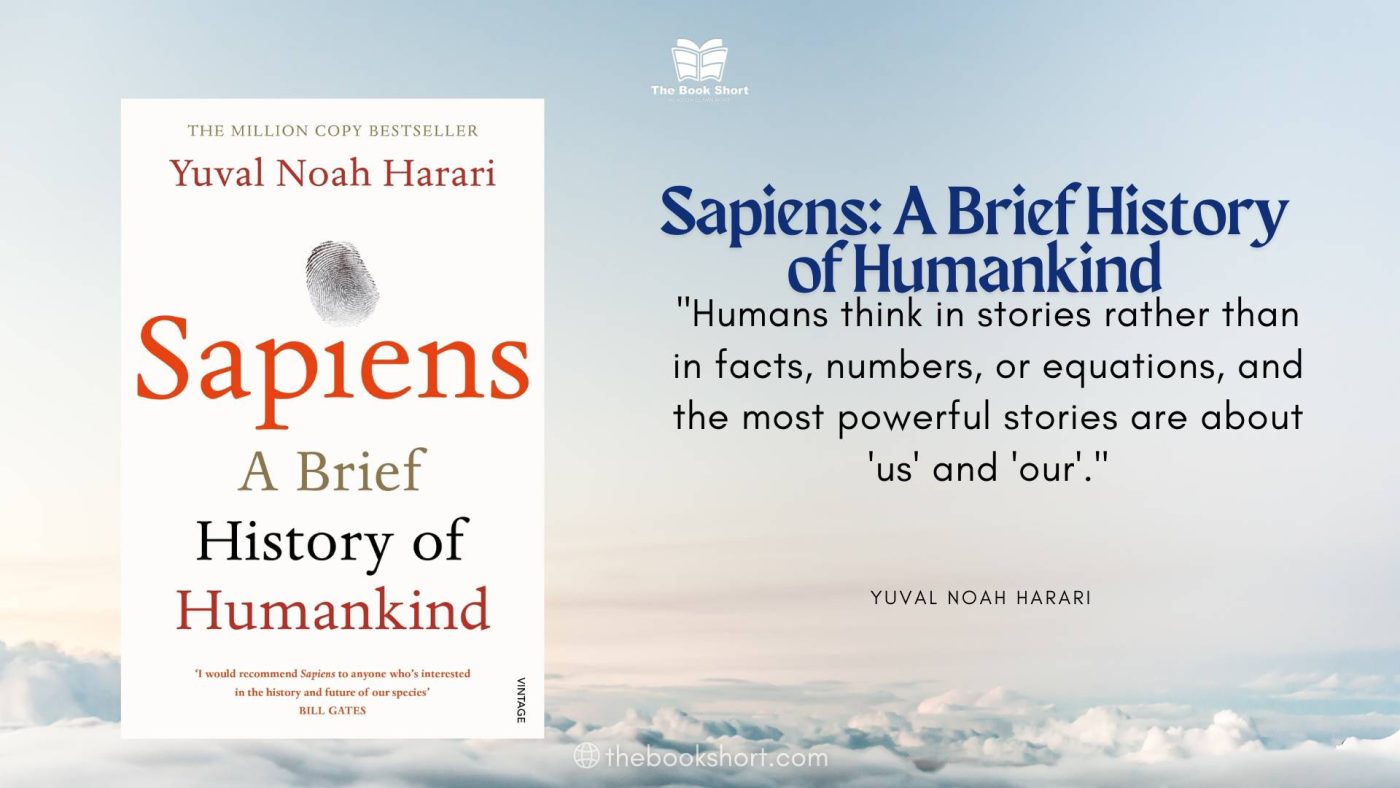
Journey through human history! Uncover our rise from obscure ape to world ruler. A must-read deep dive into Sapiens.
Sapiens: A Brief History of Humankind, by Yuval Noah Harari, takes readers on a sweeping journey through the 70,000-year history of Homo sapiens. I chose this book for analysis due to its immense popularity and thought-provoking perspective on what makes us unique. Its value lies in challenging conventional wisdom and offering a grand narrative of our species’ evolution, making it a truly captivating read.
Sapiens: A Brief History of Humankind – Book Information
- Title: Sapiens: A Brief History of Humankind
- Author: Yuval Noah Harari
- Year of publication: 2011 (Hebrew), 2014 (English)
- Genre: Non-fiction, Popular Science, Big History
- Number of pages: Approx. 400-500 (varies by edition)
- Target audience: General readers interested in history, anthropology, sociology, and the human condition.
Sapiens: A Brief History of Humankind – Main Content Summary
Yuval Noah Harari’s Sapiens: A Brief History of Humankind presents a broad, interdisciplinary exploration of human history, focusing not on kings and wars, but on the major revolutions that shaped our species and its dominance over the planet. The book is structured chronologically, dividing human history into four major parts, each marked by a significant shift in the way Sapiens lived and interacted with the world.
Part 1: The Cognitive Revolution
This section delves into the period roughly 70,000 years ago, when Homo sapiens underwent a dramatic shift in cognitive abilities. Harari argues that this revolution wasn’t necessarily due to a change in brain size, but rather a change in the internal wiring of the brain, allowing for new ways of thinking and communicating.
- Key Concept: Fictional Reality: The core idea here is the ability of Sapiens to create and believe in shared myths, collective fictions, or “imagined realities.” These range from tribal spirits and national identities to money, human rights, and corporations. This capacity for collective belief allowed Sapiens to cooperate flexibly in large numbers, a crucial advantage over other human species and animals.
- Impact: This revolution led to the development of complex language, the ability to tell stories, plan future actions, and adapt quickly to changing environments. It enabled Sapiens to migrate out of Africa and eventually populate the entire globe, leading to the extinction of other human species like Neanderthals. Harari controversially suggests that this early expansion was also marked by significant ecological damage, including the extinction of much of the world’s megafauna.
Part 2: The Agricultural Revolution
Around 12,000 years ago, Sapiens began domesticating plants and animals, transitioning from a nomadic hunter-gatherer lifestyle to settled agriculture. Harari presents a counter-intuitive view of this revolution.
- Key Concept: History’s Biggest Fraud: Rather than seeing agriculture as a step forward that automatically improved human lives, Harari argues it was potentially “history’s biggest fraud.” While it allowed for a significant increase in human population, it often led to harder work, poorer nutrition (relying on a few staple crops), increased susceptibility to disease (living in dense settlements with domesticated animals), and greater social inequality (surplus food led to hierarchies and elites).
- Impact: Agriculture tied humans to specific territories and led to the rise of villages, towns, and eventually cities. It created the conditions necessary for the development of complex societies, states, writing systems (initially for accounting agricultural surplus), and increasingly elaborate social structures and belief systems to manage larger populations.
Part 3: The Unification of Humankind
This section explores the long-term trends that gradually brought disparate human cultures and societies together into larger, more interconnected units. Harari identifies three main forces of unification: money, empires, and universal religions.
- Money: As an intersubjective reality (a shared belief), money created trust between strangers and facilitated trade across different cultures and regions.
- Empires: While often brutal, empires integrated diverse groups under a single political structure, spreading ideas, technologies, and norms across vast territories.
- Universal Religions: Religions like Christianity, Islam, and Buddhism offered shared sets of beliefs and values that could unite people from different backgrounds, transcending tribal or national loyalties.
- Impact: These forces, operating over thousands of years, led to increasing globalization, cultural exchange, and the gradual reduction of human diversity in terms of languages, social structures, and lifestyles.
Part 4: The Scientific Revolution
Beginning around 500 years ago, the Scientific Revolution fundamentally changed human capabilities and our understanding of the universe.
- Key Concepts:
- Ignoramus: The acceptance of ignorance as a starting point, leading to systematic observation and experimentation.
- Power of Research: The belief that investing resources in research can solve problems and increase human capabilities.
- The Alliance with Empire and Capital: Harari argues that the scientific revolution was deeply intertwined with the rise of European empires and capitalism. Scientific inquiry was funded by and served the goals of exploration, conquest, and economic growth.
- Impact: This revolution led to unprecedented technological advancements, industrialization, massive economic growth, the rise of modern medicine (dramatically increasing life expectancy), and the ability to harness new forms of energy. It also accelerated the pace of change and led to the modern world as we know it, posing new questions about human happiness and the future of our species.
Harari concludes by contemplating the future, including the potential for genetic engineering, artificial intelligence, and the blurring lines between Sapiens, technology, and other life forms. He provocatively asks whether, despite our immense power, we are actually happier or have a better understanding of what we want.
Sapiens: A Brief History of Humankind – In-Depth Analysis
Sapiens: A Brief History of Humankind stands out not just for the scope of its historical narrative but for its unique perspective and the way it challenges commonly held assumptions about progress, human nature, and history itself.
Key Arguments & Structure
The book’s structure is chronological, moving through major revolutions, which provides a clear framework for understanding the sweep of human history. However, the analysis within this structure is highly thematic and driven by key arguments. The central thesis is the power of “fictional reality” – the ability of Sapiens to create and believe in shared myths (from gods and nations to money and human rights) – as the primary driver of our success and ability to cooperate flexibly in large numbers, unlike other animals or even extinct human species.
Harari argues against the idea of history having an inherent moral arc or a clear path of progress benefiting the individual Sapiens. He is often critical of the unintended negative consequences of major historical shifts like the Agricultural Revolution and the entanglement of science with empire and capitalism. His arguments are bold and frequently counter-intuitive, forcing readers to re-evaluate long-accepted narratives.
Writing Style & Content Quality
Harari’s writing style is remarkably accessible for a book covering such complex topics. He uses clear, engaging prose, often employing vivid analogies and contemporary examples to illustrate historical points. He is a master storyteller, capable of weaving a compelling narrative out of vast historical data. The content quality is high in terms of synthesizing information from diverse fields (archaeology, anthropology, biology, history, economics, religion).
However, it’s important to note that the book is a work of popular science and history, not a peer-reviewed academic text. Some of his more provocative claims, particularly regarding the Agricultural Revolution as a “fraud” or the extent of early Sapiens’ ecological damage, have been debated by specialists in those fields. Harari himself acknowledges that he is presenting a particular interpretation aimed at a broad audience. Despite this, the book’s strength lies in its synthesis and the novel connections it draws across disciplines.
Notable Quotes from the Book
- “Sapiens rule the world because we are the only animal that can cooperate flexibly in large numbers.” – This encapsulates the core argument about shared fictions.
- “The Agricultural Revolution was history’s biggest fraud.” – A provocative statement highlighting his controversial take on this pivotal event.
- “Homo sapiens rule the world because we are the only animal that can believe in things that exist purely in its own imagination, such as gods, states, money and human rights.” – Another variation on the theme of shared fictions and their power.
- “Happiness does not depend on objective conditions of either wealth, health or even community. Rather, it depends on the correlation between objective conditions and subjective expectations.” – A key point from his discussion on modernity and happiness.
- “We are more powerful than ever before, but have very little idea what to do with all that power.” – A concluding thought on the modern predicament.
The analysis in Sapiens isn’t just about past events; it’s about understanding the underlying mechanisms of human behavior and societal organization that continue to shape the present and future. Its interdisciplinary approach and willingness to challenge established narratives set it apart from more conventional history books.
Sapiens: A Brief History of Humankind – Evaluation & Personal Review
Sapiens is a book that fundamentally changed the way I think about history and the human species. My personal impression is overwhelmingly positive.
Advantages
The greatest strength of the book is its sheer scope and the compelling narrative Harari weaves. He manages to make 70,000 years of history feel relevant and engaging. The interdisciplinary approach, drawing on biology, anthropology, economics, and history, provides a richer and more complete picture than a traditional historical account might offer. His ability to present complex ideas in accessible language is remarkable. The “shared fictions” concept is a powerful lens through which to view everything from ancient myths to modern nation-states and economies. It makes you see the invisible threads that hold large human societies together.
Disadvantages
If there’s a disadvantage, it lies in the nature of such a sweeping history: some specific claims or interpretations might be debated by experts in niche fields. Because it covers so much ground, it necessarily simplifies certain historical periods or developments. While the provocative arguments are stimulating, readers should be aware that they represent Harari’s perspective and synthesis, not always a universally accepted historical consensus. Occasionally, the philosophical musings, while interesting, might feel slightly detached from the historical narrative for some readers.
Readability Level & Suitability
The book is highly readable for a general audience. Harari avoids dense academic jargon and maintains an engaging pace. It’s suitable for anyone with a curiosity about human history, biology, and society. You don’t need a background in history or science to follow his arguments. It’s an excellent choice for students, curious adults, and anyone interested in big-picture thinking about humanity’s place in the world.
Practical Value
The practical value of Sapiens is immense, primarily in its ability to change your mindset. It encourages critical thinking about the fundamental concepts that govern our lives – money, nations, religions, rights. By showing these as “imagined realities,” it highlights their constructed nature, which can be both unsettling and empowering. It provides a framework for understanding current global issues in a much deeper historical context. It prompts reflection on our relationship with the environment, the nature of progress, and what truly constitutes human happiness. While it doesn’t offer specific action steps, it provides a vital perspective that informs how you view the world and your place in it.
Comparison with Similar Books: Sapiens
Sapiens falls into the “Big History” genre, which aims to tell the story of the universe, Earth, life, and humanity from a multidisciplinary perspective. It shares common ground with books like Jared Diamond’s Guns, Germs, and Steel, which also explores the factors leading to human societal inequality, though Diamond focuses more on environmental determinism and geography, while Harari emphasizes the cognitive and cultural factors like shared fictions.
Another comparable book is David Christian’s Maps of Time, a more academic text often considered foundational to the Big History field. However, Sapiens is significantly more accessible and narrative-driven than Christian’s work.
While Sapiens provides a historical overview, it also touches on themes explored in books about human behavior and cooperation, such as The Righteous Mind by Jonathan Haidt (on moral psychology) or Scale by Geoffrey West (on the scaling laws of cities, companies, and organisms).
If readers enjoyed Sapiens‘ sweeping scope, challenging perspectives, and accessible style, they might also enjoy:
- Jared Diamond – Guns, Germs, and Steel: Explores geographical and environmental factors behind human history.
- Yuval Noah Harari – Homo Deus: A Brief History of Tomorrow: A sequel that explores the potential future of humanity based on the trends discussed in Sapiens.
- Yuval Noah Harari – 21 Lessons for the 21st Century: Applies Harari’s historical perspective to contemporary global issues.
- Steven Pinker – The Better Angels of Our Nature: Argues for a decline in violence throughout history, offering a different perspective on human progress.
Sapiens carved out a unique niche in the popular science and history landscape by offering a truly global, long-term perspective delivered with exceptional clarity and provocative insight.
Sapiens: A Brief History of Humankind – Conclusion & Recommendations
Sapiens: A Brief History of Humankind is an outstanding book that offers a uniquely compelling narrative of our species’ journey. Its greatest value lies in its ability to synthesize vast amounts of information across diverse fields and present a challenging, thought-provoking perspective on human history, centered on the power of shared beliefs.
Is it worth reading? Absolutely. It’s a book that will broaden your horizons and likely change the way you think about the world and humanity.
Who should read it? Anyone curious about our origins, the forces that shaped civilizations, and the fundamental nature of human society. It’s suitable for readers from late teens upwards, provided they have an interest in non-fiction and are open to having their assumptions questioned.
It’s more than just a history book; it’s an exploration of what it means to be human.
Have you read this book? Share your thoughts in the comments below!