
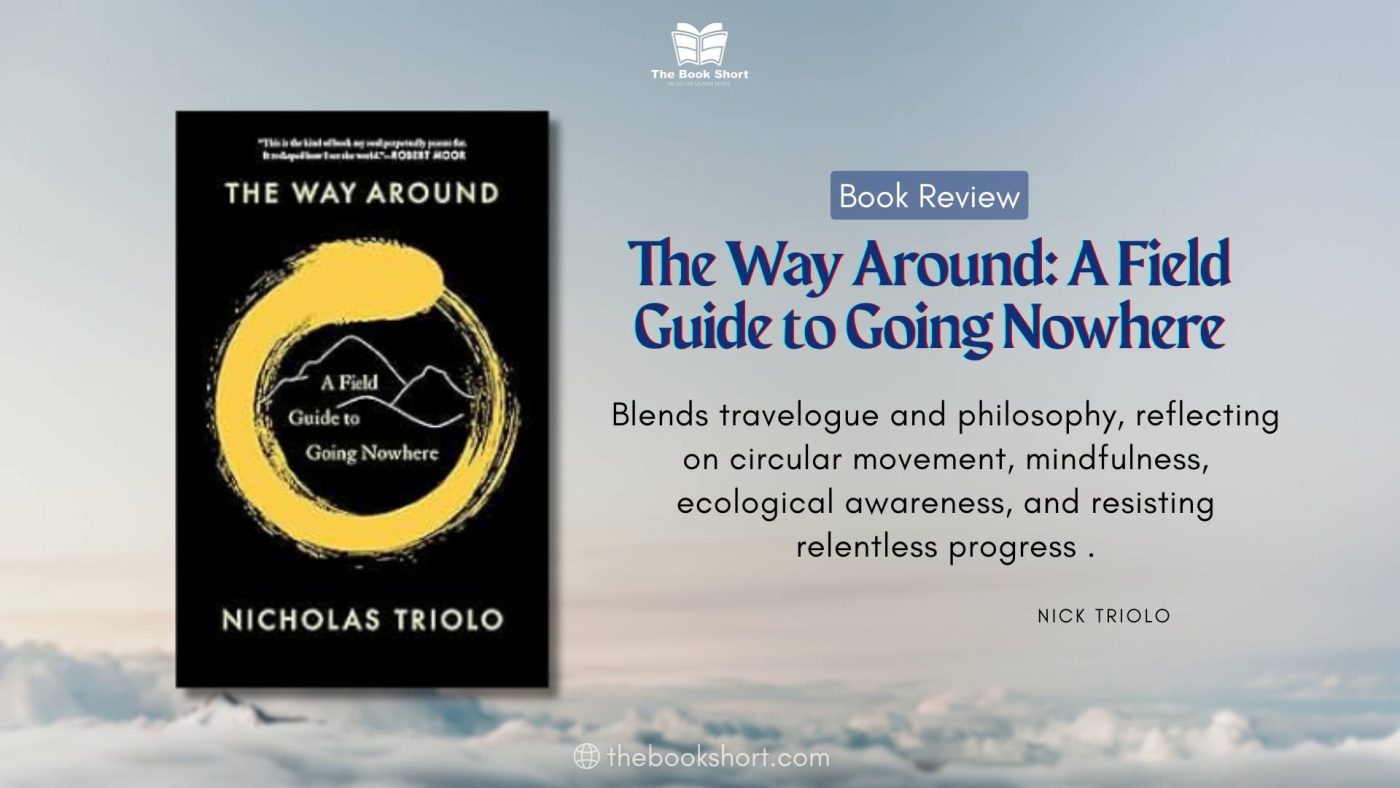
Explore the unexpected richness of staying put. This analysis of “The Way Around” redefines travel and invites you to look closer at home. Why chase distant horizons when profound discovery awaits at your doorstep? Nick Triolo’s “The Way Around: A Field Guide to Going Nowhere” doesn’t just challenge conventional notions of travel; it gently dismantles them, urging us to seek wonder and depth in the immediate, overlooked world around us. I was drawn to this book for its audacious premise – finding adventure by not leaving – and its timely message in a world preoccupied with constant movement. Its true value lies in offering a compelling blueprint for cultivating presence, fostering a deeper, more sustainable relationship with one’s local environment, and revealing the extraordinary hidden within the ordinary.
Basic Information about The Way Around: A Field Guide to Going Nowhere
- Title: The Way Around: A Field Guide to Going Nowhere
- Author: Nick Triolo
- Year of publication: 2021
- Genre: Nature Writing, Philosophy, Memoir, Essay, Travel (redefined)
- Number of pages: Approximately 208
- Target audience: Readers interested in mindful living, local nature exploration, philosophical reflection on place, alternative travel concepts, and literary nature writing.

The Way Around: A Field Guide to Going Nowhere
Main Content Summary of The Way Around: A Field Guide to Going Nowhere
Far from a typical travelogue detailing journeys across continents, Nick Triolo’s “The Way Around: A Field Guide to Going Nowhere” is a deeply contemplative exploration of place, presence, and perception. It centers on the radical act of staying put and engaging intensely with one’s immediate surroundings. Triolo proposes that genuine adventure and profound discovery are not solely products of physical distance but rather of the quality of attention and intention we bring to the near-at-hand world.
The book unfolds not as a linear narrative but as a series of interconnected essays and meditations, each delving into a specific facet of this concept of “going nowhere.” Drawing on personal experiences, primarily his detailed observations within his own limited geographical radius, Triolo weaves in rich threads from philosophy, natural history, literature, and art. The central argument is potent: by deliberately limiting outward movement, we open ourselves to a richer, more sustainable form of exploration – one that deepens our internal landscape and strengthens our connection to the local ecosystem.
Key Themes and Concepts Explored in “The Way Around”:
- Reinventing Exploration: The book serves as a powerful critique of the modern obsession with distant destinations and the notion that meaningful experience requires leaving home. Triolo champions intense local focus as a more sustainable and potentially more profound form of discovery.
- The Richness of the Immediate: He vividly illustrates the hidden complexity, beauty, and history embedded in familiar places – the intricate life within a patch of moss, the subtle shifts in a local creek throughout the year, the layered stories of a well-worn path.
- Cultivating Presence and Attention: A foundational element is the imperative of mindful observation. By slowing down and focusing intently, the seemingly mundane is transformed into the extraordinary. The book acts as a guide to cultivating this heightened awareness.
- Ecological Connection: Triolo underscores the vital interconnectedness of local ecosystems, emphasizing the importance of understanding and appreciating one’s specific place within the web of life. His observations are rooted in the specific ecology of his environment.
- Identity and Place: The narrative explores the symbiotic relationship between self and environment, suggesting that a deeper understanding of the places we inhabit can lead to a deeper understanding of ourselves.
- Challenging the “Somewhere Else” Mindset: Triolo directly confronts the cultural conditioning that tells us value, excitement, and growth are always located away from home.
- Sustainable Living & Localism: Though not overtly a political tract, the book inherently promotes a more sustainable way of being in the world, fostering appreciation and stewardship of local environments over the resource-intensive pursuit of distant experiences.
Triolo structures the book through distinct thematic sections, though they flow together fluidly rather than following a rigid order.
Examples of Content and Approach:
- Detailed meditations on repeatedly walking the same trails, revealing how familiarity breeds depth rather than boredom.
- Close observations of specific local flora, fauna, or geological features, using them as springboards for broader reflections.
- Musings on the history and human footprint within a particular local landscape.
- Integration of philosophical ideas on place, home, and belonging, drawing on figures like Thoreau, Gary Snyder, and others who valued local immersion.
- Personal accounts of intentionally limiting travel and the unexpected gifts this restriction unveiled.
- Explorations of different scales of observation, from the microbial world underfoot to the expansive local sky.
- Reflections on the concept of a “field guide” itself, applying its principles not just to identifying species but to deciphering the layers of meaning in a place.
Each essay-like section functions as a focused expedition into a particular aspect of his chosen “nowhere.” One chapter might meticulously detail the life cycle of an insect encountered on a walk, while another explores the psychological freedom found in surrendering the possibility of distant travel. These specific observations become catalysts for universal philosophical points about perception, value, and the nature of authentic experience.
The “Field Guide” aspect is primarily metaphorical yet crucial. This isn’t a literal guide with checklists of species or maps of trails. Instead, it serves as a guide for the reader’s attention, offering frameworks and examples for how to observe, reflect, and connect with their own immediate surroundings. It teaches the reader how to perceive their world – whether urban, suburban, or rural – as a place of infinite richness and complexity, if only they choose to look closely.
Ultimately, “The Way Around” is a compelling, beautifully written argument for the transformative power of radical presence. It suggests that the most profound adventures may not demand passports or airline tickets, but merely a willingness to open our eyes and minds to the wonders patiently waiting for our attention, right here, all along. It is a quiet call to shift our gaze inward, downward, and slowly, rather than constantly outward and ahead. The book provides both the inspiration and the intellectual scaffolding to embark on your own rich journey of “going nowhere.”
In-depth Analysis of The Way Around: A Field Guide to Going Nowhere
Nick Triolo’s “The Way Around” presents a deeply resonant counter-narrative to the prevalent cultural narrative that equates value, excitement, and personal growth with physical distance and constant movement. The book’s central thesis—that profound engagement with one’s immediate environment offers a richer, more sustainable form of exploration than conventional travel—is delivered with grace and intellectual rigor.
Structure and Core Arguments:
The book deliberately eschews traditional character arcs or a linear plot. Its structure is essayistic and thematic, mirroring the non-linear nature of deep local exploration. Instead of a journey to a destination, it presents a journey within a fixed location, composed of interconnected reflections that build upon each other. This structure is key to the book’s message: understanding a place is not a destination to be reached, but an ongoing process of layering observations and insights. Chapters fluidly transition between detailed natural descriptions, personal reflections, historical notes, and philosophical inquiries, creating a rich tapestry of experience.
The core arguments are clearly articulated and compellingly supported through Triolo’s observations:
- A sharp yet gentle critique of modern travel’s potential for superficiality and its roots in a consumerist mindset.
- The powerful assertion that extraordinary beauty, complexity, and mystery are readily available in the familiar world, often overlooked.
- The counterintuitive idea that limiting physical mobility can paradoxically expand one’s internal world and sharpen perceptive abilities.
- The fundamental role of cultivating mindful attention and presence as essential tools for authentic discovery.
- The intrinsic connection between our personal identity, the places we inhabit, and the broader ecological systems we are part of.
Writing Style & Content Quality:
Triolo’s prose is a significant strength of the book. It is lyrical, contemplative, and marked by a keen, precise eye for detail, particularly evident in his descriptions of the natural world. His writing is often evocative, skillfully blending the precise language of scientific observation with a poet’s sensibility. He moves effortlessly between micro-level natural descriptions (a specific insect, the texture of bark) and macro-level philosophical reflections, making complex ideas feel grounded and accessible. The content quality is exceptional; it is intellectually stimulating, genuinely moving, and beautifully crafted. Triolo’s deep connection to his subject is palpable, and his insights feel earned through diligent practice and reflection.
What truly sets “The Way Around” apart from much nature writing or traditional travel literature is its radical focus on the staying. While many nature books immerse the reader in wilderness or specific remote locales, and travel books recount journeys across the globe, Triolo elevates the local, the mundane, and the familiar to the primary subject of profound philosophical inquiry. He doesn’t just describe nature; he describes the experience and the process of observing nature intensely within a limited radius and the transformative impact this has on perception and selfhood. The book is less about where he is, and more about how he learns to be there, deeply and attentively. This makes the book universally relevant, offering a methodology for finding wonder regardless of one’s geographical location or circumstance.
Notable Quotes from The Way Around:
Triolo’s writing is replete with resonant passages that encapsulate his core philosophy. While exact phrasing can vary, these capture the essence of his message:
- “Perhaps true exploration is not about finding new landscapes, but about seeing the familiar world with new eyes.” (A distillation of his central thesis on perceptual shift).
- “The most vital field guide we might need is one that teaches us simply how to be present, how to truly notice what is already here.” (Emphasizing the priority of internal over external tools for discovery).
- “When you finally cease chasing the horizon, the world, in its infinite detail, rushes in to meet you exactly where you stand.” (Illustrating the abundance revealed by stillness).
- “There is infinite complexity and mystery held within even the smallest patch of earth; we need not go far to find it.” (Highlighting the depth available in the immediate environment).
These quotes are not just soundbites; they are distilled insights reflecting the dedicated practice of observation and reflection that underlies the entire book. They serve as potent reminders of the accessible wonders available when we shift our focus.
Evaluation & Expert Personal Review of The Way Around: A Field Guide to Going Nowhere
“The Way Around” by Nick Triolo is, in my estimation, a quietly profound and genuinely important book. It doesn’t arrive with fanfare, but rather settles into the reader’s consciousness through its patient observation and thoughtful reflection. My personal impression is overwhelmingly positive; I found it deeply inspiring and thought-provoking. Appearing at a time when many faced unprecedented restrictions on travel, its central premise—finding depth and wonder right where you are—felt remarkably timely and offered a practical, enriching response to feeling confined.
Advantages of Reading “The Way Around”:
- Groundbreaking Perspective: Its singular focus on radical localism and the richness of “going nowhere” offers a truly fresh and necessary counterpoint to our culture’s relentless pursuit of external validation through travel.
- Exquisite Prose: Triolo’s writing is consistently beautiful, marrying precise observation with poetic sensibility, making the act of reading an aesthetic pleasure.
- Intellectually Stimulating: The book genuinely challenges deeply ingrained cultural assumptions about adventure, success, and fulfillment, prompting a significant shift in perspective.
- Accessible Philosophy: It seamlessly integrates philosophical ideas related to place, perception, and belonging without becoming dense or academic, making complex concepts relatable through everyday observation.
- Practical Inspiration: While not a step-by-step manual, the book provides a clear framework and profound inspiration for readers to adopt principles of deep local observation in their own lives, regardless of location.
Potential Considerations:
- Pacing: Due to its essayistic, contemplative nature, readers accustomed to a strong narrative drive or action-oriented plot might find the pacing meditative and occasionally slow.
- Subjectivity: While Triolo uses specific examples from his particular locale, some readers whose environments are drastically different might initially find it a slight hurdle to fully connect, though the underlying principles are universally applicable.
Readability and Suitability:
“The Way Around” is highly readable and rewarding for a broad audience, particularly those with an interest in nature, mindfulness, philosophy, or simply seeking a more grounded way of living. Triolo’s language is rich yet accessible, free of unnecessary jargon. It is exceptionally well-suited for:
- Anyone feeling fatigued by the pressure to constantly seek new experiences or travel to distant lands.
- Nature enthusiasts looking to deepen their connection with the environment close to home.
- Individuals practicing or interested in mindfulness, seeking tangible ways to cultivate presence in their daily lives.
- Readers drawn to the intersection of personal reflection, philosophical inquiry, and the natural world.
- Those interested in sustainable living and fostering a deeper appreciation for local ecosystems.
Practical Value and Lasting Impact:
The practical value of “The Way Around” is perhaps its most significant contribution. It doesn’t offer survival tips or travel itineraries; instead, it is a powerful guide to seeing differently. It equips the reader with a methodology for observing their surroundings with greater depth and curiosity, fostering a profound sense of wonder and belonging right in their own patch of the world.
- Key Lessons: The central lesson is transformative: meaningful experience is a function of attention and perspective, not geographical distance. It imparts the value of patience, diligent observation, and finding novelty in repetition (like walking the same trail repeatedly).
- Real-World Application: Readers are directly inspired to initiate their own “field guide to going nowhere” simply by stepping outside and consciously paying attention to the details they’ve habitually overlooked, whether in an urban park, a suburban street, or a rural field.
- Mindset Shift: The book powerfully counters the pervasive “grass is always greener” mentality, encouraging a profound appreciation for the richness that is already present. It fundamentally reframes the idea of adventure from a grand, external expedition to an accessible, daily practice of curious engagement with the immediate world. It promotes a more grounded, appreciative, and ultimately, more sustainable and fulfilling way of inhabiting and experiencing the world.
Comparison with Similar Books
“The Way Around: A Field Guide to Going Nowhere” occupies a distinctive niche within the realms of nature writing, philosophy, and personal reflection, primarily defined by its explicit focus on finding depth through staying rather than venturing far. While it shares thematic territory with other notable works, its central premise and structure set it apart.


It can be fruitfully compared with foundational texts and contemporary works that value local observation and presence:
- Walden by Henry David Thoreau: Both works are iconic explorations of intentional living, self-reliance, and deep observation within a limited geography. However, Thoreau’s project at Walden Pond involved a degree of societal withdrawal and focused heavily on self-sufficiency and political critique. Triolo’s approach, while similarly valuing observation, is less about isolation and more directly a manifesto for finding richness in the already inhabited and familiar world, making it arguably more accessible and applicable to contemporary life outside of wilderness.
- Pilgrim at Tinker Creek by Annie Dillard: Dillard’s Pulitzer Prize-winning book is a benchmark for nature observation and philosophical reflection rooted in a specific local environment. Like Triolo, she reveals the immense complexity and wonder available close at hand. Triolo’s book distinguishes itself by being more explicitly framed as a critique of the conventional “travel” mindset and presenting local immersion as a deliberate, alternative method of exploration, whereas Dillard’s is more purely a documentation of intense observation and reflection on the mysteries found in nature.
- The Hidden Life of Trees by Peter Wohlleben: While fundamentally a work of popular science about forest ecology, Wohlleben’s book resonates with Triolo’s theme by unveiling the incredible, often unseen, complexity and interconnectedness present in a common, accessible environment (a forest). It aligns with Triolo’s goal of showing that profound wonders don’t require exotic locations.
- Braiding Sweetgrass by Robin Wall Kimmerer: Kimmerer beautifully blends scientific understanding, Indigenous wisdom, and personal narrative to explore the reciprocal relationship between humans and the natural world. She shares Triolo’s emphasis on deep connection to place and the lessons nature offers, but her scope is broader, encompassing ecological science, cultural heritage, and the ethics of reciprocity, extending beyond the specific ‘going nowhere’ argument.
Compared to these, Triolo’s book functions most distinctly as an explicit argument and inspiration for a particular practice: finding adventure and meaning through stillness and heightened attention to the local. It’s less a comprehensive study or a narrative of hermetic life, and more a persuasive call for a perceptual shift available to anyone, anywhere.
Readers who find “The Way Around” resonating with them might also enjoy exploring:
- Pilgrim at Tinker Creek by Annie Dillard (for unparalleled deep nature observation and philosophical depth).
- Walden by Henry David Thoreau (for classic reflections on place, simplicity, and intentional living).
- The Wanderer’s Necessity by Nick Ripatrazone (exploring walking, place, and connection, offering a slightly different angle on local movement).
- Works by contemporary nature writers and ecological thinkers who emphasize local connection, such as authors who follow in the tradition of Gary Snyder.
- Books on mindfulness, the benefits of nature connection, or urban ecology that reveal the hidden life in built environments.
Triolo’s work serves as an excellent, accessible entry point into this growing body of literature that champions presence, localism, ecological awareness, and finding richness not through relentless motion, but through rooted attention.
Conclusion & Recommendations
“The Way Around: A Field Guide to Going Nowhere” by Nick Triolo is an exceptional and timely book that skillfully redefines what it means to explore and find adventure. Its core strength lies in its compelling and beautifully articulated argument that profound, meaningful experiences are not limited to far-flung destinations, but are abundantly available in our own immediate environments, requiring only the cultivation of attention and presence.
Is “The Way Around” worth reading? Unequivocally, yes. In a culture perpetually urging us towards the next distant experience, Triolo’s book offers a necessary, refreshing, and deeply enriching counterpoint. It encourages a more grounded, sustainable, inwardly rich, and ultimately more connected way of engaging with the world.
Who should read this book? I highly recommend it to anyone feeling pressured by the modern imperative to constantly travel or seek external novelty. It is perfect for nature lovers yearning for a deeper, more philosophical connection to their local environment, individuals interested in mindfulness and the transformative power of observation, students of philosophy and place, and anyone simply curious about uncovering the hidden beauty and wonder in the familiar world around them.
Have you read “The Way Around: A Field Guide to Going Nowhere”? What were your thoughts on Triolo’s unique perspective? Share your insights in the comments below!