
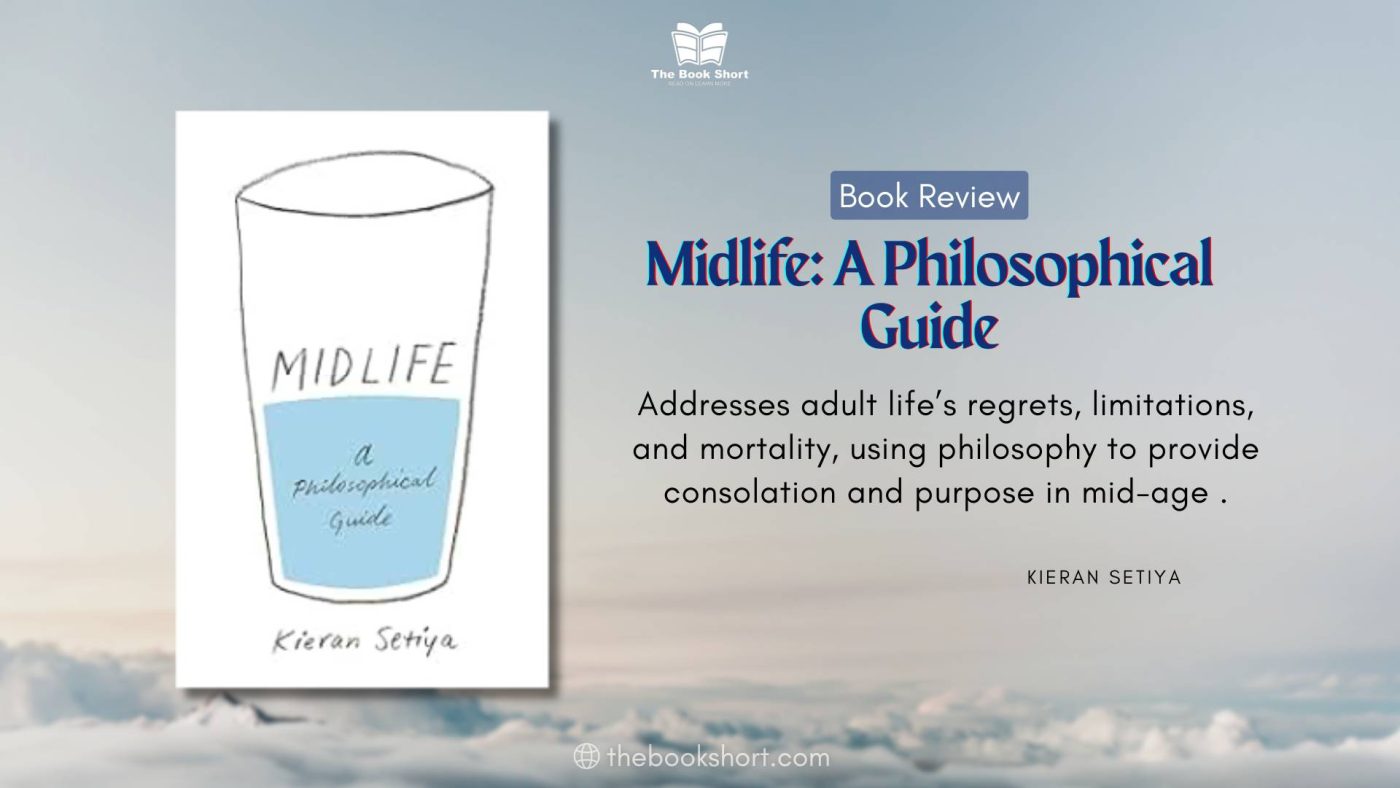
Navigating midlife? This philosophical guide offers profound wisdom on regrets, mortality, and finding meaning in the heart of life’s journey.
What truly happens when you arrive at the middle of life? It’s a phase often marked by a peculiar blend of established routine and unsettling questions. Kieran Setiya’s Midlife: A Philosophical Guide dives deep into the challenges and opportunities of this often-disorienting passage. I was drawn to analyze this book because it offers a rare and potent combination: the vulnerability of personal experience fused with the rigor of philosophical inquiry. It’s not just a book about midlife; it’s a guide through it, offering not facile advice but a robust intellectual framework for grappling with common feelings like regret, dissatisfaction, and the undeniable sense of finitude that creeps in. Its value lies precisely in equipping readers with the intellectual tools needed to navigate their middle years with greater clarity, acceptance, and perhaps, a deeper appreciation for the life unfolding. For anyone wrestling with the subtle (or not so subtle) shifts midlife inevitably brings, this book is a compelling and necessary companion.
Basic Information About Midlife: A Philosophical Guide
- Title: Midlife: A Philosophical Guide
- Author: Kieran Setiya
- Year of publication: 2017
- Genre: Philosophy, Self-Help, Non-fiction (bridging academic philosophy and popular reflection)
- Number of pages: Approximately 224 pages (may vary by edition)
- Target audience: Adults navigating the midlife transition (roughly 40s-50s), readers interested in how philosophy can address everyday life challenges, individuals contemplating themes of regret, mortality, and the search for meaning.

Midlife: A Philosophical Guide
Exploring the Core Ideas: Summary of Midlife: A Philosophical Guide
Kieran Setiya’s Midlife: A Philosophical Guide stands apart from typical self-help literature. It bypasses quick tips and motivational platitudes in favor of a deeply thoughtful exploration, using philosophical concepts and candid personal reflection to dissect the common experiences associated with the middle decades of life. Setiya, a seasoned philosophy professor, approaches midlife less as a dramatic crisis to be cured and more as a fundamental human condition, characterized by specific feelings, paradoxes, and existential realisations. He provides philosophical frameworks designed not to eliminate these feelings, but to understand and navigate them with greater wisdom.
The book is thoughtfully structured around key themes that define this phase, moving from the initial sense of disorientation to profound philosophical insights.
Diagnosing the Midlife Condition
Setiya begins by defining the “midlife condition.” This isn’t necessarily a sudden, dramatic upheaval often depicted in stereotypes, but more commonly involves a persistent sense of stagnation, quiet dissatisfaction, or feeling as though you’ve reached a plateau. Life, which once felt like an expansive landscape of infinite future possibilities stretching before you, now appears more constrained. The horizon of potential seems to shrink, and the paths already taken feel increasingly irreversible. This section acknowledges the common feelings of boredom or restlessness that can arise, sometimes surprisingly, even when one has achieved many conventional markers of success in career, family, or finance.
The Paradox of Achievement and Dissatisfaction
A central paradox explored is the phenomenon where achieving long-held goals (career milestones, stable relationships, financial security) doesn’t necessarily lead to lasting happiness or deep satisfaction. Setiya probes the philosophical reasons behind this, drawing on ideas about the nature of goals and human activity. He introduces a crucial distinction: telic activities (those defined by a specific endpoint, like writing a book, completing a project, or raising children to adulthood) and atelic activities (those engaged in for their own sake, where the activity is its own end, such as listening to music, spending time with loved ones, engaging in conversation, or philosophical reflection). Midlife often sees the completion of many significant telic goals, potentially leaving a void or a questioning of “what’s next?” The book powerfully suggests that finding deeper fulfillment often lies in shifting focus towards atelic pursuits, which offer continuous engagement and meaning in the present moment, rather than relying on the achievement of a future state.
Grappling with Regret and Paths Not Taken
Regret emerges as a significant and complex focus. Setiya tackles the multifaceted nature of regretting choices made or paths not taken. He distinguishes between “agent regret” (regretting one’s own actions or inactions, which might call for amends) and a deeper, more philosophical regret stemming from the very structure of life – the fundamental fact that choosing one path necessarily means forsaking countless others. The book acknowledges that some regrets are valid and require honest acknowledgment or action. However, it also offers a framework to understand that many regrets are simply the unavoidable consequences of living a finite life with limited choices. He encourages a form of reconciliation with the past, suggesting that dwelling excessively on hypothetical alternative lives is not only unproductive but fundamentally misunderstands the nature of human choice and finitude.
Confronting Finitude and the Awareness of Mortality
Perhaps the most existentially profound aspect of midlife that Setiya addresses is the growing, often unavoidable, awareness of finitude and mortality. Life no longer feels endless; the future feels shorter than the past. This realization can be deeply unsettling, bringing anxieties about aging, decline, loss, and death. The book doesn’t offer comforting platitudes about mortality but encourages a direct, philosophical confrontation with it. By acknowledging finitude, Setiya argues, one can potentially gain valuable perspective, re-evaluate priorities, appreciate the present moment more profoundly, and find meaning not in boundless possibility but in the finite, tangible time available. This theme strongly connects back to the value of atelic activities – pursuits whose meaning is derived from the doing itself, untethered from future outcomes or an illusion of infinite time.
Finding Meaning and Value Amidst Limitations
Given the potential disillusionment with purely goal-oriented achievement, the weight of regret, and the stark reality of finitude, the book thoughtfully explores avenues for finding renewed meaning and value in midlife. Setiya proposes a significant shift in perspective and focus: moving away from the relentless pursuit of future states towards a deeper engagement with present activities and experiences. This involves:
- Prioritizing Atelic Activities: Consciously valuing and making time for experiences that are inherently rewarding, independent of a final product or achievement. This includes nurturing relationships, engaging in hobbies, appreciating simple pleasures, and pursuing ongoing learning or creative expression.
- Engaging Constructively with the Past: Learning to acknowledge regrets and past mistakes without being consumed by them, understanding them as part of the unique, unrepeatable path one has taken.
- Embracing Finitude: Understanding that limitations – whether of time, opportunity, or ability – are not merely constraints but can also be clarifying, focusing attention on what truly matters and is possible in the present.
- Cultivating Wisdom: Setiya suggests midlife is a potent time for developing a particular kind of practical wisdom – not merely intellectual knowledge, but a deeper understanding involving perspective, acceptance, and a nuanced appreciation of life’s inherent limitations and potential satisfactions.
Philosophy as a Navigational Tool
Throughout his exploration, Setiya seamlessly weaves in the insights of philosophical giants like Aristotle, Schopenhauer, Camus, and others. He doesn’t just reference them; he actively uses their ideas as powerful lenses through which to view modern midlife dilemmas. For instance, Aristotle’s concept of eudaimonia (often translated as flourishing or living well) is re-examined in the context of midlife, shifting emphasis from accumulating external goods to cultivating internal states and engaging in valued activities. Schopenhauer’s views on the cyclical nature of desire and satisfaction are employed to illuminate the disappointment that can follow the achievement of long-sought goals.
In essence, Midlife: A Philosophical Guide offers a sophisticated philosophical toolkit for understanding and navigating this complex life stage. It validates the common feelings of dissatisfaction and disorientation but reframes them not as personal shortcomings but as predictable responses to the fundamental structure of human life at this juncture. By encouraging a shift from a future-oriented, outcome-driven mindset to a present-focused, activity-oriented perspective, and by confronting finitude with intellectual honesty and courage, Setiya lights a path towards finding deeper meaning and a more settled, perhaps even profound, form of contentment in the middle years and beyond. It is a guide that inspires thoughtful reflection, fosters deeper self-understanding, and proposes a different, perhaps richer, way of valuing one’s life as it is.
An Expert Look: In-depth Analysis of Midlife: A Philosophical Guide
Kieran Setiya’s Midlife: A Philosophical Guide occupies a unique and valuable space. In a literary landscape often dominated by psychological self-help or anecdotal memoirs when addressing this period, Setiya firmly anchors his exploration of a common human phase in rigorous philosophical thought. It’s a deeply introspective and intellectual undertaking that seeks to understand why midlife can feel like a peculiar “slump,” even when external circumstances appear stable or successful.
The Core Argument and Its Structure
The book’s central argument is compelling and quietly revolutionary: the fundamental challenges of midlife are not primarily due to external circumstances, personal failures, or poor choices alone. Instead, they are inherent consequences of the very structure of human life – specifically, our complex relationship with time, the nature of our goals, and the unavoidable awareness of our finite existence. Setiya persuasively argues that dissatisfaction often stems from:
- The Paradox of Achieved Goals: Much of early adulthood is structured around pursuing definable, often external, endpoints (career milestones, building a family, acquiring assets). Successfully achieving these goals can ironically leave a sense of emptiness or a loss of direction, as the powerful motivation provided by future objectives diminishes.
- The Inevitability of Regret: As the past accumulates and potential futures narrow, the paths not taken become more visible and can trigger regret. Setiya skillfully shows this isn’t always regret for specific mistakes, but sometimes a deeper regret tied to the fundamental human condition of limited choice – the impossibility of living all the lives one could have lived.
- The Shift in Temporal Perspective: Confronting one’s own mortality – the stark realization that more time lies behind than ahead – fundamentally alters one’s perspective. The previous reliance on a seemingly infinite future for finding meaning becomes problematic, necessitating a re-evaluation of what constitutes a life well-lived now.
The book is structured thematically, with each chapter meticulously examining a specific facet of the midlife condition: the initial feeling of unease, the problem of achieved success, the burden of regret, the confrontation with mortality, and ultimately, pathways towards finding enduring value and meaning. This thematic progression allows Setiya to build his argument layered, using diverse philosophical concepts to illuminate each challenge. He doesn’t offer prescriptive steps but rather provides insightful lenses through which readers can understand and reinterpret their own experiences.
Setiya’s Distinctive Writing Style and Content Quality
Setiya’s writing style is arguably the book’s most distinctive and appealing feature. It is precise, measured, intellectually calm, yet infused with a disarming personal honesty. He openly shares his own struggles with midlife dissatisfaction and the philosophical questions it raised for him, grounding abstract philosophical concepts in relatable human feeling. This seamless blend of personal vulnerability and rigorous intellectual analysis is highly effective, making complex ideas accessible and resonant. He masterfully avoids dense jargon, or when necessary, explains philosophical terms with clarity, inviting a general audience into profound intellectual territory.
The content quality is exceptionally high, a testament to Setiya’s expertise as a philosopher. He doesn’t simplify or dilute the philosophical concepts but presents them with clarity and powerfully demonstrates their direct relevance to the lived experience of midlife. The book’s strength lies in his ability to synthesize ideas from various philosophical traditions – from ancient Greek ethics to modern existentialism – and apply them directly to the specific dilemmas of this life stage. His distinction between telic and atelic activities, in particular, is a profoundly insightful framework that offers readers a concrete way to re-evaluate how they spend their time and cultivate deeper sources of meaning.
What Makes This Book Unique
What truly sets Midlife: A Philosophical Guide apart from the vast landscape of books addressing midlife, aging, or happiness is its unapologetically philosophical foundation and approach. While many books might focus on psychological coping mechanisms, lifestyle changes, or anecdotal accounts of midlife transitions, Setiya goes to the root, questioning why this period feels the way it does from a fundamental perspective on human existence, time, and value.
- Deep Philosophical Engagement: It doesn’t shy away from core existential questions about meaning, time, death, and regret, engaging directly with major philosophical ideas in a way few books on the topic do.
- Focus on the Human Condition: Setiya argues that the midlife slump isn’t primarily about the specifics of your job, your relationships, or your regrets, but about universal aspects of the human condition that become particularly salient at this point in life.
- Emphasis on Atelic Value: His powerful argument for finding meaning and satisfaction in activities that have no endpoint stands in sharp contrast to a contemporary culture often obsessed with achievement, outcomes, and productivity.
- Integrated Personal and Academic Voice: The genuine integration of Setiya’s personal experiences with his professional philosophical analysis creates a unique, trustworthy, and deeply human voice.
Engaging with this book requires a willingness to think abstractly and introspectively. But for readers seeking more than superficial advice – for those who crave a robust intellectual framework to understand and navigate one of life’s most challenging, yet potentially transformative, periods – Midlife: A Philosophical Guide offers unparalleled insight and guidance.
Notable Quotes from the Book
These quotes capture the essence of Setiya’s perspective and his thoughtful, sometimes poignant, exploration of the midlife experience:
- “Midlife is not a crisis. It is a condition.” (Setting the stage for the book’s core premise)
- “You have reached a certain elevation and can see the landscape clearly, including the limits of where you are going.” (Poetically describing the shrinking horizon of future possibilities)
- “Much of what we do aims at goals which, once achieved, no longer provide a rationale for what we do.” (On the inherent problem with exclusively pursuing telic activities)
- “Every path taken is a thousand paths not taken.” (A concise and powerful statement on the inherent nature of regret tied to the necessity of choice)
- “The problem is not how long you live, but how to live with death in view.” (A direct and profound challenge related to confronting mortality)
- “We need to learn to value the journey not just for the sake of the destination, but for itself.” (Highlighting the crucial shift towards valuing atelic activities and present engagement)
These passages offer a glimpse into Setiya’s clear prose and the depth of his inquiry.
Evaluation & Expert Personal Review of Midlife: A Philosophical Guide
Midlife: A Philosophical Guide by Kieran Setiya is decidedly not a quick-fix book, but for the right reader, it is a deeply rewarding and profoundly insightful experience. My personal reflection is that this book serves less as a prescriptive guide on what to do in midlife, and much more as an essential guide on how to think about the midlife experience itself.
Advantages:
- Intellectually Grounded: Setiya provides a sophisticated and rigorous philosophical framework for understanding the common feelings of midlife dissatisfaction and restlessness, moving far beyond simplistic explanations.
- Relatable Humanity: His brave willingness to share his own struggles and uncertainties lends significant authenticity and makes the abstract philosophical arguments feel deeply personal and relevant.
- Fresh Perspective: The distinct philosophical focus, particularly the illumination provided by the telic/atelic distinction and the analysis of regret as rooted in the structure of choice, offers genuinely novel insights compared to much of the existing literature on midlife.
- Surprisingly Comforting: By reframing midlife challenges as inherent to the human condition rather than personal failings, the book can alleviate pressure and offer a strange, quiet form of comfort.
- Accessible Prose: Despite tackling complex subjects, the writing is remarkably clear, precise, and engaging, making challenging philosophical ideas accessible to a broad audience.
Disadvantages:
- Not Action-Oriented: Readers seeking step-by-step guides, practical exercises, or concrete solutions to specific midlife challenges (like career change or relationship issues) may find the book lacking. Its focus is on changing your understanding, not prescribing behaviors.
- Requires Engagement: While accessible, the philosophical concepts require focused attention and a willingness to think conceptually and introspectively. It is not a book to skim lightly.
- Understanding Over Resolution: Setiya excels at helping you understand why you feel a certain way in midlife, but the process of internalizing this understanding and changing your emotional response or approach to life is left largely to the reader’s own ongoing reflection and effort.
Readability Level and Suitability:
The book is moderately challenging. It is written for an intelligent general audience and assumes a willingness to engage with abstract concepts and introspective thought. While not overly academic in tone, the subject matter demands thoughtful engagement rather than passive reading.
This book is highly suitable for:
- Individuals currently navigating their 40s, 50s, or even late 30s who are experiencing feelings of restlessness, dissatisfaction, stagnation, or a questioning of meaning, even if their lives appear stable and successful from the outside.
- Anyone with an interest in applied philosophy and exploring how philosophical ideas can illuminate and help navigate the challenges of everyday life.
- Readers who appreciate introspective, analytical non-fiction and prefer deep understanding over prescriptive self-help.
- People who value intellectual honesty, nuanced perspectives, and a direct confrontation with fundamental existential questions.
It might be less suitable for those seeking simple, immediate solutions to perceived “midlife crises,” or readers who prefer a more emotionally driven, anecdote-heavy, or purely psychological approach.
Practical Value:
The practical value of this book lies primarily in its transformative power to shift one’s perspective and frame of mind. It provides:
- A Powerful Reframe: It helps readers reframe midlife dissatisfaction, regret, and anxiety about finitude not as personal failures or deviations from a ‘normal’ path, but as predictable, understandable responses to fundamental aspects of the human condition at this stage. This reframing alone can significantly alleviate pressure and self-criticism.
- Tools for Re-evaluation: The insightful distinction between telic and atelic activities offers a powerful, actionable tool for consciously evaluating how time is spent and intentionally cultivating pursuits that provide ongoing meaning and satisfaction, rather than solely chasing future outcomes.
- A Better Relationship with Regret: It provides a robust philosophical basis for understanding the nature of regret, distinguishing between different kinds and offering a path towards accepting the unavoidable nature of some regrets, thereby reducing their debilitating power.
- Clarity from Finitude: By encouraging a thoughtful, non-avoidant confrontation with mortality, the book can paradoxically lead to greater clarity about what truly matters and a deeper appreciation for the finite, precious time available in the present.
Reading Midlife: A Philosophical Guide fundamentally changed my perspective on the common anxieties and feelings associated with this stage of life. Instead of viewing them as problems demanding external fixes (like buying a new car or changing careers), it compellingly encourages an internal shift – looking inward and engaging with fundamental questions about what it means to be human, finite, and living a chosen life within limitations. It is a book that empowers not by prescribing actions, but by providing profound understanding.
Comparing Setiya’s Guide with Other Books on Midlife and Meaning
While Kieran Setiya’s Midlife: A Philosophical Guide carves out a distinct niche due to its deeply philosophical foundation, it exists within a broader literary landscape addressing midlife transitions, aging, and the search for meaning. Understanding its place within this conversation highlights its unique contribution.
Compared to seminal works like Gail Sheehy’s classic Passages: Predictable Crises of Adult Life, Setiya moves beyond describing the psychological stages and transitions of adult life, including midlife shifts. While Sheehy provides a valuable map of common emotional landscapes, Setiya delves into the underlying reasons for these feelings from an existential and philosophical standpoint, offering a different order of analysis than purely descriptive psychology.
Similarly, books rooted in positive psychology or empirical research on the “happiness curve” (which often shows a dip in middle age before rising again) may discuss the phenomenon of decreased life satisfaction in midlife. Authors like Martin Seligman or Jonathan Rauch (The Happiness Curve) provide data and psychological explanations. Setiya, however, offers a philosophical explanation rooted in the very nature of goals, time, and regret, engaging with fundamental concepts of value and human striving in a way that empirical science typically does not.
Books within the existentialist tradition (e.g., Albert Camus, Jean-Paul Sartre, or Viktor Frankl’s profoundly influential Man’s Search for Meaning) certainly share concerns with meaning, finitude, freedom, and responsibility. Setiya brings these grand philosophical themes down to the specific, relatable context of the midlife experience. While Frankl focuses on finding meaning through suffering, work, and love, Setiya concentrates on finding meaning and value within the structure of a life that has passed its halfway point, confronting the consequences of accumulated choices and shrinking future possibility.
In contrast to more practical “how-to” guides for navigating specific midlife transitions (like career changes, financial planning for later life, or relationship dynamics), Setiya offers very little in terms of concrete, actionable steps. His focus is almost entirely on cognitive shifts, providing a framework for understanding the why behind midlife feelings rather than a blueprint for external change.


For readers who found Midlife: A Philosophical Guide insightful, the following books might offer complementary perspectives or similar approaches to applying philosophy to life:
- The Consolations of Philosophy by Alain de Botton: This book uses the lives and ideas of philosophers (from Socrates to Schopenhauer) to help readers cope with various modern woes, sharing Setiya’s core approach of applying philosophical wisdom to everyday challenges and emotional states.
- Being Mortal: Medicine and What Matters in the End by Atul Gawande: Written by a physician, this powerful book reflects on aging, dying, and how modern medicine often struggles to address the human experience of finitude. While focused on later life and end-of-life care, it resonates deeply with Setiya’s theme of confronting mortality and re-evaluating priorities in light of limited time.
- The Happiness Curve: Why Life Gets Better After 50 by Jonathan Rauch: Offers an empirically-driven perspective on the U-shaped happiness curve across the lifespan. While different in methodology, it provides a complementary view on the midlife dip and potential reasons, blending research with personal reflection.
- Four Thousand Weeks: Time Management for Mortals by Oliver Burkeman: Although framed as a time management book, it is a profoundly philosophical work that directly confronts human finitude and encourages a more realistic, meaningful, and less frantic relationship with our severely limited time on Earth. It echoes Setiya’s themes of finitude and valuing activities for their own sake.
In summary, Setiya’s book distinguishes itself by offering a unique philosophical diagnosis of the midlife condition, providing intellectual tools for profound understanding and reframing rather than merely mapping psychological stages or prescribing practical solutions.
Conclusion & Recommendations for Exploring Midlife Philosophically
Midlife: A Philosophical Guide by Kieran Setiya offers exceptional value for anyone seeking a deeper, more intellectual understanding of the challenges and feelings commonly associated with the middle years of life. Its profound worth lies not in offering superficial remedies or prescriptive actions, but in providing a robust, philosophically grounded framework for comprehending why this stage can feel so disorienting, restless, or imbued with regret, even amidst outward success.
Is it worth reading? Unquestionably, yes, especially if you are currently navigating midlife yourself or possess an interest in exploring how philosophical thought can illuminate and help process fundamental human experiences. It is a profoundly thought-provoking book that actively encourages deep introspection and equips the reader with powerful intellectual tools to reframe their perspective on this pivotal life stage.
Who should pick up this book? This guide is particularly ideal for individuals in their 40s, 50s, or even late 30s, who are experiencing a sense of restlessness, dissatisfaction, stagnation, or grappling with regrets and the recognition of time’s passage, regardless of their external circumstances. It is also highly recommended for anyone interested in applied philosophy, human psychology, and thoughtful explorations of the nature of meaning, time, and finitude. If you are a reader who appreciates nuanced, well-argued analysis over quick tips or purely anecdotal accounts, this book is tailored for you.
Kieran Setiya’s guide will not provide instructions on whether to buy a sports car or embark on a dramatic new career path. Instead, it delves into the fundamental human condition that often prompts such desires, offering a pathway towards finding more profound and sustainable satisfaction by understanding and valuing the life you are living now, acknowledging its inherent limitations, and appreciating its unique, finite opportunities.
Have you read Midlife: A Philosophical Guide? Share your thoughts and reflections on Setiya’s ideas in the comments below!