
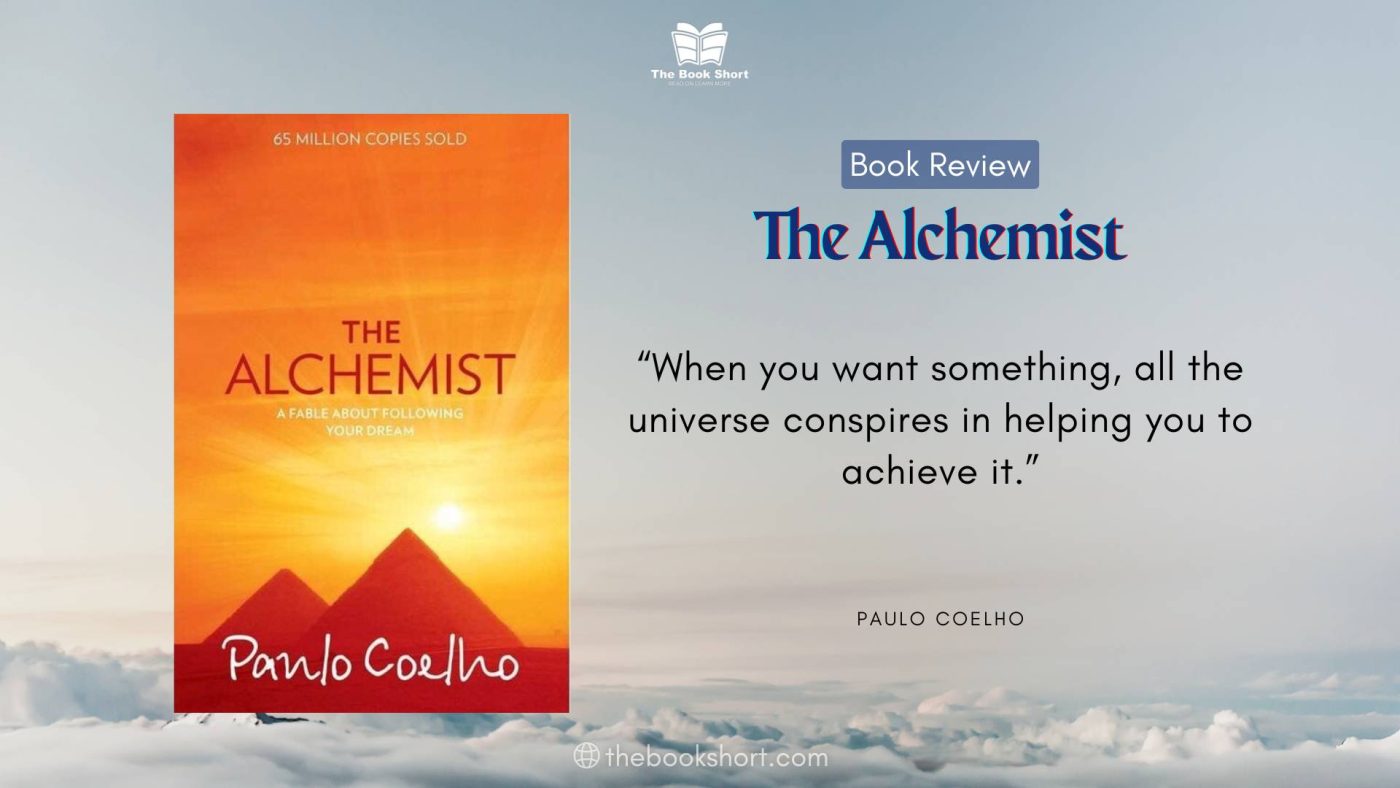
Embark on a journey of self-discovery with Paulo Coelho’s global phenomenon, The Alchemist. This captivating novel has touched millions with its deceptively simple yet profound wisdom. Often described as a modern-day fable, The Alchemist holds enduring popularity and possesses a unique ability to resonate deeply with readers across diverse cultures and ages. Its true value lies in its inspiring message about the courage to follow your dreams, listen to your heart, and understand the subtle language of the universe—offering a perspective that feels both ancient and urgently relevant in today’s world. Join us as we explore this timeless tale of fate, dreams, and finding your Personal Legend.
The Alchemist Book Information
- Title: The Alchemist (O Alquimista)
- Author: Paulo Coelho
- Year of publication: 1988 (Original Portuguese), 1993 (English translation)
- Genre: Allegorical Novel, Philosophical Fiction, Quest Narrative, Inspirational Fiction
- Number of pages: Varies by edition (typically ranges from 160 to 208 pages), making it a relatively quick but impactful read.
- Target audience: Broad readership, particularly those interested in spiritual themes, personal growth, motivational stories, and exploring the meaning of life and destiny.
The Alchemist Book Summary: Discovering and Following Your Personal Legend
The Alchemist unfolds the story of Santiago, a young and thoughtful Andalusian shepherd boy. Unlike his peers, Santiago finds contentment in the simple life of traveling with his flock and reading, yet he harbors a deep-seated yearning for something more—specifically, the desire to travel and explore the world beyond his familiar pastures. The narrative is masterfully structured as a spiritual and physical journey, marked by distinct stages that reflect Santiago’s evolving understanding of himself and the world.
The story opens in Andalusia, where Santiago is troubled by a recurring dream: a child shows him a hidden treasure at the base of the Egyptian pyramids. Initially, he dismisses it, hesitant to disrupt his comfortable life. However, persistent curiosity leads him to consult a Romani fortune-teller, who interprets the dream literally and urges him to travel to Egypt. Soon after, he encounters a mysterious old man, Melchizedek, who reveals himself as the King of Salem. The King immediately recognizes Santiago’s dream and introduces him to the concept of “Personal Legends”—the unique path each person is meant to follow to fulfill their deepest destiny and purpose. He shares a fundamental truth: “when you want something, all the universe conspires in helping you to achieve it.” To guide Santiago, the King gives him two stones, Urim and Thummim, symbolic aids for decision-making when omens are unclear. Following the King’s counsel, Santiago sells his beloved sheep, severing ties with his past life, and embarks on his quest.
Santiago’s journey takes him across the Strait of Gibraltar to the bustling, foreign city of Tangier, North Africa. His first taste of this new world is a harsh lesson in reality; he is quickly robbed of all his money, leaving him penniless and utterly alone. Despair threatens to consume him, but remembering the King’s words about paying attention to omens, he finds a way forward. He secures work with a kind but stagnant crystal merchant. Santiago, despite his lack of business experience, breathes new life into the shop with innovative ideas—building a display case, selling tea in crystal glasses—significantly boosting profits. He works for the merchant for nearly a year, accumulating enough money to return home and buy more sheep, a tempting path back to familiarity and safety.
However, the call of his Personal Legend is too strong to ignore. After deep contemplation, Santiago chooses to continue his quest for the treasure. He joins a caravan crossing the vast, formidable Sahara Desert towards Egypt. On this arduous passage, he meets an Englishman obsessed with alchemy, searching for the legendary Alchemist capable of transmuting metal and possessing the Elixir of Life and the Philosopher’s Stone. The Englishman is rooted in scholarly knowledge, pouring over books, while Santiago learns by observing the natural world, listening to the wind, and connecting with the heart of the desert itself.
As tribal wars escalate in the desert, the caravan seeks refuge at a vast, neutral oasis. Here, Santiago encounters and falls deeply in love with Fatima, a woman of the desert. Her presence offers the possibility of a fulfilled life right there, tempting him to abandon his search for the pyramids, believing he has found his true treasure in her. Yet, omens—two hawks fighting—grant him a vision of an impending attack on the seemingly safe oasis. He warns the tribal chieftains, who, after deliberation, trust his insight. When the predicted attack occurs and is repelled thanks to his warning, Santiago is celebrated as a hero for listening to the language of the world.
His ability to read the omens attracts the attention of the legendary Alchemist himself. The Alchemist, recognizing Santiago’s potential, tests him and agrees to guide him for the remainder of his journey to the pyramids. Under the Alchemist’s tutelage, Santiago delves deeper into understanding the Soul of the World, the interconnectedness of all things, and the critical importance of listening to his heart, even when it whispers of fear. The Alchemist imparts crucial lessons: the greatest truths are often the simplest, and the universe speaks a universal language accessible to anyone willing to listen. Santiago learns to perceive the world not just intellectually, but spiritually and intuitively.
Their journey continues through increasingly dangerous territories. At one point, they are captured by a warring tribe. To save their lives, the Alchemist presents Santiago as an alchemist capable of turning himself into the wind. Faced with imminent death, Santiago must truly commune with the desert, the wind, the sun, and the Soul of the World, demonstrating his profound connection to the universe by momentarily transforming into the wind. This extraordinary feat astonishes the tribe and secures their release, marking a pivotal moment in Santiago’s spiritual mastery.
Finally, Santiago arrives at the majestic Egyptian pyramids. With his heart pounding, he begins digging at the spot from his dream, finding only sand. Just as despair returns, he is attacked by refugees from the tribal wars who are also scavenging for treasure. Frustrated, Santiago recounts his recurring dream of treasure at the pyramids. One of the attackers laughs, revealing that he too had a recurring dream about treasure – buried in the ruins of an old church in Spain where shepherds and their sheep slept, specifically mentioning a sycamore tree growing from within the ruins.
In that instant, Santiago grasps the profound truth his entire journey has revealed. The treasure was waiting for him all along, not in a faraway land, but back where he started. He returns to Spain, to the crumbling church where he first dreamt of the treasure while sleeping with his flock. Digging beneath the sycamore tree, he unearths a chest overflowing with gold and precious jewels. He realizes the physical treasure was merely the catalyst; the true wealth was the journey itself, the lessons learned, the wisdom gained, and the transformation he underwent to become worthy of finding it. The book concludes with Santiago preparing to return to Fatima at the oasis, having fulfilled his Personal Legend and discovered that “the treasure is in the journey.”
In-Depth Analysis of The Alchemist Themes and Profound Messages
The Alchemist functions less as a conventional novel and more as a timeless fable or parable for the modern age. Its enduring impact lies in its powerful, universally applicable themes, which Paulo Coelho presents with remarkable clarity and deceptive simplicity. The central tenet revolves around the concept of the “Personal Legend,” framed as each individual’s unique destiny, purpose, or spiritual calling in life. The book argues persuasively that the universe is inherently benevolent and actively conspires to help those who pursue their Personal Legend with unwavering commitment and courage.
Characters as Archetypes, Structure as Spiritual Journey
The protagonist, Santiago, is deliberately drawn as a relatable, unassuming figure. He serves as an everyman, a vessel for the reader to experience the journey and learn alongside him. The characters he encounters—the King of Salem, the Crystal Merchant, the Englishman, Fatima, and the Alchemist—function primarily as powerful archetypes or guides, each embodying different facets of the human experience, representing obstacles, sources of wisdom, or reflections of Santiago’s own state. The narrative structure is strikingly linear, mirroring a classic quest structure. This chronological progression reinforces the idea of a spiritual path with distinct, necessary stages of learning, testing, perseverance, and ultimate realization. The core arguments are woven directly into the fabric of the story, often articulated through dialogue or Santiago’s reflections:
- Embracing Your Personal Legend (Following Your Dreams): This is the heart of the book. It asserts that fear—especially the fear of failure or the unknown—is the primary barrier to fulfilling one’s purpose.
- Listening to Your Heart: The book emphasizes inner wisdom, intuition, and emotional truth as essential guides on the path to destiny.
- Reading the Omens / The Language of the World: Coelho presents the idea that the universe constantly communicates with us through signs, coincidences (synchronicity), and the natural world, and we must learn to perceive and interpret this language.
- The Soul of the World: This concept underscores the profound interconnectedness of all living things, objects, and events—a universal consciousness or energy that binds everything together.
- The Principle of Favorability: The idea that beginners are often met with a degree of luck or initial ease to encourage them, though challenges will inevitably arise later.
- Alchemy as Transformation: Beyond the literal pursuit of turning lead into gold, alchemy serves as a powerful metaphor for personal transformation, spiritual enlightenment, and achieving one’s highest potential. The ultimate treasure is the internal growth and wisdom gained through the journey itself, rather than just the external goal.
Coelho’s Simple, Lyrical Style & Content Depth
Coelho’s writing style in The Alchemist is notable for its remarkable simplicity, clarity, and directness, often possessing a lyrical, almost childlike quality. He avoids complex sentence structures, intricate subplots, or elaborate descriptive passages. This deliberate simplicity is a significant strength; it renders the book incredibly accessible to a vast global audience, lending it the timeless feel of an ancient fable passed down through generations. The narrative flows effortlessly, moving seamlessly from one meaningful encounter or life lesson to the next. While it doesn’t delve into deep psychological complexity or intricate plotting, its content excels in the clarity of its message, its emotional resonance, and its ability to feel like fundamental truth being revealed.
What truly sets The Alchemist apart is its explicit allegorical nature and overt philosophical teaching. Unlike many novels that subtly explore themes, Coelho lays bare his core messages through character dialogues, internal monologues, and symbolic events. There is little room for ambiguity about the lessons being conveyed. Compared to complex fantasy epics with vast world-building and intricate magic systems, The Alchemist is stripped down to the essentials of the human condition and the spiritual quest. It is a quest story where the true treasure is not material wealth, but profound wisdom, self-understanding, and spiritual connection. The “magic” is not presented as spells or potions, but as the inherent power of interconnectedness, the responsiveness of the universe to intention, and the extraordinary potential within each individual.
Enduring Wisdom: Memorable Quotes from The Alchemist
The book is renowned for its abundance of memorable, oft-quoted lines that crystallize its core philosophy and serve as powerful affirmations for readers:
- “And, when you want something, all the universe conspires in helping you to achieve it.” (A foundational principle articulated by the King of Salem, echoing throughout the book).
- “It’s the possibility of having a dream come true that makes life interesting.” (Highlighting the vital role of aspiration and hope).
- “The secret of life, though, is to fall seven times and to get up eight times.” (Spoken by the King of Salem, an enduring message of resilience).
- “There is only one thing that makes a dream impossible to achieve: the fear of failure.” (Directly confronting the primary obstacle to pursuing one’s Legend).
- “When we love, we always strive to become better than we are.” (Connecting love, growth, and self-improvement).
- “The Alchemist said, ‘No matter what he does, every person on earth plays a central role in the history of the world. And normally he doesn’t know it.'” (Emphasizing the significance of individual lives and actions within the larger tapestry of existence).
- “The boy remembered the old merchant he had worked for in Tangier. He had said that he always wanted to go to Mecca, and that it was the only thing keeping him alive. Santiago realized that the crystal merchant hadn’t gone to Mecca because it was that possibility that kept him alive.” (A poignant insight into the danger of valuing the possibility of a dream over its actual pursuit).
- “You must understand that love never keeps a man from pursuing his Personal Legend. If he abandons that pursuit, it’s because it wasn’t true love… The love that speaks the Language of the World.” (Spoken by the Alchemist, clarifying the relationship between love and purpose).
- “The fear of suffering is worse than the suffering itself… No heart has ever suffered when it goes in search of its dreams.” (Also from the Alchemist, a powerful affirmation of courage and the nature of the quest).
These resonant quotes are integral to The Alchemist‘s lasting impact, serving as easily digestible nuggets of wisdom that lodge themselves in the reader’s mind long after the final page.
Evaluating The Alchemist: A Personal Review and Practical Life Lessons
The Alchemist is a book that tends to elicit passionate responses; readers typically either embrace its message wholeheartedly or find its simplicity off-putting. My personal experience leans strongly towards the former. I found it to be a genuinely uplifting, deeply moving, and powerfully inspiring read. Its most significant strength is its remarkable ability to distill complex philosophical and spiritual ideas into a simple, accessible, and compelling narrative form. The fable-like structure makes it incredibly easy to connect with on an emotional level and follow Santiago’s journey as if it were your own. It is a book that encourages deep introspection and offers a profoundly hopeful perspective on navigating life’s challenges and pursuing one’s deepest aspirations.
However, it is precisely this simplicity that some critics might find a disadvantage. The characters are designed as archetypes serving the narrative’s themes rather than fully fleshed-out individuals with complex psychologies. The plot is primarily a vehicle for delivering the core messages, lacking the intricate twists and turns of more conventional fiction. For readers who prioritize complex narratives, deeply nuanced characters, or gritty realism, The Alchemist might feel overly simplistic, perhaps even preachy or didactic. The direct nature of its lessons leaves little room for individual interpretation, which, as noted, can be seen as either a strength (clarity of message) or a weakness (lack of intellectual subtlety).
The Alchemist boasts an exceptionally high readability level. Its use of straightforward language, concise sentences, and a clear, linear narrative make it accessible to a remarkably wide audience, including young adults and those who may not be avid readers. It serves as an excellent gateway book, non-intimidating and quickly rewarding. It is particularly well-suited for individuals who:
- Are at a crossroads in life, feeling lost, or uncertain about their future path.
- Are actively pursuing a significant dream or goal and encountering obstacles, self-doubt, or fear.
- Are interested in spiritual or philosophical concepts but prefer them presented through engaging storytelling rather than abstract discourse.
- Appreciate allegories, parables, or inspirational fiction with clear moral or life lessons.
The practical value of The Alchemist is arguably its most celebrated aspect. It offers potent life lessons capable of significantly shifting a reader’s mindset and approach to life. The central teaching about identifying and pursuing one’s Personal Legend, despite fear and external challenges, is a powerful call to courageous action. The emphasis on trusting intuition, paying attention to the signs the universe provides, and recognizing the interconnectedness of everything encourages a more mindful, responsive, and purpose-driven existence. It shifts the focus away from external validation towards internal fulfillment and fosters a belief in a fundamentally supportive universe for those aligned with their true path. Reading The Alchemist can genuinely inspire a reader to identify their buried dreams, confront the fears holding them back, and take meaningful steps towards living a life that feels authentic, purposeful, and rich. It serves as a profound reminder that the journey itself—with all its trials, lessons, and unexpected encounters—is often the most valuable treasure of all.
Comparing The Alchemist with Similar Inspirational Works
The Alchemist holds a prominent place within the genre of philosophical fiction and inspirational allegories that utilize a physical or metaphorical journey as a central motif for spiritual growth, self-discovery, and the pursuit of purpose. It shares thematic and structural similarities with other works that aim to impart life lessons and profound insights through narrative, rather than through direct self-help instruction.
For readers who found resonance and inspiration in The Alchemist, they are likely to appreciate and find value in the following comparable books:
- Siddhartha by Hermann Hesse: A classic and deeply philosophical journey of a young man in ancient India seeking spiritual enlightenment and understanding. Like The Alchemist, it follows a protagonist who learns profound wisdom through direct experience of the world and various paths of life, rather than solely through received teachings.
- Jonathan Livingston Seagull by Richard Bach: A concise, moving allegory about a seagull who dares to pursue a higher purpose and greater potential than the norms of his flock dictate. It shares the core theme of breaking free from limitations and societal expectations to follow one’s unique, passionate path.
- The Little Prince by Antoine de Saint-Exupéry: While often categorized as a children’s book, this timeless story is a profound philosophical allegory presented with simple language and a journey structure. It beautifully explores themes of love, loss, friendship, responsibility, and the vital importance of seeing with the heart, much like The Alchemist‘s emphasis on intuition and the Language of the World.
- Life of Pi by Yann Martel: A more complex and extensive novel, but one that shares a strong focus on faith, storytelling, destiny, and survival against seemingly insurmountable odds. It explores different ways of seeing the world and believing in forces beyond the immediately visible, resonating with the themes of omens and the Soul of the World.
- Selected Works by Mitch Albom, such as The Five People You Meet in Heaven or Tuesdays with Morrie: Albom’s novels often employ simple, accessible language and allegorical or reflective structures to explore life’s meaning, interconnectedness, loss, and the lessons learned through the human journey. They share The Alchemist‘s focus on distilling profound truths into relatable stories.
These books collectively invite readers to look beyond the superficial aspects of life, question conventional limitations, and embark on their own internal quests for deeper meaning, self-understanding, and connection to the world, making them excellent companions to The Alchemist.
Conclusion: Is The Alchemist Worth Reading for Your Personal Legend?
The Alchemist‘s extraordinary and enduring value lies in its powerful, universally resonant message about having the courage to pursue your dreams, trusting the subtle guidance of the universe, and embracing the transformative power of the journey itself. It is a remarkably concise, highly accessible, and profoundly inspiring book that serves as a powerful reminder of the potential that resides within each of us to shape our own destiny and find our unique purpose—our Personal Legend.
Yes, The Alchemist is unequivocally worth reading. It is particularly recommended for anyone who feels adrift, uncertain of their direction, or simply in need of a hopeful, empowering perspective on life’s challenges and opportunities. It is an ideal read for:
- Young adults navigating significant life choices and the transition into independence.
- Individuals contemplating a major life change, pursuing a long-held passion, or starting a new venture.
- Anyone interested in personal growth, spirituality, and exploring the philosophy of trusting one’s intuition and the flow of life.
- Readers who appreciate fables, allegories, and stories that offer clear, inspiring life lessons.
While it may not satisfy readers seeking intricate plotlines, deep psychological realism, or dense academic philosophy, for millions around the globe, its simple magic, clear wisdom, and uplifting message provide precisely the spark of inspiration needed to embark on their own extraordinary journeys.
Have you read The Alchemist? What lessons did you take away? Share your thoughts and experiences in the comments below!