
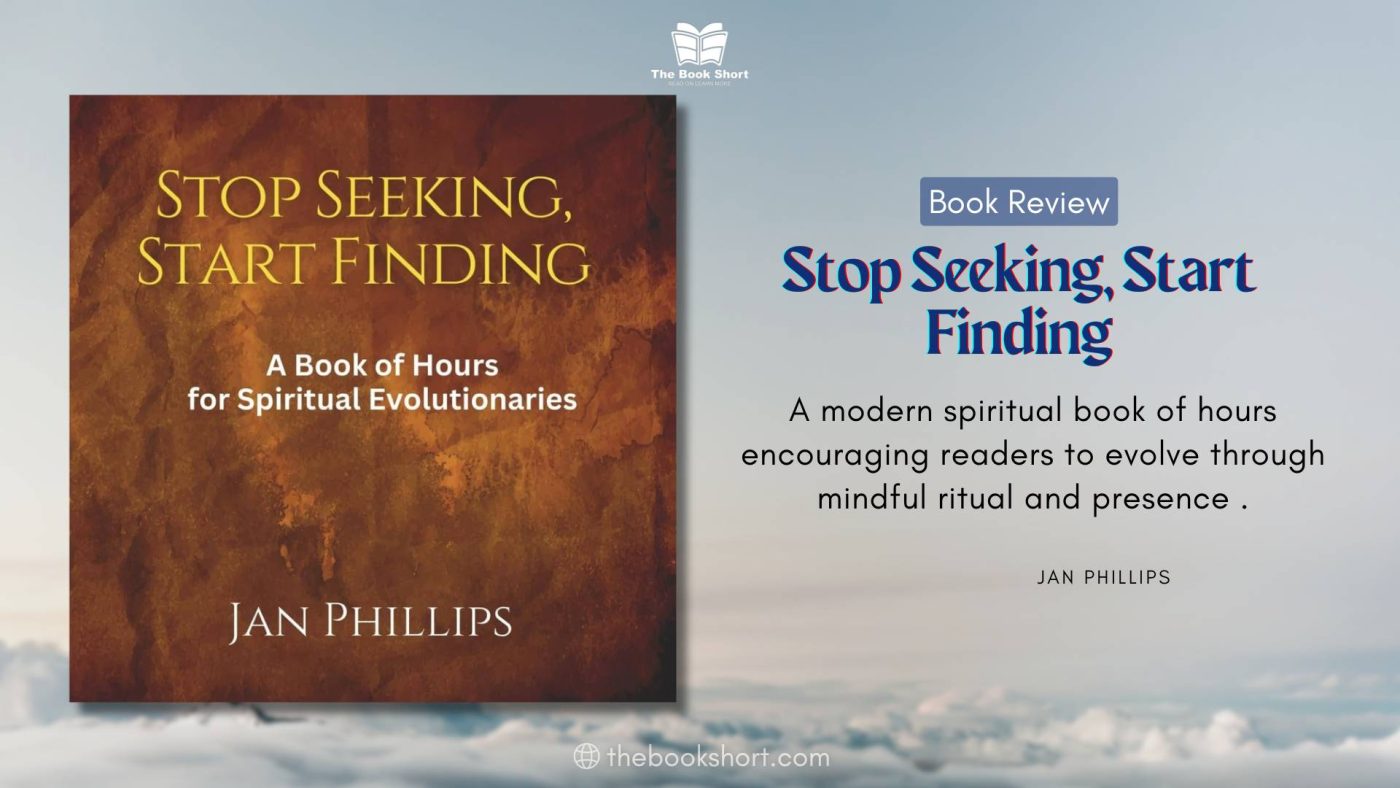
Discover inner peace now. Uncover stillness beyond the search. A review of Jan Phillips’ “Stop Seeking, Start Finding”.
Step off the relentless treadmill of searching and discover the profound richness already present within you. Jan Phillips’ Stop Seeking, Start Finding offers a truly refreshing and fundamentally paradigm-shifting perspective on spirituality and the quest for self-discovery. I chose this book for a deep dive because its very title acts as a gentle yet powerful challenge to a prevalent belief: that happiness, truth, or spiritual fulfillment are elusive goals waiting “out there” to be chased down. The book’s unique and transformative value lies precisely in this radical reorientation – it shifts the focus from external pursuits and future achievements to the simple, immediate recognition of a truth that is ever-present. Phillips suggests that true fulfillment isn’t a distant peak to be scaled, but an ever-available reality waiting patiently to be realized, right here, right now. This seemingly simple reframing is profoundly liberating, inviting readers to pause, breathe, and look inward with fresh, unobstructed eyes, dismantling the lifelong habit of relentless spiritual seeking.
Basic Information About Stop Seeking, Start Finding Book
- Title: Stop Seeking, Start Finding: Cultivating the Will to Awaken
- Author: Jan Phillips
- Year of Publication: 2009
- Genre: Spirituality, Self-Help, Personal Development, Mysticism, Presence, Non-Duality
- Number of pages: Approx. 240 (May vary slightly between editions)
- Target audience: Individuals actively engaged in or disillusioned with traditional spiritual paths; those interested in mindfulness, meditation, and cultivating presence; seekers of inner peace and authentic self-discovery; anyone yearning for a less effortful approach to personal transformation.

Stop Seeking, Start Finding: A Book of Hours for Spiritual Evolutionaries
Exploring the Core Message: Main Content Summary of Stop Seeking, Start Finding
Stop Seeking, Start Finding by Jan Phillips delivers a compelling and compassionate argument against the pervasive notion that spiritual awakening, inner peace, or personal fulfillment are destinations requiring exhaustive searching and striving. Instead, Phillips eloquently posits that the awakened state, the state of wholeness and connection, is our intrinsic nature, always present, simply obscured by the clamor of the conditioned mind and the ingrained habit of pursuing external goals. The book is not structured as a prescriptive, step-by-step manual to “find” something new, but rather as a warm invitation to pause, turn inward, and recognize the boundless truth and stillness that are already here.
At its heart, the book’s message revolves around the understanding that “finding” is fundamentally an act of recognition, not an acquisition. We are already complete, inherently whole, and deeply interconnected with a reality far vaster than our individual seeking minds often grasp. The very process of outward seeking, Phillips suggests, can paradoxically blind us to the ever-present reality we crave. Phillips masterfully weaves together intimate personal anecdotes, timeless insights from various spiritual traditions, evocative poetry, and gentle, practical exercises designed to guide the reader away from the anxious mindset of the ‘seeker’ towards a grounded state of conscious awareness and abiding presence.
The Illusion of Perpetual Seeking
Phillips opens by tenderly exploring the universally human condition of perpetual seeking. We chase happiness, yearn for love, strive for success, grasp for purpose, and even pursue spiritual enlightenment as if these vital aspects of life are objects located somewhere outside ourselves. This outward orientation breeds a persistent sense of lack, creates dependency on fleeting external circumstances, and fuels a gnawing feeling of being “not enough” or “not yet there.” The author argues that this relentless outward search is born from a fundamental misunderstanding of our true nature and the nature of reality itself. The very desire to “find” something implies it is missing, thereby unconsciously reinforcing the illusion of separation and inherent deficiency.
The Shift from Seeking to Finding (Recognition)
The pivotal shift proposed by Phillips is a radical change in perspective. Instead of anxiously asking, “How do I find inner peace, love, or truth?”, the book gently encourages the reader to inquire, “How do I recognize the peace, love, or truth that is already here?” Recognition implies that the reality we seek – whether peace, wholeness, or connection – is already within the field of our awareness, waiting to be unveiled. This profound shift in perception is facilitated by cultivating qualities such as:
- Presence: Deepening awareness of the present moment. Phillips emphasizes that the “finding” doesn’t happen in some future state, but precisely now, in the quiet stillness that underlies the mind’s ceaseless activity.
- Stillness: Learning to gently quiet the mental chatter and emotional turbulence that so often obscures our luminous inner reality. Meditation, contemplative practices, and simply pausing are suggested not as tools to achieve a state, but as ways to be present with reality exactly as it is.
- Letting Go: Releasing the desperate need to control outcomes, intellectually grasp every concept, or force spiritual experiences. Crucially, this includes gently letting go of the very identity of being a “seeker” – the one who is constantly looking for something better or different.
- Trust: Cultivating a deep and abiding trust in the inherent intelligence and flow of life, and in one’s own intuitive inner knowing, rather than solely relying on external authorities, methods, or systems.
Exploring the Rich Inner Landscapes
Once the outward striving and seeking begin to quiet, the book gently guides the reader into exploring various aspects of the inner landscape that reveal themselves in presence:
- The Whispers of the Inner Voice: Learning to discern the difference between the noisy, conditioned mind (the voice of seeking, fear, and the ego’s demands) and the quiet, intuitive wisdom of the “still small voice” (the voice of finding, presence, and inherent truth).
- Embracing the Shadow: Courageously acknowledging and integrating difficult emotions, fears, perceived flaws, and past wounds. Phillips suggests these aspects are not obstacles to be conquered through striving, but integral parts of the whole self to be held in awareness and compassionate acceptance.
- Discovering Authentic Power: Realizing that true, sustainable power arises not from external achievement, control over others, or accumulating possessions, but from deeply aligning with one’s true self and the natural flow of life. This power is quiet, grounded, and distinctly non-striving.
- Love as Being: Understanding love not as a commodity to be sought, earned, or demanded from others, but as an essential, ever-present quality of our own being, fully accessible in the present moment.
- Recognizing Connection: Experiencing the deep, undeniable interconnectedness of all things, which becomes beautifully apparent when the illusion of separation, so often created by the seeking mind, begins to dissolve.
Practical Invitations for Reflection and Presence
While Stop Seeking, Start Finding deliberately avoids being a rigid “how-to” manual, it is woven through with gentle, contemplative exercises and insightful reflections. These are designed not to lead the reader to a future state, but to help them:
- Observe their own ingrained seeking patterns with gentle, non-judgmental awareness.
- Practice cultivating presence and awareness in the midst of their daily lives.
- Tune into and listen for the subtle guidance of their inner wisdom.
- Connect deeply with nature and the simple, often-overlooked beauty of existence as vibrant expressions of the “finding” that is always occurring.
- Engage in reflective journaling to process experiences and deepen insights.
The book’s structure often feels less like a linear progression and more like a series of interconnected meditations or insightful essays. Each chapter or section serves as a gentle nudge, guiding the reader towards a deeper, embodied understanding of the “finding” principle, offering different angles and illuminating how this recognition naturally unfolds in various aspects of life – relationships, creativity, navigating challenges, and experiencing everyday moments. The emphasis remains consistently, beautifully, and powerfully on the eternal now and the inherent completeness that lies dormant beneath the surface of seeking. It’s a book meant to be savored, pondered, and lived with, rather than simply read for information, encouraging a direct, felt experience of the liberating truth it so clearly points towards.
An Editor’s Deep Dive: In-depth Analysis of Stop Seeking, Start Finding
Jan Phillips’ Stop Seeking, Start Finding truly sets itself apart within the crowded spiritual and self-help landscape by directly and courageously challenging the deeply embedded narrative of personal growth as an arduous upward climb or a desperate treasure hunt. Her central thesis is refreshingly, elegantly simple: what we relentlessly seek is, in fact, already and always profoundly present. This fundamental shift in perspective is undoubtedly the book’s most powerful and potentially life-altering contribution. The core message is not about doing more, accumulating more practices, or striving harder to become awakened, but rather about the gentle undoing – dismantling the mental habits, limiting beliefs, and the identity of the seeker that prevent us from recognizing our already-present state of wholeness and awareness.
Key Arguments, Structure, and Thematic Depth
The book’s structure is distinctly thematic rather than strictly linear, a choice that feels deeply resonant with the non-linear, often surprising nature of “finding” or awakening. Chapters flow organically from one to the next, exploring different facets of the central theme from various angles: the insidious nature of seeking, the transformative power of presence, the art of listening to inner guidance, the wisdom inherent in embracing difficulty, and the lived experience of interconnectedness. There are no traditional “characters” in the narrative sense, but Phillips masterfully employs personal anecdotes, intimate stories, and relatable examples to illustrate her abstract concepts, grounding them in shared human experience.
Key arguments woven throughout the text include:
- The Paradox of Seeking: The very act of searching, while seemingly positive, subtly reinforces the underlying belief that something vital is missing, thereby perpetuating an illusion of separation and incompleteness.
- Finding is Recognition: True discovery isn’t about acquiring something new from the outside, but about recognizing, unveiling, and returning to what is already inherently present – our wholeness, our connection to life, our luminous inner presence.
- The Primacy of Presence: The present moment is not merely a point in time but the only dimension where the recognition of our inherent nature and the reality of “finding” can authentically occur, free from the echoes of the past or the projections of the future.
- Innate Inner Guidance: We are equipped with an inherent, trustworthy inner wisdom that can be accessed not by thinking harder, but by gently quieting the mind and learning to listen deeply.
- Life as the Path: Challenges, joys, and the mundane experiences of everyday life are not obstacles to be overcome en route to a spiritual destination, but the very fabric within which the recognition of “finding” naturally unfolds.
Writing Style & Content Quality Analysis
Phillips’ writing style is a significant strength of the book. It is remarkably accessible, deeply lyrical, and profoundly personal. She writes with a gentle, lived-in authority, born not from academic theory but from direct experience, deftly avoiding opaque jargon while seamlessly drawing upon universal spiritual principles shared across traditions. Her language is frequently poetic, employing vivid metaphors drawn from nature, light, and everyday human moments to ground abstract ideas in felt reality. The prevailing tone is one of deep compassion, gentle encouragement, and non-judgment, creating a sense of being seen and understood rather than being instructed or exhorted.
The content quality is exceptionally high. Phillips offers genuinely insightful perspectives that resonate deeply with anyone who has experienced the exhaustion and futility inherent in the endless effort of spiritual or personal striving. She effectively integrates wisdom that echoes through various contemplative traditions without ever getting bogged down in religious dogma, consistently focusing on the universal human experience of striving and the inherent potential for recognizing peace and wholeness. The inclusion of her personal reflections and vulnerabilities adds layers of authenticity, warmth, and profound depth to the message.
What truly makes Stop Seeking, Start Finding stand out from the vast sea of books in the self-help and spirituality genres is this radical, uncompromising pivot from the conventional “how-to get there” approach to a simple, powerful invitation to “how-to be here.” So many books offer practices framed as tools to achieve a desired outcome – reducing stress, becoming happier, reaching enlightenment. Phillips, in contrast, presents presence, wholeness, and awakening not as future states to be achieved, but as the natural, inherent state that already exists, and offers practices as ways to notice or uncover this existing reality by gently letting go of the habit of seeking. She doesn’t provide a formula for enlightenment, but extends a gentle, persistent invitation to cease the exhausting struggle and simply be with what is. This non-striving, recognition-based approach is not only refreshing but potentially far more effective for individuals weighed down by the relentless pressure to constantly improve themselves spiritually.
Representative Concepts from the Book
While quoting directly requires the book, the core essence of Jan Phillips’ transformative message is powerfully captured in concepts that resonate like these:
- “The most intense spiritual seeking often becomes the very veil that obscures the truth already found.”
- “Stop trying so hard to find yourself; you are not lost. You are simply waiting to be recognized.”
- “Authentic spiritual practice isn’t a list of duties; it’s simply showing up fully, moment by moment, for the life unfolding within you.”
- “The treasure you have been seeking across distant lands lies quietly, patiently, within the cave of your own heart.”
These resonant concepts powerfully highlight the book’s essential inward turn and its unwavering emphasis on inherent presence as the ground of being, defining the profound invitation that underpins Phillips’ entire message.
Evaluation & Expert Personal Review of Stop Seeking, Start Finding
Reading Stop Seeking, Start Finding felt less like consuming information or following instructions and much more like settling into a prolonged, gentle, and deeply comforting conversation with a wise, trusted friend who somehow understands the quiet ache of constant striving. My personal impression upon finishing the book, and in reflecting on its message since, has been one of profound relief, spaciousness, and a sense of returning home. The relentless pressure often subtly associated with personal growth – the feeling that you should be meditating more, reading more spiritual texts, attending more workshops, constantly doing something to improve – beautifully dissolves in the face of Phillips’ central, liberating premise.
Key Advantages:
- Profound Simplicity & Depth: The core message is astonishingly simple, yet its implications for how one approaches life, practice, and self-understanding are incredibly deep and far-reaching.
- Accessible, Lyrical Language: Phillips writes with beautiful clarity and often poetic grace, making the book accessible and engaging for a wide audience, regardless of their background in spirituality.
- Compassionate, Non-Judgmental Tone: The writing is consistently gentle, encouraging, and free from dogma or judgment, fostering a powerful sense of acceptance and ease in the reader.
- Transformative Perspective Shift: It offers a truly radical and potentially life-altering shift from the exhausting paradigm of striving to acquire a state to the liberating possibility of simply recognizing the state that already is. This can be a profound balm for spiritual burnout.
- Integration of Daily Life: The book masterfully emphasizes that spirituality and awakening are not separate from the messiness and beauty of daily life, but are found and lived precisely within it.
Minor Considerations:
- Less Structured for Some: Readers accustomed to or seeking a highly structured, step-by-step program with clear actions and measurable goals might find the book’s more thematic, contemplative structure less immediately directive.
- Can Feel Abstract: While Phillips grounds her concepts beautifully, the ideas of “finding” as recognition or the nature of “being” can still feel abstract at times for readers entirely new to contemplative thought or non-dual perspectives.
Readability and Suitability Assessment:
Stop Seeking, Start Finding boasts a high readability level. Phillips’ clear, warm, and often lyrical prose makes it a genuinely enjoyable and contemplative reading experience. It is exceptionally well-suited for:
- Individuals who feel weary, frustrated, or disillusioned with traditional self-help methodologies or spiritual paths that emphasize constant striving and future outcomes.
- Practitioners of mindfulness, meditation, or other contemplative practices who are seeking a deeper theoretical and experiential understanding of the ground from which their practice arises.
- Anyone open to exploring a presence-based, non-dualsitic, or recognition-oriented approach to spirituality that moves beyond the ego’s endless pursuit.
- People yearning for a deeper sense of peace, contentment, and wholeness not as future goals, but as inherent qualities available in the present moment.
Practical Value and Transformational Impact:
The practical value of Stop Seeking, Start Finding resides not in providing a new set of techniques to master or goals to achieve, but in fostering a fundamental, deeply embodied change in mindset and perception. The primary “lesson” the book imparts is the simple, yet profoundly liberating, realization that you don’t need to become someone else, acquire external approval, or gain something external to be inherently whole, complete, or connected to the deepest truths of existence.
- Key Lessons: The central, transformative lesson is the power of presence and the profound nature of finding as recognition. It teaches you to gently turn your attention inward and towards the current moment, trusting that the truth, peace, and connection you seek are already here, within your own being, waiting for you to simply notice them.
- Application in Daily Life: The application of the book’s wisdom is woven into the fabric of everyday existence. It encourages you to learn to pause, observe your ingrained seeking patterns without judgment, and practice simply being present with whatever arises – thoughts, emotions, circumstances – trusting implicitly that what you truly need is not missing, but already present in the unfolding moment.
- Potential for Mindset Shift: The most significant and lasting impact of the book lies in its potential to catalyze a radical shift from a mindset rooted in striving, lack, and future orientation to one grounded in presence, acceptance, gratitude, and the recognition of inherent completeness. It cultivates a gentler, kinder, more trusting relationship with oneself, with others, and with the entirety of life.
It is a book that doesn’t add to your to-do list but invites you to stop doing and simply start being, which is perhaps the most profound and challenging spiritual practice in a world fixated on relentless achievement and external validation.
Contextualizing the Message: Comparison with Similar Books
Stop Seeking, Start Finding occupies a meaningful and distinctive space within the broad landscape of modern spiritual literature that emphasizes presence, mindfulness, and non-duality. While sharing common ground with many such titles, it distinguishes itself significantly through its direct and unblinking critique of the deeply ingrained “seeking” paradigm itself.
Many highly regarded books, while advocating for presence or mindfulness practices, still implicitly or explicitly frame these practices as tools to achieve a desired future state (e.g., reducing stress, cultivating happiness, eventually reaching enlightenment). Phillips, conversely, presents presence, wholeness, and the awakened state not as outcomes of practice, but as the fundamental, natural state of being that already exists. Practices are then reframed as ways to notice, uncover, or remember this existing reality by gently letting go of the very activities and beliefs that obscure it – foremost among them, the habit of seeking.
Compared to foundational texts like Eckhart Tolle’s The Power of Now, which powerfully underscores the critical importance of living fully in the present moment as the key to transcending suffering and mental noise, Phillips offers a slightly different, yet complementary, angle. While Tolle masterfully invites you into the power of presence, Phillips helps you understand why your default human mode is likely one of anxious seeking and provides gentle guidance on how to recognize and rest in the ever-present alternative. She specifically addresses the identity of the seeker and the inherent futility of that particular pursuit.
Compared to more traditionally structured self-help or spiritual “how-to” books, Phillips is markedly less prescriptive. She offers profound insights, asks guiding questions, shares personal reflections, and extends invitations for contemplation rather than providing a detailed, step-by-step plan or program. This makes it less of a manual designed for problem-solving and more of a contemplative guide inviting a shift in perspective and being.
For readers who resonated deeply with Stop Seeking, Start Finding, they might also find profound value and connection in:
- The Power of Now: A Guide to Spiritual Enlightenment by Eckhart Tolle: An essential text exploring the liberation found by identifying with the present moment rather than the thinking mind.
- Stillness Is the Key by Ryan Holiday: While drawing more from Stoic philosophy, this book compellingly explores the universal value and practice of cultivating inner quiet, mental discipline, and presence in a chaotic world.
- Radical Acceptance: Embracing Your Life With the Heart of a Buddha by Tara Brach: Offers a compassionate, mindfulness-based approach to healing emotional pain and fostering freedom, directly addressing the pervasive feeling of being “not enough” through practices of awareness and self-compassion.
- Anything by Adyashanti: A contemporary spiritual teacher whose direct, non-dual teachings frequently address the illusion of the seeking self and point directly to the reality of present-moment awakening.
These complementary texts share themes of presence, inner peace, moving beyond the ego’s limitations, and exploring non-dual reality, offering different voices, depths, and paths into similar transformative terrain. Phillips’ book stands out as a particularly gentle yet unwavering guide in prompting the reader to courageously question the very foundation of their spiritual quest, revealing the peace that was never lost.
Final Thoughts: Conclusion & Recommendations for Stop Seeking, Start Finding Book
Stop Seeking, Start Finding by Jan Phillips delivers a profound, liberating, and ultimately hopeful message: that the peace, joy, wholeness, and fulfillment we so tirelessly seek are not elusive future goals or external acquisitions, but inherent, ever-present aspects of our deepest being, simply waiting to be recognized and lived from. Its outstanding value lies in its courage to directly challenge the deeply ingrained habit of external seeking and its gentle, compassionate guidance in leading the reader back to the boundless wisdom, stillness, and completeness that already reside within.
Is this book worth reading? Absolutely, and emphatically so. It is particularly vital reading for anyone who feels exhausted, discouraged, or disillusioned by the relentless, often-futile pursuit of spiritual or personal development goals. It offers a much-needed pause, a breath of fresh air, and a fundamental, transformative reorientation of one’s approach to life and inner work.
Who should pick up this book? This book is highly recommended for individuals interested in spirituality, mindfulness, meditation, personal growth, or any form of inner exploration who feel open to a perspective that moves decisively beyond traditional striving and goal-oriented approaches. It is perfect for those who harbor a quiet suspicion that perhaps the answers they seek are not located “out there” somewhere in the distance, but are miraculously and profoundly “in here,” waiting to be unveiled.
It is a book that doesn’t burden you with more to do, but instead extends a gentle, radical invitation to simply be more fully present with what already is – a practice that is both simple and, in a striving world, profoundly revolutionary.
Have you read Stop Seeking, Start Finding? What was your experience of its message? Share your thoughts and reflections in the comments below!