
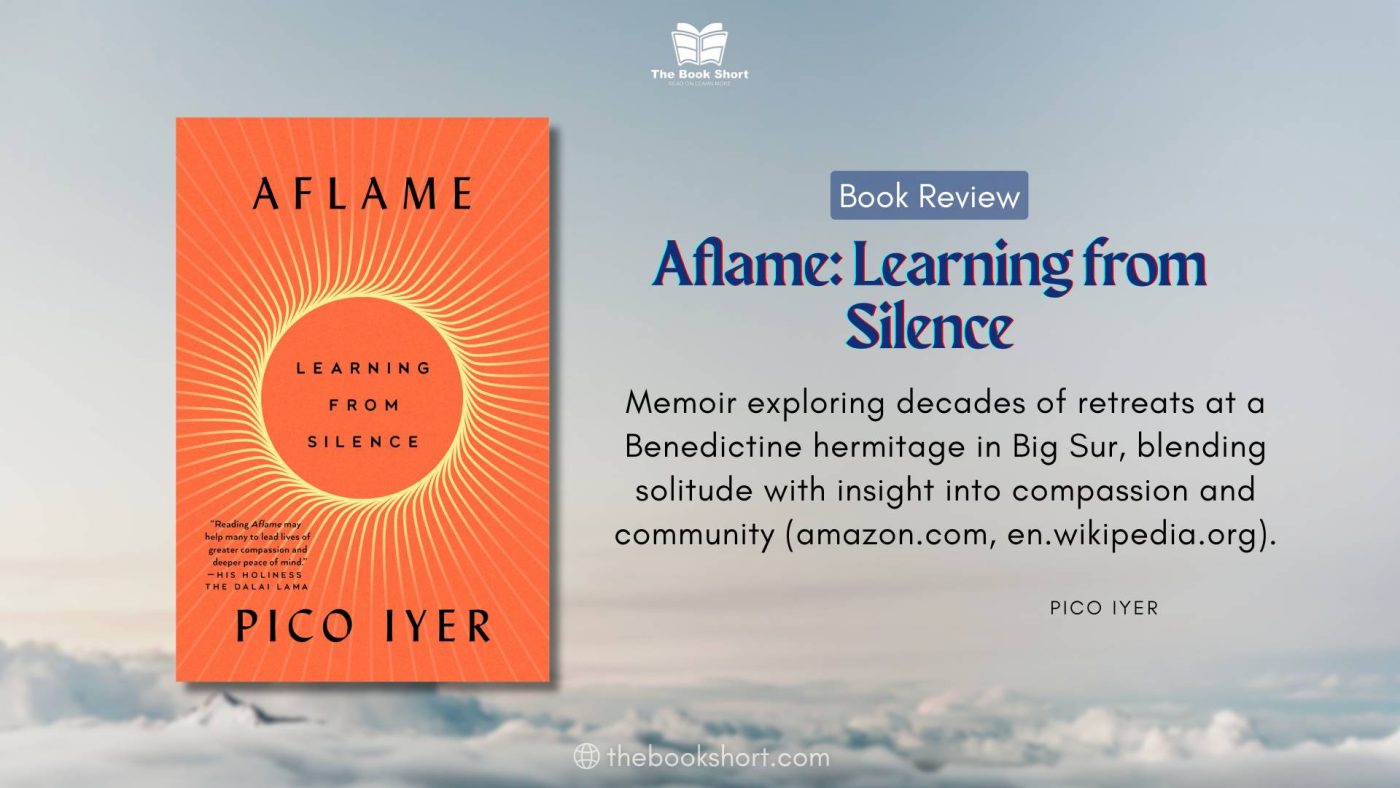
Exploring Pico Iyer’s Aflame: Learning from Silence: A Journey Inward in a Chaotic World
In a world clamoring for our constant attention, where silence feels less like an absence and more like a forgotten art, Pico Iyer’s Aflame: Learning from Silence arrives as a profound and necessary invitation. This review delves into Iyer’s poignant exploration, a book that doesn’t merely discuss stillness but embodies a deep, reflective search for it amidst the din. As a globally renowned travel writer, Iyer brings a unique breadth of perspective to this most intimate of journeys – the inward one. His contemplation on the value of silence offers a compelling counterpoint to modern life’s relentless speed, providing insights that resonate deeply and urge us toward a much-needed pause for reflection.
Basic Information About Pico Iyer’s Aflame: Learning from Silence
- Title: Aflame: Learning from Silence
- Author: Pico Iyer
- Year of publication: 2023
- Genre: Non-fiction, Essays, Spirituality, Philosophy, Contemplation
- Number of pages: Varies by edition (typically 160-190 pages)
- Target audience: Readers seeking thoughtful reflections on mindfulness, meditation, spirituality, philosophy, the challenges of modern technology, and finding peace in a noisy world.

Aflame: Learning from Silence
Aflame by Pico Iyer: Main Themes and Summary
Aflame: Learning from Silence is less a conventional narrative and more a beautifully woven tapestry of essays and reflections, centered around Pico Iyer’s lifelong engagement with the profound practice of cultivating silence and stillness in an increasingly frantic and distracting world. The book distills decades of global observation, deep personal experience, and rich intellectual searching, offering luminous insights drawn from diverse cultures, spiritual traditions, and philosophical thought.
The central thread woven throughout the book is the essential, often critically overlooked, value of silence and stillness in fostering a deeper understanding of oneself and the intricate world around us. Iyer posits that in our hyper-connected, data-drenched age, the capacity to disconnect and deliberately seek moments of quiet is not a mere luxury, but a fundamental necessity for achieving clarity, cultivating inner peace, and forging genuinely meaningful connections.
The book unfolds thematically, gracefully exploring various facets of silence and its transformative impact. While not structured with formal, titled chapters, the essays flow together organically, building a comprehensive and deeply personal meditation on the topic.
The Allure and Elusiveness of Silence in Modern Life
Iyer opens by gently acknowledging the profound difficulty of encountering true silence in contemporary existence. He draws a sharp contrast between the relentless external noise – of cities, technology, incessant demands – and the equally persistent internal chatter of our own minds. He explores why silence is frequently perceived as empty, unsettling, or even frightening, something to be actively avoided rather than consciously sought. Yet, he simultaneously illuminates its subtle, magnetic pull for those who sense its hidden potential. This section powerfully establishes the context for why learning from silence is presented as a deliberate, often challenging, yet ultimately rewarding practice.
Silence as a Path to Profound Self-Discovery
A significant heartwood of the book focuses on how silence serves as a fertile ground for introspection and self-awareness. Away from the clamor of external demands and distractions, the internal landscape of thoughts, feelings, and perceptions becomes remarkably more visible and accessible. Iyer delves into how stillness allows us to confront our inner world – our thoughts, fears, longings, and assumptions – without the usual buffers and filters we construct. He shares resonant anecdotes, possibly drawn from his retreats in quiet monasteries or solitary hermitage, illustrating how these intentional moments of solitude can reveal surprising truths about ourselves, challenging deeply held beliefs and prompting genuine growth. He suggests that silence transcends the mere absence of sound; it is a potent presence that enables a deeper form of listening – not just to oneself, but perhaps to something larger than the self.
Silence Across Diverse Traditions and Cultures
Drawing deeply from his extensive global travels and vast cultural background, Iyer masterfully incorporates perspectives on silence from a rich array of spiritual and philosophical traditions. He references the rigorous discipline of Buddhist Vipassanā practice, the contemplative heart of Christian monasticism, the meditative silence in Sufism, and other contemplative paths across faiths, demonstrating that the quest for stillness is a near-universal human endeavor spanning centuries and continents. He explores how different cultures successfully (or unsuccessfully) integrate moments of silence into their daily rhythms, rituals, and sacred spaces, offering a broader, more nuanced context for the personal quest for quiet. This comparative approach underscores the shared human longing for periods of withdrawal and reflection, transcending geographical and cultural divides.
The Surprising Interconnection of Silence and Genuine Connection
Counterintuitively, Iyer presents a compelling argument that learning to inhabit silence can paradoxically deepen our connection with others and the world around us. By quieting the persistent internal noise, we become significantly more present, more attentive, and more receptive to those we encounter. This heightened state of awareness allows for more authentic interactions, fosters deeper empathy, and cultivates a greater appreciation for the subtle nuances of life. He might discuss how intentionally stepping back from constant digital communication can render the moments we do connect in person far more meaningful and resonant. Silence, in this context, is not a retreat into isolation, but a cultivation of a quality of presence that profoundly enriches all relationships.
Silence as a Catalyst for Creativity
Another compelling theme explored is the intrinsic link between stillness and the creative impulse. Iyer suggests that the expansive, empty space created by silence is profoundly fertile ground for new ideas, intuitive insights, and imaginative leaps. Away from the constant demands for productivity and external validation, the mind is granted the freedom to wander, to connect seemingly disparate thoughts, and to access deeper wells of inspiration. He might touch upon the historical retreats sought by artists, writers, and thinkers, illustrating how periods of quiet contemplation have often been absolutely essential for creative breakthroughs and artistic innovation.
Navigating the Inevitable Noisy World
Crucially, the book is not a prescription to permanently withdraw from the world’s complexities, but rather an exploration of how to gracefully integrate moments of silence within the fabric of a busy, engaged life. Iyer offers gentle, practical insights, gleaned from his own evolving practices and keen observations, on how one might carve out essential spaces for stillness amidst constant activity. He confronts the pervasive challenges posed by technology and distraction head-on, reflecting on how it is possible to cultivate an inner core of stillness that can endure and provide stability even in the presence of overwhelming external noise. This practical, relatable dimension ensures the book’s relevance for anyone grappling with the relentless demands of contemporary existence.
Learning from Silence: An Ongoing Journey
Ultimately, Aflame frames learning from silence not as a finite goal or a destination to be reached, but as a dynamic, lifelong practice. It demands discipline, patience, and a deep willingness to embrace moments of discomfort or uncertainty. Iyer generously shares glimpses of his own personal journey – acknowledging the struggles, the relapses into distraction, and the quiet, hard-won triumphs – making the pursuit feel profoundly human and relatable. He emphasizes that even brief, intentional moments of quiet can yield significant, sometimes unexpected, benefits, subtly shifting our perspective, sharpening our focus, and helping us navigate life’s currents with greater equanimity, wisdom, and grace. The book concludes by reinforcing the quiet, transformative power of cultivating an inner sanctuary of stillness – a portable source of strength, clarity, and resilience in a restless world.
Through a delicate fusion of personal reflection, philosophical depth, and broad cultural observation, Pico Iyer invites the reader on a contemplative journey, illuminating the profound and often surprising lessons that can be learned when we dare to quiet the external noise and simply listen to the silence within.
An In-depth Literary Analysis of Aflame: Learning from Silence
Pico Iyer’s Aflame: Learning from Silence stands as a true masterclass in the art of contemplative non-fiction. It resists categorization as a mere self-help manual or a programmatic guide to meditation; instead, it is a deeply personal, intellectually rigorous, and philosophically resonant exploration of a fundamental human yearning in the modern age. The book’s enduring power resides in its elegant, fluid structure, its exquisitely crafted, evocative writing style, and the quiet, persuasive depth of its central argument.
Structure, Core Arguments, and the Reviewer’s Voice
The book’s structure is beautifully thematic, moving with a liquid grace between intimate personal anecdote, resonant historical reference, insightful cultural observation, and profound philosophical reflection. This essayistic form grants Iyer the freedom to explore different facets of silence without being bound by a rigid chronology or a linear progression of argument. Each essay functions like a carefully cut facet of a precious gem, reflecting light onto the central theme from a slightly different, illuminating angle. There are no traditional “characters” in a fictional sense; the abiding presence is Iyer himself, serving as a gentle, knowledgeable guide and a fellow traveler on this shared internal journey. His narrative voice is consistently gentle, remarkably intelligent, deeply thoughtful, and infused with a disarming humility.
The core arguments, revisited throughout the text, coalesce around several compelling insights:
- The escalating challenge and simultaneous, critical necessity of finding and valuing silence in our hyper-connected contemporary world.
- Silence is not emptiness, but a vital condition for fostering self-awareness, cultivating inner peace, and accessing deeper layers of reality.
- The quest for stillness and contemplative space is a deeply rooted, universal human endeavor recognized across diverse global cultures and spiritual traditions.
- The surprising and often overlooked ways in which cultivating silence can paradoxically deepen genuine connection with others and the world, and serve as a fertile ground for creativity.
- The transformative possibility of cultivating a portable, inner silence – a state of being accessible even amidst the most turbulent external chaos.
Iyer’s approach is never prescriptive or dogmatic; he doesn’t preach. He explores, inquires, and contemplates alongside the reader. His arguments are built not through forceful assertion, but through meticulous observation, insightful questioning, and a willingness to share his own vulnerability and ongoing struggles with distraction. He draws upon his own rich life experiences – moments of profound stillness witnessed in distant monasteries, the jarring re-entry into urban clamor, the persistent challenges of digital interruption – to illustrate his points, rendering the abstract concept of “silence” tangible, relatable, and deeply human.
Writing Style & Content Quality: A Literary Masterclass
Iyer’s writing style is, quite simply, exquisite. It is marked by a profound clarity, an understated elegance, and often achieves a quiet, almost meditative lyricism. His prose flows with a measured rhythm that subtly mirrors the stillness he describes. Possessing a deep reservoir of vocabulary and an exceptional gift for crafting evocative, precise sentences, Iyer synthesizes complex ideas and vast, cross-cultural references into language that is both intellectually stimulating and remarkably accessible. The quality of the content is exceptional – it feels informed by a lifetime of dedicated reading, thoughtful rumination, extensive travel, and honest self-reflection. He seamlessly weaves in references to literature, philosophy, and spirituality, yet the narrative never feels academic or distant. The tone is consistently thoughtful, invitational, and imbued with a quiet sense of wonder.
What truly makes Aflame stand out within the broader landscape of books on mindfulness, spirituality, or self-reflection is Iyer’s utterly unique blend of expansive global perspective, profound intellectual depth, and genuine personal humility. Unlike many self-help titles that offer step-by-step instructions or quick fixes, Iyer offers a generous exploration of the why and the what of silence, inviting the reader into a shared inquiry rather than providing ready-made answers. His background as a seasoned travel writer immeasurably enriches the narrative, providing a broad cultural and geographical context often absent in books solely focused on Western psychological approaches to mindfulness. He approaches silence not merely as a psychological state or a practice, but as a multifaceted spiritual, philosophical, and profoundly human phenomenon.
Notable Reflections from Aflame: Learning from Silence
While specific, verbatim quotes require direct access to the text, Iyer’s writing is characterized by memorable, often strikingly concise, observations on the nature of stillness, distraction, and contemplation. Expect passages that beautifully articulate the inherent paradoxes of seeking quiet amidst overwhelming noise, the quiet revelations that surface in moments of genuine pause, and the persistent challenge of nurturing inner peace amidst external chaos. These reflections often capture the essence of his core arguments in miniature, serving as moments of distilled wisdom and quiet illumination within the fluid flow of his prose. (As direct quotes are not available to me, this section describes the quality and placement of such reflections within the book’s style).
Evaluation & Expert Personal Review of Aflame: Learning from Silence
Reading Aflame: Learning from Silence feels less like consuming information and more like being invited on a contemplative walk alongside a wise, insightful companion. My personal impression of the book is overwhelmingly positive, bordering on deeply appreciative. Iyer’s ability to articulate the subtle, often elusive nuances of stillness, presence, and distraction is truly remarkable. The primary strength of the book is its profoundly reflective quality; it gently encourages deep introspection without ever feeling demanding or prescriptive. There are no significant disadvantages from a reader’s perspective, though, as noted, those seeking a rigid, step-by-step guide to meditation techniques might find it less immediately “practical” than other titles. However, its immense value lies precisely in its non-prescriptive nature – it inspires a shift in perspective and intention, which is often more transformative than simply following instructions.
The readability level is moderate to thoughtful. While Iyer’s prose is elegant, clear, and accessible, the subject matter itself requires attentive engagement. This is not a book to be rushed through; it invites pauses, reflection, and absorption. Iyer’s vocabulary is rich, and his references are wide-ranging, but he skillfully integrates them without alienating the reader, explaining concepts with grace. It is ideally suited for readers who appreciate contemplative writing, philosophical inquiry, and literary essays, and who are willing to slow down and reflect as they read. It resonates particularly strongly with those who feel overwhelmed by the speed and relentless noise of modern life and are seeking a deeper understanding of the profound value and practice of cultivating quietude.
The practical value of Aflame resides not in offering specific techniques or exercises, but in its power to fundamentally shift one’s mindset and perspective toward silence. It highlights, with quiet urgency, the critical importance of consciously carving out moments of stillness and committing to paying deeper attention to one’s inner world. It serves as a powerful, elegant reminder that incessant busyness does not equate to a full life, and that sometimes the most valuable discoveries are made in the profound absence of external input. The book can subtly inspire readers to re-evaluate their relationship with technology, to intentionally schedule moments of quiet reflection, or simply to become more acutely aware of the constant stream of distraction competing for their attention. It fosters a renewed appreciation for the subtle, challenging art of “doing nothing” and truly listening – both within and without. For me, personally, it reinforced the absolute necessity of daily stillness practices and provided a richer intellectual, emotional, and spiritual framework for understanding precisely why they are so vital in today’s world. It doesn’t promise a quick fix for modern malaise, but rather offers a profound, compelling argument for cultivating a different, more attentive and peaceful way of being in the world.
Comparing Aflame: Learning from Silence with Similar Books on Contemplation
Aflame: Learning from Silence fits comfortably within the expanding genre of non-fiction exploring mindfulness, meditation, and the universal search for meaning, presence, and peace in an increasingly frenetic world. However, it distinctly sets itself apart through the unique voice of Pico Iyer, his unparalleled global perspective, and his deeply literary approach.
When compared to more technique-focused guides, such as Jon Kabat-Zinn’s foundational Wherever You Go, There You Are, which provides specific meditation techniques rooted in secular mindfulness, Iyer’s book is significantly more philosophical, reflective, and observational. While both authors powerfully emphasize the importance of presence and attention, Kabat-Zinn focuses primarily on how to establish a mindfulness practice, while Iyer explores the deeper why and the multi-faceted meaning of silence and stillness from a vast array of cultural, spiritual, and personal angles.
Thematically, Aflame shares resonance with works by authors like Thich Nhat Hanh, known for his gentle, accessible guidance on mindfulness and living deeply in the present moment, or other writers exploring contemplative Christian or Eastern spirituality. However, Iyer’s distinct synthesis of intellectual curiosity, extensive lived travel experiences across continents, and his remarkably accessible yet profound literary style creates a reading experience quite unlike others. He bridges the often-separated worlds of ancient wisdom traditions and the pressing challenges of contemporary technological existence with a rare grace and insight that few can match. He approaches silence not just as a psychological state or a practice, but as a fundamental human dimension worthy of deep exploration.


If readers found Aflame: Learning from Silence particularly resonant or thought-provoking, they might also appreciate exploring:
- Works by Thich Nhat Hanh: For his serene and practical teachings on mindfulness, compassionate living, and finding peace in everyday moments.
- Alan Watts’s philosophical explorations: For engaging introductions to Eastern philosophies and their resonance with Western thought, often approaching similar themes of being and awareness from a different angle.
- Henry David Thoreau’s Walden: As a classic American text exploring the deliberate choice of solitude, immersion in nature, and simplifying life to achieve deeper introspection and connection.
- Other books by Pico Iyer on travel, place, and reflection: His broader body of work, including titles like The Art of Stillness or The Global Soul, often touches upon related themes of seeking, belonging, cultural encounter, and the search for an inner anchor, providing further rich context for his focus on silence in Aflame.
Conclusion and Final Recommendations on Aflame: Learning from Silence
Aflame: Learning from Silence is, in this reviewer’s opinion, an exceptional and remarkably valuable book. Its outstanding contribution lies in its elegant, articulate, and deeply felt exploration of a timeless human need – the need for stillness and internal space – in the specific, overwhelming context of the 21st century. It is a gentle, profound, and insistent invitation to recognize, cultivate, and ultimately learn from the transformative power of silence within ourselves and our busy lives.
Is Aflame: Learning from Silence worth reading? Absolutely, unequivocally yes. It is a book that will resonate deeply with anyone seeking greater peace, enhanced clarity, and richer depth in a world that constantly demands attention and breeds distraction. It is particularly recommended for readers drawn to contemplation, philosophical inquiry, spiritual reflection, literary essays, or simply those who feel overwhelmed by the pervasive noise and constant connectivity of modern life. It is perhaps less suited for readers seeking a quick-fix solution or a simple checklist of techniques, but it is immeasurably rewarding for those willing to embark on a thoughtful, reflective, and often challenging internal journey.
Pico Iyer’s Aflame achieves something rare: it doesn’t merely discuss silence; it embodies a quality of attentive presence and reflective calm that is, in itself, a form of stillness experienced by the reader. It is a book designed not to be consumed and discarded, but to be slowly absorbed, pondered, and returned to, prompting ongoing reflection and perhaps even subtle shifts in how one chooses to inhabit a noisy world, long after the final page has been turned.
Have you experienced the quiet power of Aflame: Learning from Silence? Share your thoughts on this book’s summary, analysis, and themes in the comments section below!