
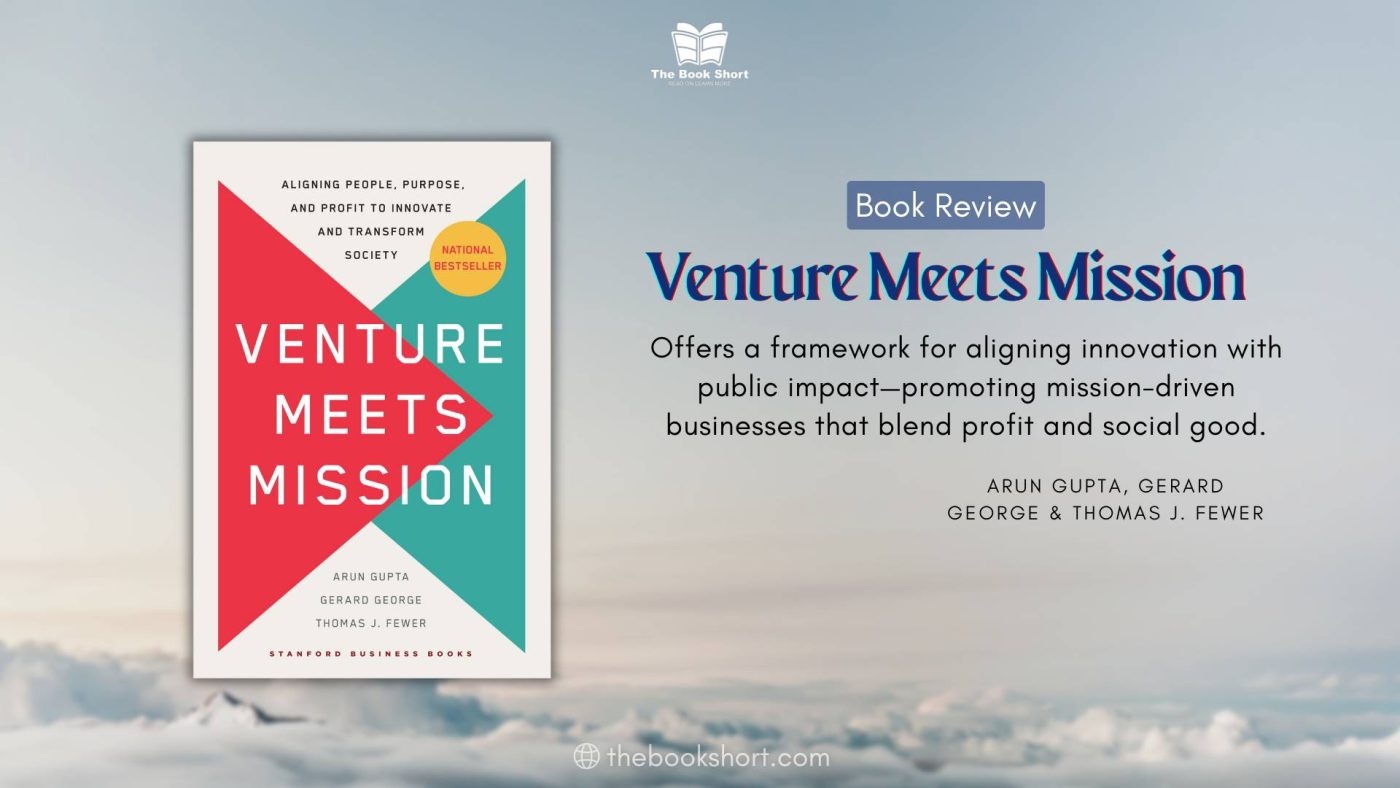
A groundbreaking model for solving society’s grandest challenges. This Venture Meets Mission book review explores a new framework for uniting profit with purpose.
Can venture capital solve society’s biggest problems? Venture Meets Mission argues it can, outlining a powerful model that merges the velocity of startups with the scale of public missions to build a better future. In a sea of business books, I chose this one for a deep analysis because it offers a rare, actionable playbook for collaboration between two worlds often seen at odds: profit-driven ventures and purpose-driven government. Its unique value isn’t in abstract ideals, but in a concrete framework for tackling civilization-level challenges like climate change, pandemics, and national security, making it essential reading for innovators in any sector.
Venture Meets Mission: Key Book Information
- Title: Venture Meets Mission: A New Model for Deep Tech and Social Impact
- Authors: Arun Gupta, Gerard George & Thomas J. Fewer
- Year of Publication: 2023
- Genre: Business, Entrepreneurship, Public Policy, Social Impact
- Number of Pages: 336
- Target Audience: Entrepreneurs, venture capitalists, policymakers, public sector leaders, academics, and anyone passionate about social innovation and deep tech.

Venture Meets Mission: Aligning People, Purpose, and Profit to Innovate and Transform Society
Venture Meets Mission Book Summary: A Deep Dive
Venture Meets Mission presents a compelling and timely thesis: the most potent path to solving humanity’s grand challenges lies in forging a symbiotic alliance between mission-driven government and the agile, capital-fueled engine of entrepreneurship. Drawing from their extensive experience across venture capital, academia, and public service, the authors introduce the “Venture Meets Mission” (VMM) model—a comprehensive framework designed to align these two powerful, yet disparate, forces.
The Core Thesis: Bridging Two Worlds
At its heart, the book diagnoses a fundamental disconnect. Both the public and private sectors possess complementary strengths but are hobbled by their respective weaknesses, often failing to connect effectively.
- Governments and Public Institutions: Command a deep understanding of large-scale societal problems (“missions”), operate on long-term horizons, and control significant resources. Yet, they are frequently slow, risk-averse, and mired in bureaucracy, stifling the pace of innovation.
- Venture-Backed Startups: Are masters of speed, agility, and calculated risk. They excel at developing disruptive technology and scaling solutions with breathtaking velocity. However, they are typically governed by short-term financial returns and can lack the direction or stamina to tackle complex, long-horizon public needs.
The VMM model is engineered to be the bridge, fostering “dual-use” ventures that can simultaneously generate outstanding financial returns and address a critical public mission.
The VMM Framework Explained
The book is meticulously structured around the VMM model, which is presented not as a mere theory but as a practical, operational guide. It deconstructs the process of creating and scaling mission-driven ventures into actionable stages, illuminated by insightful case studies.
Part 1: Identifying the Mission
The model’s foundation is the “mission.” This is not a vague hope but a clearly defined, large-scale problem that a government is committed to solving. The authors stress the importance of pinpointing challenges where a market-based, technological solution can create a transformative impact. These missions are often found in sectors such as:
- National Security and Defense
- Public Health and Life Sciences
- Climate Tech and the Energy Transition
- Space Exploration and Infrastructure
- Education and Workforce Development
The key is to identify missions where the government can act not just as a regulator, but as a crucial first customer or anchor partner, providing a stable “demand signal” for innovation.
Part 2: Building the Venture
With a mission identified, the focus shifts to architecting a venture capable of meeting the challenge. This requires far more than a clever idea; it demands a mastery of the “deep tech” often necessary to solve these problems. The authors persuasively argue that mission-driven ventures are a different species from typical consumer-facing startups. They require:
- Patient Capital: Investors who grasp the long development cycles and are genuinely aligned with the dual-use mission.
- Profound Technical Expertise: Founders and teams with PhD-level knowledge in fields like AI, quantum computing, biotechnology, or advanced materials.
- Bureaucratic Fluency: An ability to navigate the complex worlds of government contracts, regulatory pathways, and public-sector stakeholders.
The book powerfully illustrates these points with case studies of companies like SpaceX (redefining space exploration), Moderna (revolutionizing public health response), and Anduril (transforming defense technology), presenting them as premier examples of ventures that masterfully aligned commercial ambition with a national mission.
Part 3: The Ecosystem—Where Venture Meets Mission
The true power of the VMM model is unleashed within a deliberately cultivated ecosystem. The authors argue that success hinges not on a single heroic company or government agency, but on a collaborative network where every stakeholder can thrive. The key players in this ecosystem include:
- Mission-Driven Entrepreneurs: The visionary founders building the companies.
- Venture Capitalists: The investors providing risk capital, strategic oversight, and network access.
- Government Agencies: Acting as anchor customers, providing non-dilutive funding (grants, contracts), and articulating the mission’s ultimate goals.
- Universities and Research Labs: The wellspring of foundational research and deep-tech talent.
- Established Corporations: Who can serve as strategic partners, commercial customers, or acquirers for the startups.
The book details how these actors must coordinate to create a virtuous cycle of innovation and impact. A government agency, for instance, can de-risk a nascent technology for VCs by providing early-stage research grants, while VCs can help a startup scale with a speed no traditional government contractor could ever match.
Venture Meets Mission Book Analysis: Themes and Arguments
Venture Meets Mission is more than a business guide; it’s a strategic manifesto for a new era of public-private innovation. Its analysis reveals a meticulously constructed argument that challenges the conventional, often cynical, wisdom about the roles of government and the private sector.
Structure and Key Arguments
The book’s primary strength is its architectural clarity, built around the VMM framework. It moves with compelling logic from the “why” (the problem of siloed innovation) to the “what” (the VMM model) and the “how” (rich case studies and actionable steps), making a complex subject both digestible and inspiring.
Key Argument 1: The Government as a Market-Maker, Not Just a Regulator.
Unlike narratives that cast government as a bureaucratic impediment, Venture Meets Mission reframes its role as a powerful catalyst. By serving as a predictable, large-scale first customer for deep-tech solutions, the government can effectively create entirely new markets from scratch. This powerful “demand signal” gives venture capitalists the confidence to back high-risk, long-term projects, knowing a viable path to revenue exists. This is a profound departure from the libertarian view of the state and a far more practical take than simply calling for more grants.
Key Argument 2: Dual-Use is the Strategic Sweet Spot.
The conceptual core of the VMM model is the “dual-use” venture—a company with both a thriving commercial market and a direct application for a public mission. This argument is vital because it ensures sustainability. A venture solely dependent on government contracts is fragile and politically vulnerable. A venture that also serves commercial customers is more resilient, more innovative, and ultimately more scalable. The authors masterfully use examples like Palantir and SpaceX to demonstrate how commercial success fuels their ability to serve mission-critical needs, and vice versa.
Writing Style and Content Quality
The authors’ collective authority radiates from every page. The writing is:
- Authoritative: The text is deeply rooted in data, historical precedent (tracing Silicon Valley’s origins to defense spending), and direct, hard-won experience. It avoids platitudes in favor of concrete evidence.
- Accessible: Despite tackling complex topics like government procurement and deep-tech science, the language is remarkably clear and direct. The authors skillfully employ analogies and well-chosen case studies to demystify the process.
- Prescriptive: This is no mere academic observation. The book provides clear, targeted advice and even checklists for each stakeholder in the ecosystem—what entrepreneurs must do, how VCs must adapt, and how policymakers can cultivate these vital innovation hubs.
What truly elevates the book is its optimistic yet pragmatic tone. It unflinchingly acknowledges the immense difficulty of its proposals but provides a hopeful and credible path forward. It distinguishes itself from purely academic texts by being intensely practical, and from typical startup books by its grander, societal vision.
Core Ideas from the Book
The essence of the book’s message can be captured in its core principles:
- The next great wave of economic value will be created by solving society’s most intractable problems. The question is not if it can be done, but who will build the ecosystem to do it.
- A government contract can be the most powerful form of non-dilutive funding an entrepreneur can receive. It isn’t just capital; it’s market validation at the highest level.
- For the VMM model to succeed, venture must learn the language of mission, and mission must learn the speed of venture. This highlights the central theme of a necessary cultural and operational fusion between two worlds.
Personal Review of Venture Meets Mission: Is It Worth Reading?
Venture Meets Mission is one of those rare books that feels both profoundly timely and destined to be timeless. It delivers a compelling and, crucially, an optimistic and actionable framework for tackling problems that too often feel insurmountable.
Advantages and Strengths
- A Genuinely New and Actionable Blueprint: The VMM model is the book’s crown jewel. It is not a theoretical abstraction but a working model, brought to life with vivid, real-world examples that make the concepts tangible.
- Unimpeachable Credibility: The authors are seasoned practitioners and experts in the fields they cover. This is an insider’s guide, not an outsider’s critique, which lends immense weight and authenticity to its recommendations.
- A Pragmatic, Balanced Perspective: The book masterfully avoids ideological traps. It is neither a call for unbridled state control nor a free-market libertarian fantasy. It champions a wise synthesis that leverages the distinct strengths of both the public and private sectors.
- Deeply Action-Oriented: Every reader, regardless of their background, will find specific, actionable takeaways. An entrepreneur will discover how to court government partnership, a policymaker will learn to design smarter innovation programs, and an investor will see a new thesis for generating both alpha and impact.
Potential Disadvantages
- Specialist Language for a Universal Message: While its themes are universal, the detailed discussions of venture capital, deep tech, and government procurement may prove dense for a general reader. Its primary audience consists of those already operating within or adjacent to these fields.
- US-Centric Examples: While the principles are globally applicable, many of the cornerstone case studies (DARPA, In-Q-Tel, NASA) are American. International readers will need to translate the concepts into their own national and political contexts.
Readability and Suitability
The book is exceptionally well-written and logically organized, making it highly readable for its target audience. The frequent and well-told case studies prevent the complex material from ever feeling dry or academic.
This book is essential reading for:
- Entrepreneurs in deep tech, gov-tech, climate tech, and biotech.
- Venture Capitalists and Investors searching for the next frontier of impactful, high-growth opportunities.
- Policymakers and Public Servants tasked with driving national innovation and solving public challenges.
- Academics and Students of business, public policy, and technology innovation.
- Corporate Strategy Leaders in legacy industries (e.g., defense, energy, pharma) seeking to partner with the next generation of disruptors.
Practical Value and Mindset Shift
The practical value here is immense, offering a shared language and a clear roadmap for public-private collaboration. Yet its most significant contribution may be the profound mindset shift it fosters: viewing government not as a bureaucratic hurdle but as a market-defining partner, and seeing societal crises not as charity cases but as the greatest business opportunities of our generation. It inspires a powerful belief that profit and purpose are not in opposition, but can be the two engines of a single, world-changing vehicle.
Venture Meets Mission vs. Other Books on Innovation
Venture Meets Mission carves out a unique and vital space in the canon of literature on innovation, business, and public policy. Here’s how it dialogues with other influential titles:
- vs. “The Lean Startup” by Eric Ries: If The Lean Startup provides the tactical methodology for how to build a company efficiently (MVP, pivot, iterate), Venture Meets Mission provides the strategic context for which companies to build. It answers the “why” on a societal scale, making it a perfect strategic companion. You use Lean Startup principles to build the VMM venture.
- vs. “Mission Economy” by Mariana Mazzucato: Mazzucato’s landmark book makes the powerful case for a mission-oriented approach led by a confident, “entrepreneurial state.” Venture Meets Mission is the essential sequel, providing the detailed operational playbook for how the venture capital world can—and must—plug into that state-led mission. It is the “how-to” guide for Mazzucato’s “what-if.”
- vs. “The Innovator’s Dilemma” by Clayton Christensen: Christensen brilliantly explains why successful, large organizations (both corporate and government) consistently fail to innovate. Venture Meets Mission offers an elegant solution: these large organizations don’t have to do all the innovating internally. Instead, they can partner with and empower an external ecosystem of agile startups to solve their most pressing problems for them.


If you found value in “Venture Meets Mission,” you might also enjoy:
- “The Entrepreneurial State” by Mariana Mazzucato: For a deeper historical dive into the government’s pivotal role in funding nearly every major technological breakthrough.
- “Loonshots” by Safi Bahcall: For a fascinating exploration of how to nurture fragile, radical ideas (“loonshots”) within large organizations, a theme that resonates deeply with the VMM model.
- “Zero to One” by Peter Thiel: For a venture capitalist’s incisive perspective on building monopolistic companies that create entirely new markets—the ultimate goal of many ambitious, mission-driven ventures.
Conclusion: Final Thoughts on the Venture Meets Mission Book
Venture Meets Mission is a landmark work that delivers a powerful, optimistic, and urgently needed message for our time. Its genius lies in creating a common language and a practical framework—the VMM model—to finally unite the entrepreneurial dynamism of venture capital with the scale and purpose of public missions. It masterfully reframes our greatest societal challenges not as burdens to be borne, but as the defining innovation opportunities of the 21st century.
Is it worth reading? Absolutely. For anyone working at the intersection of technology, finance, and public policy, this book is not merely recommended; it is essential. It provides a credible and inspiring roadmap for building a more prosperous, secure, and resilient future.
Who should read it? This book is for the builders: the innovators, investors, and public leaders who refuse to accept that our biggest problems are unsolvable. If you believe in the power of technology to serve humanity and are looking for a blueprint to make it happen, this book is for you.
Have you read this book? Share your thoughts in the comments below.