
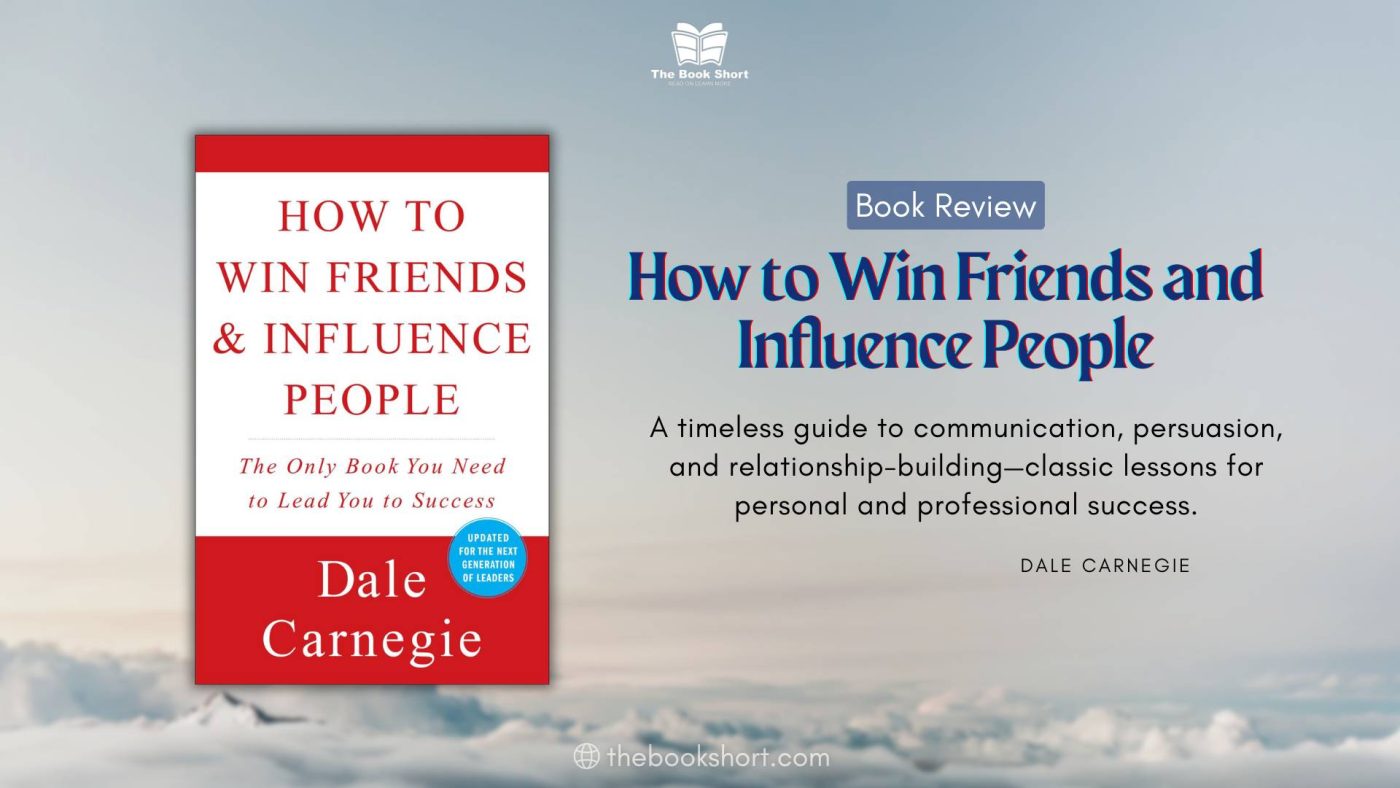
A timeless guide to human relations, this How to Win Friends and Influence People book review decodes Dale Carnegie’s enduring wisdom for a modern world. Ready to unlock the secrets to social grace and genuine influence? Dale Carnegie’s masterclass in human interaction isn’t just another self-help book; it’s the foundational text on which the entire genre was built.
How to Win Friends and Influence People: Book at a Glance
- Title: How to Win Friends and Influence People
- Author: Dale Carnegie
- Year of publication: 1936
- Genre: Self-help, Personal Development, Psychology
- Number of pages: Approximately 288 (varies by edition)
- Target audience: Anyone—from students and young professionals to seasoned leaders and parents—seeking to build more meaningful and effective relationships in their personal and professional lives.

How to Win Friends & Influence People (Dale Carnegie Books)
A Comprehensive Summary of How to Win Friends and Influence People
Dale Carnegie’s How to Win Friends and Influence People is less a book and more a life-altering toolkit for mastering the art of human connection. Born from the crucible of the Great Depression, its principles have not only survived but thrived, proving remarkably resonant today. The book rests on a revolutionary premise: you can change how people behave toward you by simply changing how you behave toward them. Carnegie elegantly unpacks this philosophy across four parts, each brimming with actionable principles and illustrated by unforgettable stories.
Part One: Fundamental Techniques in Handling People
This section establishes the bedrock of Carnegie’s entire philosophy. Before you can win a friend or influence a colleague, you must first master your own conduct. Carnegie argues that we are not creatures of logic, but creatures of emotion, driven by a profound, often-unspoken desire to feel significant. Therefore, every meaningful interaction must honor this core human need.
- Principle 1: Don’t criticize, condemn, or complain. Carnegie asserts that criticism is a fool’s errand. It instantly puts people on the defensive, forcing them to justify their actions. It deals a blow to their pride, injures their sense of importance, and ignites a resentment that can last a lifetime. Instead of condemning, we must strive to understand.
- Principle 2: Give honest and sincere appreciation. The deepest craving in human nature is the desire to be appreciated. Carnegie draws a sharp line between hollow flattery and genuine appreciation. Flattery is counterfeit and easily detected, but sincere appreciation nourishes this fundamental human hunger, making people feel seen and valued, and thus far more open to you.
- Principle 3: Arouse in the other person an eager want. This is the secret of all influence. To persuade someone, you must stop talking about what you want and start speaking their language. Show them how to get what they want. By aligning your goals with their deepest desires, you don’t have to push; they will be naturally motivated to join you.
Part Two: Six Ways to Make People Like You
With the foundation laid, this part offers specific, practical techniques for becoming a more likable and magnetic person. The secret, Carnegie reveals, isn’t about being witty or impressive; it’s about shifting your focus entirely onto the other person with genuine curiosity.
- Principle 1: Become genuinely interested in other people. As Carnegie famously wrote, you can win more friends in two months by becoming interested in them than you can in two years by trying to get them interested in you.
- Principle 2: Smile. A warm, authentic smile is a universal ambassador of goodwill. It costs nothing yet creates an immediate sense of warmth and approachability.
- Principle 3: Remember that a person’s name is to that person the sweetest and most important sound in any language. Using someone’s name is a subtle yet profound acknowledgment of their individuality. It says, “I see you.”
- Principle 4: Be a good listener. Encourage others to talk about themselves. One of the surest paths to another’s heart is to simply listen. Ask thoughtful questions they’ll enjoy answering and give them the space to share their stories and triumphs.
- Principle 5: Talk in terms of the other person’s interests. Discover what truly animates someone—their passions, hobbies, or concerns—and engage them on that subject. You will capture their undivided attention and earn their gratitude.
- Principle 6: Make the other person feel important – and do it sincerely. The ultimate Golden Rule of relationships: treat others how you wish to be treated. Actively look for something to admire in every person and communicate their importance with genuine sincerity.
Part Three: How to Win People to Your Way of Thinking
Here, Carnegie transitions from building rapport to the delicate art of persuasion. His method isn’t about winning arguments or proving points; it’s about gently guiding people to your viewpoint in a way that preserves their dignity and makes them feel like a willing partner in the conclusion.
The core principles include:
- The only way to get the best of an argument is to avoid it entirely.
- Show respect for the other person’s opinions. Never start with, “You’re wrong.”
- If you are wrong, admit it quickly, openly, and emphatically.
- Begin every interaction in a friendly way.
- Get the other person saying “yes, yes” from the outset.
- Let the other person do a great deal of the talking.
- Let the other person feel that the idea is theirs.
- Try honestly to see things from the other person’s point of view.
- Be sympathetic with the other person’s ideas and desires.
- Appeal to the nobler motives.
- Dramatize your ideas to make them vivid and compelling.
- Throw down a challenge to inspire action.
Part Four: Be a Leader: How to Change People Without Giving Offense or Arousing Resentment
This final section is a masterclass in transformational leadership. It provides a blueprint for giving feedback, correcting errors, and inspiring improvement, all while protecting the other person’s ego and making them want to change.
Key principles for effective leadership include:
- Begin with praise and honest appreciation.
- Call attention to people’s mistakes indirectly.
- Talk about your own mistakes before criticizing the other person.
- Ask questions instead of giving direct orders.
- Let the other person save face.
- Praise the slightest improvement and praise every improvement. Be “hearty in your approbation and lavish in your praise.”
- Give the other person a fine reputation to live up to.
- Use encouragement. Make the fault seem easy to correct.
- Make the other person happy about doing the thing you suggest.
In-depth Analysis: Themes and Style in Carnegie’s Classic
How to Win Friends and Influence People has achieved a mythic status that few books, let alone in the self-help genre, ever do. Its incredible longevity is no accident; it’s the result of timeless wisdom delivered with an unparalleled, human touch.
Structure & Key Arguments
The book is meticulously engineered as a practical toolkit for life. Its division into four logical parts, each with clearly numbered principles, makes the content remarkably easy to absorb, recall, and—most crucially—apply. Each principle is a self-contained lesson, following a powerful formula: state the rule, explain the psychology behind it, and then bring it to life with a cascade of real-world stories.
Carnegie’s central argument is both simple and profound: empathy is the ultimate currency of influence. He argues that real influence is born not of dominance or debate, but from a genuine, wholehearted effort to understand and validate another person’s world. He systematically dismantles the ego’s desire to be “right” and replaces it with the far more effective goal of being connected and respected. This is what sets the book apart from aggressive negotiation tactics; Carnegie teaches a “win-win” philosophy where both parties leave an interaction feeling better.
The book’s structure masterfully reinforces this ethos. By starting with “Handling People” and “Making People Like You,” Carnegie drills home the point that rapport is the non-negotiable prerequisite for persuasion or leadership. You must first connect before you can correct or convince.
Writing Style & Content Quality
Carnegie’s prose is perhaps the secret ingredient to the book’s magic. It is conversational, direct, and utterly devoid of pretense. He writes like a trusted mentor sharing hard-won wisdom over a cup of coffee, free from academic jargon or dense theory. He speaks a universal language.
His genius lies in his masterful use of the anecdote. The book is a treasure chest of stories, featuring historical titans like Abraham Lincoln, business magnates like Charles Schwab, and ordinary people from his own seminars. This narrative approach is brilliant for two reasons:
- It makes the principles indelible. You might forget the rule “Arouse in the other person an eager want,” but you’ll never forget the story of the child convinced to love kindergarten by being allowed to “paint” the chairs with a bucket of water.
- It provides irrefutable social proof. By weaving in stories of respected figures, Carnegie demonstrates that these principles aren’t just quaint ideas; they are field-tested strategies used by the most successful people in history.
While some of the examples—written in an era of formal letters and switchboard operators—may feel dated, the psychological truths they illustrate are as potent today as they were in 1936. The book’s quality is rooted in this timelessness.
Notable Quotes from the Book
The book is a goldmine of phrases that have become part of our cultural lexicon, perfectly capturing its philosophy:
- “You can make more friends in two months by becoming genuinely interested in other people than you can in two years by trying to get other people interested in you.”
- “When dealing with people, let us remember we are not dealing with creatures of logic. We are dealing with creatures of emotion, creatures bristling with prejudices and motivated by pride and vanity.”
- “Any fool can criticize, condemn and complain – and most fools do. But it takes character and self-control to be understanding and forgiving.”
- “The only way to get the best of an argument is to avoid it.”
- “A person’s name is to that person the sweetest and most important sound in any language.”
Personal Review: Is How to Win Friends and Influence People Still Relevant?
To read How to Win Friends and Influence People for the first time is a revelation. To reread it is a humbling reminder of how simple and yet how easily we forget the fundamentals of human connection. My overwhelming impression is one of profound respect for a guide that has remained so vital for nearly a century.
Advantages:
The book’s greatest strength is its radical practicality. Carnegie provides a clear, actionable roadmap, not just abstract theory. The principles are intuitive and can be put into practice the moment you set the book down. Its unwavering emphasis on sincerity and genuine interest gives it a powerful ethical core, steering readers toward authentic connection, not cynical manipulation. The storytelling makes it an absolute joy to read.
Disadvantages:
If there’s a flaw, it lies in its vintage. Some language and scenarios feel quaint. More importantly, the book’s greatest strength is also its potential weakness: it assumes the reader has good intentions. A cynical person could wield these techniques as a set of superficial tricks for personal gain, stripping them of the sincerity Carnegie insists upon. The principles are a powerful tool, and like any tool, they can be used to build or to break.
Readability and Suitability:
The book is exceptionally readable. With simple language and short, focused chapters, it’s accessible to absolutely everyone. This should be required reading for:
- Young professionals learning to navigate the workplace.
- Leaders and managers who want to inspire rather than command.
- Anyone in sales or customer service whose success depends on rapport.
- Frankly, anyone who wants to build stronger, happier relationships with their friends, family, and community.
Practical Value & Change in Mindset:
The practical value here is immeasurable. When applied with sincerity, these lessons can fundamentally rewire how you move through the world. The book forces a paradigm shift from a self-centered perspective (“What do I need?”) to an other-centered one (“What do they need? How can I help them achieve it?”). This single shift transforms combative arguments into collaborative problem-solving and turns strangers into allies. Applying principles like admitting your own faults first, sidestepping criticism, and offering genuine appreciation can dissolve conflict and build deep reservoirs of goodwill in every corner of your life.
Carnegie’s Book vs. Other Self-Help Classics
How to Win Friends and Influence People is the patriarch of the modern self-help genre, creating the blueprint so many have followed. Its unique place in the canon becomes clear when compared to other giants.
- Compared to The 7 Habits of Highly Effective People by Stephen R. Covey: Covey’s work is a holistic philosophy for life, focused on building an effective character from the inside out (“Private Victory”) before tackling interpersonal relationships (“Public Victory”). Carnegie’s book is a deep dive specifically into the mechanics of that “Public Victory.” If Covey gives you the compass and map for your life’s journey, Carnegie teaches you how to be the best possible travel companion to others. They are perfect complements.
- Compared to Influence: The Psychology of Persuasion by Robert Cialdini: Cialdini’s book is a rigorous, scientific breakdown of the psychological triggers that make persuasion work (reciprocity, scarcity, etc.). It’s a book about the science of why we say yes. Carnegie’s is a practical field guide based on observation and narrative. Cialdini explains the anatomy of influence; Carnegie teaches the art of its application.
If you liked How to Win Friends and Influence People, you might also enjoy:
- The 7 Habits of Highly Effective People by Stephen R. Covey for a profound framework on personal character and effectiveness.
- Never Split the Difference by Chris Voss for a modern, high-stakes masterclass on negotiation.
- Dare to Lead by Brené Brown for a powerful, contemporary look at leadership rooted in vulnerability and empathy.
Final Verdict: A Must-Read Book on Human Relations
Nearly a century after its debut, How to Win Friends and Influence People remains an essential, unparalleled guide to the art of connecting with our fellow human beings. Its value lies in its simple, timeless, and profoundly decent principles. Dale Carnegie demystifies human relations, offering a clear and ethical roadmap to building stronger relationships, becoming a more inspiring leader, and navigating our complex social world with grace and confidence.
Is it worth reading? Without a doubt. It’s more than a book; it’s an investment in a better version of yourself.
Who should read it? Everyone. From the recent graduate to the seasoned CEO, from the shy introvert to the booming extrovert, any person who wants to live and work more harmoniously with others will find transformative wisdom in its pages.
Have you read this book? Share your thoughts in the comments below.