
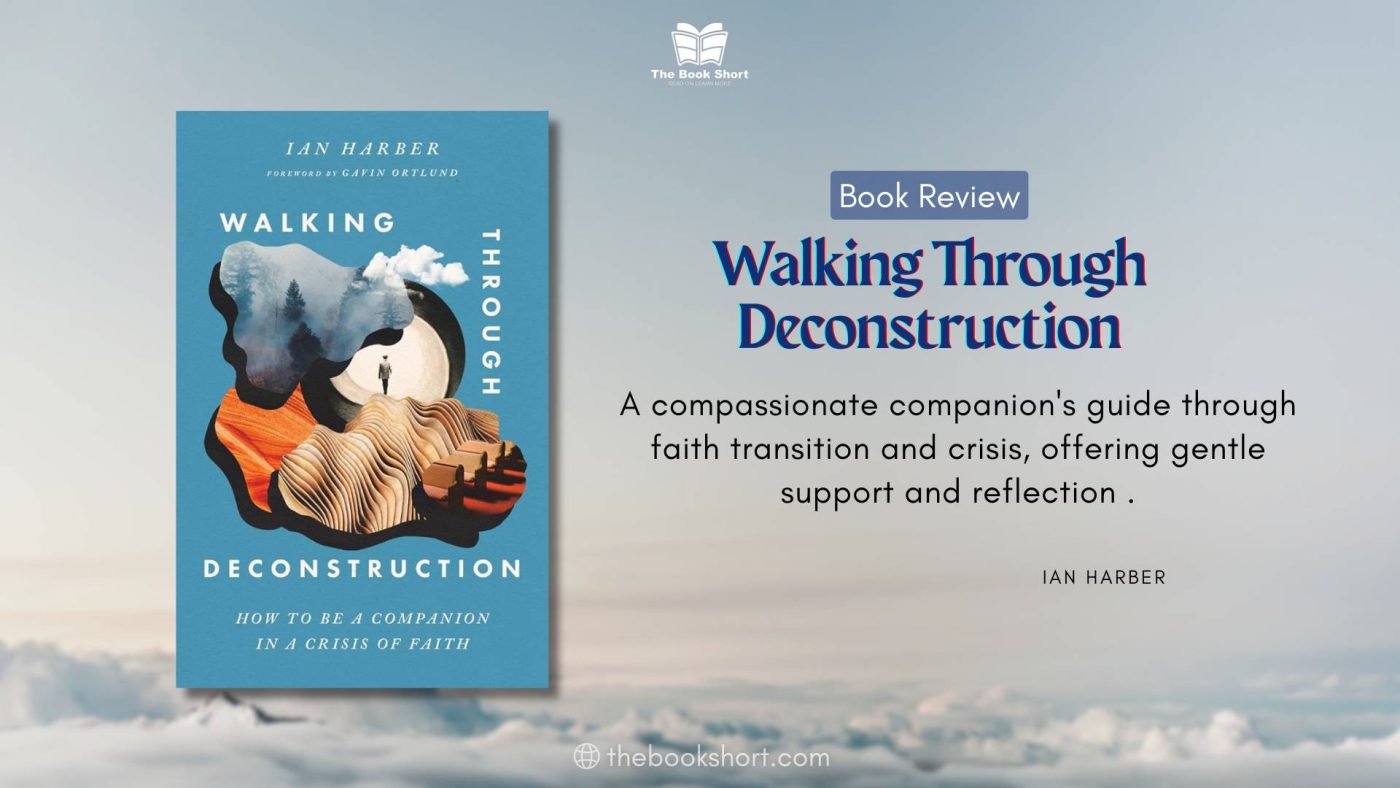
Navigating seismic shifts in faith can feel profoundly disorienting, like the ground is literally crumbling beneath your feet. It was this unsettling reality that drew me to Walking Through Deconstruction by Ian Harber. Far from offering easy answers or prescribing a single path, this book serves as a deeply compassionate roadmap for anyone questioning, dismantling, or painstakingly rebuilding their beliefs. It’s a supportive companion that stands out for its empathy, offering invaluable insights and practical grace for a complex spiritual journey.
Basic Information about Walking Through Deconstruction Book
- Title: Walking Through Deconstruction: Navigating Faith Transitions with Grace
- Author: Ian Harber
- Year of Publication: 2021
- Genre: Religion & Spirituality, Christian Living, Faith Deconstruction
- Number of Pages: Approx. 212 pages (Note: Page count can vary slightly by edition)
- Target Audience: Individuals actively questioning or undergoing faith transitions (often termed deconstruction), particularly those from evangelical or conservative Christian backgrounds. Also highly relevant for pastors, church leaders, friends, and family members seeking to understand and offer support to someone navigating religious doubt or change.

Walking Through Deconstruction: How to Be a Companion in a Crisis of Faith
Main Content Summary of Walking Through Deconstruction
Walking Through Deconstruction by Ian Harber dives directly into the often-turbulent waters faced by individuals who find themselves questioning or critically examining long-held religious beliefs, especially those rooted in evangelical or conservative Christian traditions. Harber compassionately reframes deconstruction – not as an inevitable path towards abandoning faith, but as a potentially vital and healthy stage necessary for dismantling shaky foundations and ultimately forging a more authentic and resilient belief system.
Harber intentionally structures the book to mirror the phases and emotional landscape of this intense process. He offers profound validation for the pain, confusion, grief, and isolation that so often accompany questioning one’s faith, choosing empathy and gentle guidance over judgment or simplistic solutions. The book’s beating heart is a message of grace – grace for oneself, for the difficult questions, and for the slow, unpredictable pace of the journey.
The narrative begins by clearly defining what deconstruction is, and crucially, what it is not. Harber makes a critical distinction between deconstruction as a process of critical examination and discernment versus mere cynicism or a passive loss of faith. He portrays it as an active, often painstaking effort to sift through inherited beliefs, questioning assumptions, and identifying the core spiritual truths that remain when cultural norms or non-essential doctrines are set aside. This foundational section is designed to normalize the experience and provide readers with a language and framework for understanding their internal upheaval.
Moving forward, Harber explores the common catalysts that often trigger deconstruction. These frequently include wrestling with apparent theological inconsistencies, confronting difficult or troubling biblical passages, experiencing hurt or trauma within religious institutions, grappling with scientific discoveries, encountering diverse cultures and belief systems, or simply undergoing personal growth that inevitably leads to new questions about the world and one’s place in it. By candidly acknowledging these triggers, the book helps readers pinpoint the sources of their own questioning, fostering a powerful sense of “I am not alone.”
A significant and perhaps the most validating portion of the book is dedicated to navigating the complex emotional and psychological terrain of deconstruction. Harber speaks directly to the profound sense of loss and grief involved in letting go of old certainties, the crippling fear of judgment from former communities, the anxiety about an uncertain future, and the painful potential loss of cherished relationships. He emphasizes the absolute necessity of processing these intense emotions in healthy ways and finding safe havens where vulnerability is welcomed, not weaponized. This section is indispensable, offering readers permission to feel and providing compassionate strategies for coping with the immense emotional toll of spiritual upheaval.
The book doesn’t shy away from the intellectual and theological challenges either. Harber encourages readers to engage their questions with honesty and intellectual humility. He advocates for thorough research of different perspectives and a courageous willingness to re-evaluate previously unquestioned doctrines. While he doesn’t claim to provide definitive answers to every theological puzzle, he empowers the reader to trust their own journey of seeking truth and understanding, suggesting that authentic faith is robust enough to withstand rigorous scrutiny.
Community emerges as a vital lifeline within the narrative. Harber acutely understands that deconstruction often leads to painful alienation from one’s original faith community. He addresses the ache of this separation and the significant challenge of forging new connections. He strongly encourages seeking out supportive individuals or alternative communities, whether online or in person, where grace and understanding are offered in place of condemnation. He also provides thoughtful advice for navigating often-strained relationships with family and friends who may struggle to comprehend or accept the deconstruction process.
Crucially, Harber guides the reader towards the possibility of reconstruction. This is not presented as a mere return to former beliefs but as the challenging, creative process of building a new faith or worldview – one that feels more integrated, authentic, and deeply personal. Reconstruction is portrayed as a spectrum, potentially leading to a reformed expression of Christian faith, an exploration of other spiritual paths, or even settling into a place of agnosticism or atheism. Harber’s approach is refreshingly inclusive, honoring the integrity of the individual’s unique journey and its varied potential outcomes.
Woven throughout the book is practical, grounded advice. Harber offers concrete suggestions for managing the overwhelming anxiety that can accompany doubt, practicing radical self-care during an exhausting transition, setting healthy boundaries in challenging relationships, and responsibly exploring new ideas. He underscores the essential need for patience, recognizing that deconstruction and reconstruction are organic processes that are rarely linear or quick.
In essence, Walking Through Deconstruction stands as a profoundly empathetic, non-judgmental, and remarkably practical companion for anyone traversing a faith transition. It courageously normalizes the questioning process, validates the often-overlooked emotional experience, champions intellectual honesty, emphasizes the indispensable need for supportive community, and gently points towards the hope of finding a more authentic spiritual home, whatever unique form that may take for the individual. It’s more than just a book; it feels like a trusted friend guiding you through the wilderness of doubt towards the potential of a richer, more integrated spiritual landscape.
In-Depth Analysis of Walking Through Deconstruction Book
Ian Harber’s Walking Through Deconstruction is a significant and timely contribution to the burgeoning conversation surrounding faith transitions, particularly within evangelical and post-evangelical spaces. Its profound strength lies in its deeply empathetic posture and the clear, practical framework it offers for a process that is frequently fraught with confusion, pain, and isolation.
Structure, Key Arguments, and Author’s Voice
The book is masterfully structured, following a logical and intuitive path that mirrors the lived experience of deconstruction. It moves seamlessly from establishing a clear definition and validating the reality of the experience to exploring its multifaceted triggers, the deep emotional and psychological impacts, the intellectual and theological wrestling involved, the complex relational dynamics, and finally, the potential for rebuilding something new and authentic. This step-by-step progression provides a sense of being guided through treacherous terrain, offering comfort and clarity.
Harber’s central argument is both courageous and pastorally wise: deconstruction, while undeniably challenging and painful at times, can be a profoundly healthy and even necessary process for developing a faith or worldview characterized by greater authenticity, resilience, and integrity. He pushes back gently but firmly against the common fear that deconstruction is inherently destructive, positing instead that it can lead to deeper spiritual maturity if navigated intentionally and with supportive resources. A crucial distinction he draws repeatedly is between dismantling unhealthy or non-essential elements of belief (cultural baggage, harmful doctrines) and abandoning core spiritual or ethical values.
Perhaps the book’s singular greatest asset is Harber’s voice. It is consistently warm, deeply empathetic, and utterly non-judgmental. Drawing upon a blend of personal insight and pastoral experience, he cultivates a tone that feels less like an academic treatise and more like a trusted guide or a wise friend walking faithfully alongside the reader through their darkest doubts. He deliberately avoids overly academic language or dogmatic pronouncements, favoring accessible, relatable prose that resonates on a deeply human level. While there isn’t a cast of characters in the traditional narrative sense, Harber’s presence as a compassionate fellow traveler is strong, and readers will easily recognize themselves or people they care about in the experiences he describes.
Writing Style & Content Quality
Harber’s writing style is remarkably clear, direct, and exceptionally readable – a critical factor for a book aimed at individuals often experiencing significant emotional and intellectual overload. He employs simple language, relatable (though not extensive personal) anecdotes, and effective analogies to illuminate complex emotional states and challenging theological concepts. The content quality is exceptionally high in its practical utility and sophisticated emotional intelligence. The book prioritizes providing a framework for processing the deconstruction experience itself over offering definitive answers to specific theological dilemmas, which is precisely what makes it so broadly applicable and helpful. It demonstrates a deep understanding of the psychological and social dynamics inherent in religious change.
What distinguishes Walking Through Deconstruction from many other books in this space is its unwavering focus on grace and compassion – both extended inwardly to oneself and outwardly in navigating relationships. While some books might intensely focus on critiquing specific theological points being deconstructed, or others might dwell on negative experiences within religious institutions, Harber touches upon these triggers but keeps the spotlight firmly on the individual’s internal spiritual and emotional journey and the practicalities of relational navigation and finding a healthy way forward. He doesn’t present a prescriptive blueprint for abandoning faith or adopting a particular new theology; instead, he offers a compassionate guide for being present with discomfort, caring for oneself, and engaging authentically during a time of profound spiritual transformation.
Notable Ideas from the Book
While specific quotes vary by edition, several core tenets resonate powerfully throughout the book, serving as anchors for the reader:
- Deconstruction is not synonymous with destruction: It can be a process of refinement, clarification, and ultimately strengthening faith by shedding non-essential elements or harmful baggage.
- Your feelings are valid and necessary: The grief, fear, anger, and confusion are inherent parts of this seismic shift and require acknowledgment and healthy processing.
- You are not navigating this alone: Many individuals share this experience, and intentionally seeking and finding supportive community is crucial for survival and healing.
- Patience is a necessary virtue: Deconstruction and the subsequent potential for reconstruction are not linear processes and unfold over significant time.
- Integrity is the ultimate goal: The journey often seeks to build a faith or worldview that is deeply aligned with one’s authentic self, values, and evolving understanding.
- Grace is the operating principle: Extend radical grace to yourself throughout the messiness, to those who may misunderstand or judge your path, and in your interactions with those holding differing beliefs.
These fundamental ideas are woven throughout the chapters, reinforced through explanation, validation, and actionable advice, solidifying the book’s role as a supportive, non-academic resource for navigating spiritual upheaval.
Evaluation & Expert Personal Review of Walking Through Deconstruction
From my perspective as someone familiar with the landscape of faith and its many transitions, Ian Harber’s Walking Through Deconstruction is a book I found profoundly validating and immensely helpful. My overall impression is that it not only succeeds but excels in its stated aim: to offer grace and pragmatic guidance during what is often an incredibly turbulent and isolating process.
One of its most significant strengths is its relentlessly empathetic tone. Harber manages to avoid the common pitfalls of judgment, dogmatism, or overly intellectual abstraction that can derail discussions around religious doubt. He does not presume to tell the reader what to believe after deconstruction, but rather provides a compassionate framework for how to healthily, thoughtfully, and gracefully navigate the process of figuring out what they believe. This nuance is absolutely paramount and makes the book accessible and valuable to a remarkably wide spectrum of individuals, regardless of where their journey ultimately leads them on the theological spectrum. The book’s robust focus on the emotional and relational dimensions of deconstruction is particularly powerful and necessary, addressing aspects that are often the most acutely painful parts of the experience.
A potential limitation, depending on a reader’s specific needs, is that the book focuses more intently on the process, experience, and pastoral care aspects of deconstruction rather than delving deeply into complex theological debates or offering extensive critiques of specific doctrines. Readers primarily seeking detailed intellectual arguments against particular religious tenets or a robust defense of alternative theological systems might find it less comprehensive in that specific regard. However, this deliberate focus on the personal journey is also precisely its core strength, making it broadly applicable and emotionally resonant for those actively living through the experience, rather than solely analyzing it.
The readability level is outstanding. The prose is clear, accessible, and mercifully free of unnecessary jargon. It is precisely the kind of book that someone in the throes of confusion, grief, and emotional distress can pick up and readily absorb, finding immediate points of connection and validation.
This book is remarkably well-suited for a broad and crucial audience:
- Individuals currently undergoing deconstruction: This is the book’s primary intended audience, and they will likely find it a source of profound validation, practical strategies, and much-needed comfort.
- Pastors and church leaders: It offers invaluable, compassionate insight into the experiences of individuals in their congregations who may be silently or openly wrestling with doubt, providing a framework for responding with grace rather than fear or condemnation.
- Family members and friends of those deconstructing: It serves as a vital primer for understanding the challenging journey of their loved ones and navigating those relationships with greater empathy, patience, and informed compassion.
- Anyone interested in contemporary faith development: It provides a clear, accessible window into a widespread modern religious phenomenon and the human experience behind it.
The practical value of Walking Through Deconstruction is exceptionally high. It furnishes tangible, actionable lessons: how to identify the underlying sources of your questioning, how to healthily process intense emotions like grief and fear, how to communicate boundaries and experiences with others, how to actively seek and cultivate supportive community, and how to approach the challenging task of rebuilding a coherent worldview. It profoundly encourages a transformative shift in perspective – from viewing doubt as dangerous or faithlessness as failure, to seeing honest questioning as a potential pathway towards deeper spiritual integrity and self-awareness. It offers explicit permission to not have all the answers immediately and rightly stresses the critical importance of self-compassion and care during an emotionally and intellectually draining process. For anyone feeling isolated, lost, or overwhelmed while questioning their faith, this book genuinely offers a lifeline of understanding, validation, and concrete, compassionate steps forward.
Comparison with Similar Books Walking Through Deconstruction
Walking Through Deconstruction by Ian Harber occupies a vital space within the expanding landscape of literature addressing faith transitions, particularly the complex journey away from or through conservative and evangelical frameworks.
Books covering similar ground often fall into several categories: personal memoirs detailing individual deconstruction stories (a vast and growing genre), theological works offering progressive or alternative interpretations of Christian doctrine (like those by Peter Enns or Richard Rohr), or psychological analyses of recovery from harmful religious experiences (such as Marlene Winell’s work).
What distinctly positions Harber’s book is its singular, balanced focus on the process of deconstruction itself and its deeply pastoral tone. While authors like Peter Enns (The Bible Tells Me So, How the Bible Actually Works) excel at engaging the intellectual and theological triggers of deconstruction by examining challenging biblical texts, and memoirs provide poignant, detailed accounts of the lived experience through personal narrative, Harber’s book functions most powerfully as a compassionate, practical guidebook for the journey. It is less preoccupied with dissecting specific doctrines (though it acknowledges they are often the initial points of friction) and more dedicated to providing emotional support, validation, and actionable strategies for navigating the disorientation, grief, and relational strain, while pointing towards the possibility of finding a path forward, whatever shape that ultimately takes.


For readers who found Walking Through Deconstruction resonate due to its empathetic approach and emphasis on the personal journey through doubt and change, several other books offer valuable complementary perspectives:
- The Great Spiritual Migration by Brian McLaren: Explores broader shifts within Christian faith towards more progressive, inclusive, and justice-oriented expressions, offering a vision for potential “reconstruction.”
- Faith Shift by Kathy Escobar: Offers a different model for understanding faith change, outlining distinct “stages” of spiritual transition and including personal stories from others.
- Leaving the Fold by Marlene Winell: Provides a crucial psychological framework for understanding the trauma and recovery process for those leaving high-control or harmful religious environments.
- Inspired by Rachel Held Evans: While not strictly about “deconstruction,” Evans’ honest, questioning, and loving approach to wrestling with scripture and tradition speaks directly to many of the intellectual and emotional catalysts that initiate the deconstruction process.
While these books approach the topic from varied angles – theological, personal narrative, psychological – they share a common thread of acknowledging the challenges posed by traditional faith frameworks and exploring possibilities for more authentic belief or non-belief. Harber’s book serves as an excellent and necessary starting point, uniquely focused on providing gentle, informed, and profoundly human support for the very act of walking through the deconstruction process itself.
Conclusion & Recommendations for Walking Through Deconstruction
Walking Through Deconstruction by Ian Harber offers exceptional value as a compassionate and practical guide for navigating the often-painful process of questioning and potentially rebuilding one’s faith. Its paramount strength lies in its deeply empathetic, utterly non-judgmental, and grounded approach, providing much-needed comfort, validation, and concrete strategies for individuals who feel lost, isolated, or overwhelmed during this tumultuous time of spiritual flux.
Is it worth reading? Without reservation, yes. It is a timely, necessary, and profoundly human book in a world where increasing numbers are finding their inherited beliefs challenged by life experiences, intellectual inquiries, ethical conflicts, or institutional issues.
Who should make this book a priority? Foremost, anyone currently undergoing a faith transition, particularly those emerging from conservative or evangelical backgrounds, will find it an indispensable companion. It is also highly recommended, arguably essential reading, for pastors, counselors, family members, and friends who genuinely wish to understand and offer support to someone navigating deconstruction with grace and informed compassion rather than fear or judgment. It provides a shared vocabulary and a sensitive framework for approaching a deeply complex spiritual journey.
Have you walked with Ian Harber through these pages? Share your thoughts and experiences in the comments below!