
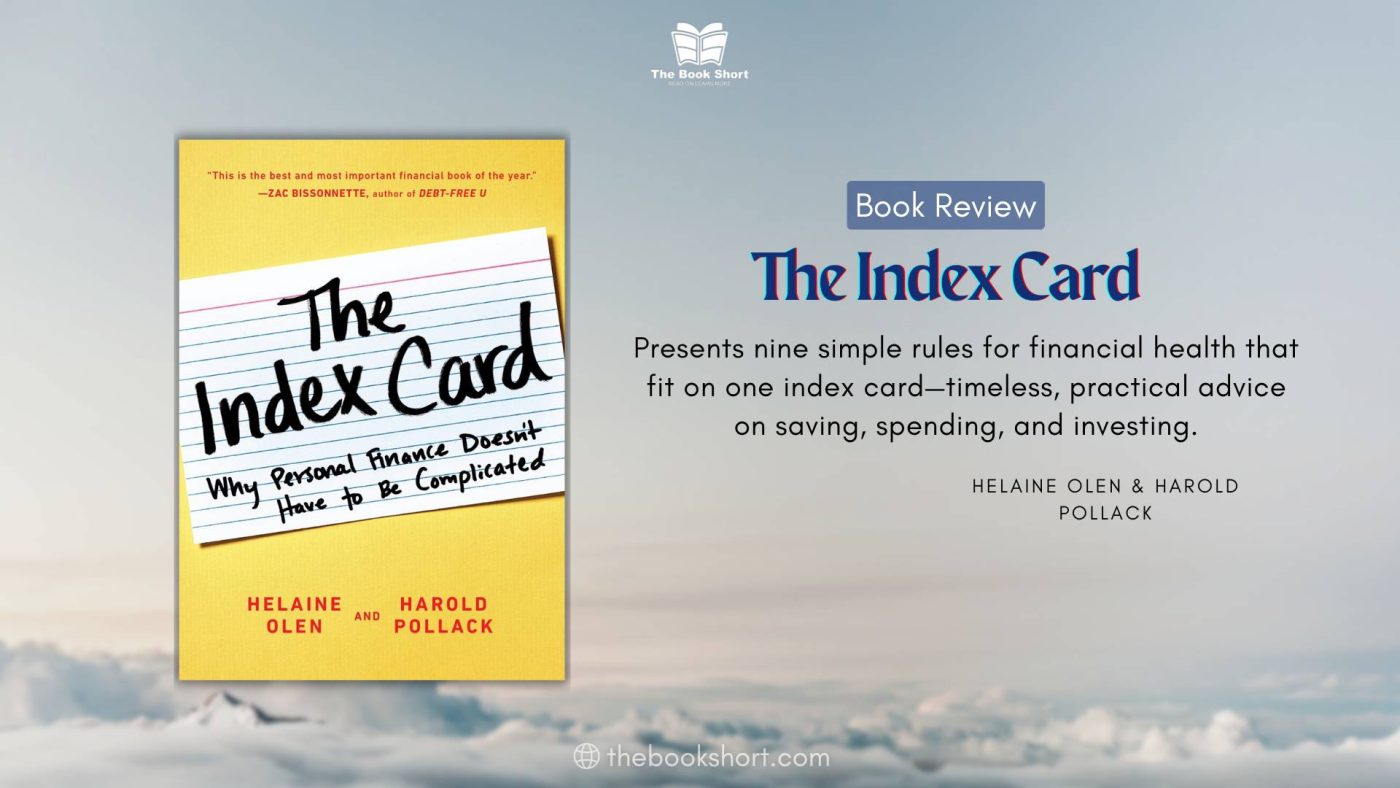
This book summary of The Index Card reveals 10 simple rules for financial success, proving that personal finance doesn’t have to be complicated.
Can all the essential financial advice you’ll ever need truly fit on a single 4×6 index card? This book argues a resounding yes, cutting through the noise and jargon of the financial industry. We chose The Index Card for this review because its radical simplicity is a powerful antidote to the overwhelming complexity that paralyzes so many people. It’s a book that empowers, reminding us that smart financial management is within everyone’s reach—not just the experts.
The Index Card: Book Fact Sheet
- Title: The Index Card: Why Personal Finance Doesn’t Have to Be Complicated
- Author: Helaine Olen & Harold Pollack
- Year of publication: 2016
- Genre: Non-fiction, Personal Finance
- Number of pages: 256
- Target audience: Financial novices, individuals overwhelmed by complex advice, and anyone seeking a simple, profoundly effective financial blueprint.

The Index Card: Why Personal Finance Doesn't Have to Be Complicated
The 10 Simple Rules: A Full Summary of The Index Card
The entire concept of The Index Card sparked from a viral moment: during an interview with financial journalist Helaine Olen, University of Chicago professor Harold Pollack casually jotted down what he believed were the only financial rules that mattered on a simple note card. The book brilliantly expands on these ten deceptively simple rules, dedicating a chapter to each one. It demystifies personal finance by arguing that mastering the basics is all you need to build a secure and prosperous future.
Rule 1: Strive to Save 10 to 20 Percent of Your Income
The cornerstone of the entire philosophy is to pay yourself first. The authors stress that the habit of consistent saving is far more powerful than chasing elusive, high-risk investment returns. They are huge proponents of automating this process. By setting up direct deposits from your paycheck into savings and retirement accounts, you make saving an effortless, default action rather than a daily test of willpower. The 10-20% target is ambitious but achievable. If that feels out of reach, the crucial first step is to simply start—with any amount—and gradually increase it, especially when you get a raise.
Rule 2: Pay Your Credit Card Balance in Full Every Month
Olen and Pollack are unflinching in their assessment of high-interest consumer debt: it is a financial emergency. The astronomical interest rates on credit cards can obliterate any gains you might achieve through investing. Their advice is non-negotiable: treat credit cards as a payment tool for convenience, never as a means to borrow. If you’re carrying a credit card balance, attacking that debt should become your single-minded financial priority, eclipsing even aggressive saving and investing until it’s gone.
Rule 3: Maximize Your 401(k) and Other Tax-Advantaged Savings Accounts
The authors illuminate the incredible wealth-building power of tax-advantaged retirement accounts like 401(k)s, 403(b)s, and IRAs. They break down the benefits into simple terms:
- Employer Match: This is described as “free money,” and they rightly insist that contributing enough to secure the full match is the single best guaranteed return on investment available anywhere.
- Tax Shield: Contributions can either lower your taxable income today (Traditional accounts) or grow completely tax-free for retirement (Roth accounts). This tax protection dramatically accelerates your long-term growth.
The clear directive is to contribute as much as you can, prioritizing the employer match first, then striving to hit the annual maximum.
Rule 4: Never Buy or Sell an Individual Stock
This is perhaps the book’s most liberating and controversial rule. Olen and Pollack argue forcefully that individual investors have no competitive advantage in trying to pick winning stocks. They present compelling evidence that even professional money managers consistently fail to outperform the market average over the long term. Attempting to do so exposes you to “uncompensated risk”—the danger of a single company’s collapse, a risk completely avoidable through diversification. The time and stress spent on stock research is better invested in your career, your family, and your life.
Rule 5: Buy Inexpensive, Well-Diversified Index Funds and Exchange-Traded Funds
Flowing directly from the previous rule, this is the solution. Instead of gambling on individual stocks, the authors champion a passive investing strategy using low-cost index funds. An index fund (or its cousin, the ETF) simply aims to mirror a broad market index, like the S&P 500. By purchasing a single share, you instantly own a tiny slice of every company in that index, achieving broad diversification at an incredibly low cost. They hammer home the importance of minimizing expense ratios (the fund’s annual fee), as high fees are a silent killer of long-term returns.
Rule 6: Make Your Financial Advisor Commit to the Fiduciary Standard
The book wades into the often-confusing world of financial advice, clarifying the critical distinction between two types of advisors:
- Brokers: Operate on a “suitability” standard. They can sell you a product that is merely suitable, even if a better, cheaper option exists that doesn’t pay them as high a commission.
- Fiduciaries: Are legally and ethically required to act in your absolute best interest, always.
The advice here is a bright line: only work with fee-only advisors who are legally bound by the fiduciary standard. This alignment ensures the advice you get serves your goals, not their pockets.
Rule 7: Buy a Home When You Are Financially Ready
Olen and Pollack methodically dismantle the cultural myth that homeownership is a guaranteed ticket to wealth. They offer a grounded perspective, urging readers to view a primary home as a place to live first and a potential investment a distant second. They warn against overextending your finances and detail the hidden costs of ownership: maintenance, taxes, insurance, and unexpected repairs. True financial readiness involves a stable income, a substantial down payment (ideally 20% to avoid private mortgage insurance), and a robust emergency fund that remains untouched by your housing goals.
Rule 8: Insurance—Make Sure You’re Protected
Insurance is framed not as a way to get rich, but as the essential tool for managing catastrophic risk. Its sole purpose is to shield you and your loved ones from financial ruin. The book advises focusing on the absolute essentials:
- Health Insurance: A non-negotiable foundation.
- Term Life Insurance: If anyone depends on your income. They strongly advise against expensive and complex whole-life policies.
- Disability Insurance: To protect your most valuable asset: your ability to earn an income.
- Homeowners/Renters and Auto Insurance: To protect your major assets from loss or liability.
Rule 9: Do What You Can to Support the Social Safety Net
This rule broadens the conversation from personal wealth to societal well-being. The authors argue that our individual financial health is deeply connected to the strength of social programs like Social Security and Medicare. These systems function as a massive, collective insurance pool that provides a baseline of security for everyone. The call to action is to be an engaged citizen—to vote and support policies that fortify this safety net for current and future generations.
Rule 10: Remember the Index Card
The final rule circles back to the book’s origin: keep it simple. The financial services industry thrives on creating complexity, convincing you that you need intricate products and costly advice to succeed. The powerful thesis of this book is that you don’t. By adhering to these timeless, straightforward principles, you can confidently tune out the noise, sidestep costly errors, and build a secure financial life.
In-depth Analysis of The Index Card: Themes and Style
The Index Card is far more than a checklist; it’s a quiet rebellion against the financial industry’s deliberate mystification of money. Its analysis is a masterclass in empowering the individual by boiling down financial concepts to their unshakeable core.
Characters, Structure, and Key Arguments
The genius of the book lies in its structure. Each chapter methodically unpacks one of the ten rules with data, relatable anecdotes, and crystal-clear explanations. This design accomplishes two things beautifully:
- It’s Inherently Actionable: A reader doesn’t just finish a chapter with more knowledge; they finish with a clear, singular mandate. The book is less a textbook and more a practical, step-by-step guide.
- It Reinforces the Core Thesis: By dedicating a full chapter to each simple rule, the authors prove that these principles aren’t just quaint suggestions but are robust pillars for a comprehensive financial plan.
The book’s central argument is a potent critique of the financial-industrial complex. Olen and Pollack assert that the industry profits by fostering feelings of inadequacy and fear in ordinary people. By inventing a bewildering maze of complex products and cloaking them in impenetrable jargon, they position themselves as the essential—and expensive—gatekeepers to wealth. The Index Card exposes this as a manufactured need. The best, most effective strategies are simple, cheap, and available to all. This “less is more” ethos is the book’s defiant, distinguishing heartbeat.
Writing Style and Content Quality
The writing style is the book’s greatest asset. It is a clinic in clarity and empathy.
- Language: The authors meticulously avoid jargon. When a technical term like “fiduciary” or “expense ratio” is necessary, it’s defined in plain English and its importance is reinforced. The tone is consistently encouraging and respectful, feeling like advice from a wise friend rather than a lecture from a professor.
- Evidence-Based: While the delivery is simple, the advice is anything but simplistic. Olen, a sharp investigative journalist, and Pollack, a respected public policy professor, anchor every rule in academic research, data, and historical evidence. They don’t just tell you active fund managers fail to beat the market; they show you the studies. This gives the simple rules an undeniable intellectual weight.
- Anecdotal Power: The book is woven with relatable stories of people who have stumbled into common financial traps or found success by embracing these core principles. These narratives breathe life into the concepts, making them tangible and unforgettable.
The quality of the content is exceptional precisely because it shuns speculative, high-risk strategies in favor of what is proven to work for most people, most of the time. It prioritizes sound risk management and consistent behavior over the siren song of outlier returns, a message that stands in stark contrast to the “get rich quick” noise dominating financial media.
Notable Quotes from the Book
- On Simplicity: “The financial-services industry wants you to think you need a financial advisor to do all this. You don’t… The best person to manage your money is you.” This quote captures the book’s fundamental message of empowerment and financial self-reliance.
- On Stock Picking: “Trying to beat the stock market is a fool’s game that, on average, enriches only the financial-services industry.” A blunt, powerful, and liberating dismissal of the myth that you need to be a stock market wizard.
- On the Role of an Advisor: “A good financial advisor is a bit like a good personal trainer. He or she will help you set goals, create a plan to get there, and—most important—encourage you to stick with it.” This brilliantly reframes an advisor’s true value—not as a mystical guru, but as a behavioral coach.
An Expert Evaluation and Personal Review of The Index Card
In a saturated market of personal finance guides, The Index Card shines through its commitment to radical simplicity. It is a refreshingly direct, evidence-based, and actionable book that honors its promise to make personal finance accessible to all.
Advantages and Disadvantages
The book’s greatest triumph is its unwavering focus on simplicity and proof. The ten rules are not only easy to remember but, crucially, easy to implement. By championing automated savings and low-cost index funds, the authors offer a “set it and forget it” framework that works tirelessly in the background, freeing your time and mental energy for what truly matters. The combined credibility of a seasoned journalist and a respected academic gives the advice an air of unimpeachable, conflict-free honesty.
If there’s a drawback, it’s that the advice may feel too foundational for financially sophisticated readers. Those looking for advanced strategies in alternative assets, complex tax planning, or real estate syndication will need to look further. Additionally, the specific examples are rooted in the U.S. financial system (401(k)s, IRAs, etc.). While the underlying principles are universal, international readers will need to translate the specific account types to their own country’s framework.
Readability and Target Audience
The book is exceptionally readable. The prose is clean, direct, and blessedly free of the dense jargon that makes other financial texts impenetrable. The use of stories and clear analogies makes it a genuinely enjoyable read, even for someone with no prior financial knowledge.
This book is the perfect guide for:
- Absolute Beginners: It is, without a doubt, the ideal first book for anyone starting their financial journey.
- The Chronically Overwhelmed: Anyone who has felt defeated by the sheer volume of conflicting financial advice will find this book to be a calming anchor.
- Young Adults and Recent Graduates: It provides the perfect blueprint for building a lifetime of sound financial habits.
- Anyone Needing a “Reset”: Even experienced investors can benefit from a return to these first principles to ensure their strategy is built on solid ground.
Practical Value and Lessons Learned
The practical value of The Index Card is off the charts. It turns the fuzzy goal of “being good with money” into a concrete and manageable checklist. The ultimate lesson is that financial success is born not from genius, but from discipline, consistency, and the wisdom to avoid common pitfalls. Readers will walk away with a life-changing understanding of:
- The insidious, wealth-destroying power of fees and high-interest debt.
- The simple, profound case for passive, diversified investing.
- The critical importance of putting your savings on autopilot.
- How to identify and insist on unbiased financial advice.
Ultimately, the book delivers a profound mindset shift: you don’t need to be an expert to build wealth. You just need to follow a few simple rules and ignore almost everything else. This feeling of empowerment is its most valuable gift.
The Index Card in Context: A Comparison with Similar Finance Books
While The Index Card is unique, it belongs to a beloved genre of “simple finance” classics. Knowing how it stacks up against its peers can help you choose the right starting point.
The most direct comparison is J.L. Collins’s The Simple Path to Wealth. Both are powerful manifestos for a low-cost, index-fund-centric strategy. Originating as letters to his daughter, Collins’s book has a more personal, paternal, and philosophical tone. It digs deeper into the “why” of index investing and the mechanics of a simple VTSAX-based portfolio. The Index Card is broader, with its ten rules covering the entire financial landscape (debt, insurance, home buying), making it a more comprehensive “first steps” guide. The Simple Path is the definitive deep dive on the investing rules mentioned in the card.
Another titan of the genre is Ramit Sethi’s I Will Teach You to Be Rich. Sethi’s book shares the focus on automation but has a more energetic, prescriptive, and systems-based approach (“6-Week Program”). His tone is that of a motivational coach, with a strong emphasis on “conscious spending” to live a “Rich Life.” While the core investment principles are similar, Sethi dedicates more time to optimizing credit card rewards, negotiating salary, and building automated money-flow systems. The Index Card is more foundational and conservative; I Will Teach You to Be Rich is more focused on optimization and lifestyle integration.


If you liked The Index Card, you might also enjoy:
- The Simple Path to Wealth by J.L. Collins: For a more profound, philosophical exploration of the “why” behind simple index fund investing.
- A Random Walk Down Wall Street by Burton Malkiel: For the comprehensive, academic bible that provides the evidence supporting passive investing.
- The Bogleheads’ Guide to Investing by Taylor Larimore, Mel Lindauer, and Michael LeBoeuf: For a community-driven handbook that expands on the simple, low-cost principles pioneered by Vanguard founder John C. Bogle.
Conclusion: Our Recommendation on The Index Card
The Index Card is a landmark book for anyone who believes personal finance is beyond their grasp. Its enduring value is its power to distill decades of financial wisdom into ten common-sense rules that are easy to grasp and immediately actionable. It confidently cuts through the cacophony of the financial industry, replacing anxiety and complexity with clarity and confidence.
Is it worth reading? Absolutely. For its intended audience, it’s not just worth reading—it’s the single best place to begin a financial education. It provides a rock-solid foundation that will prevent years of costly mistakes and set a clear course for financial freedom.
This book should be required reading in every high school and for every college graduate. It is the perfect antidote to financial anxiety and the first, best step toward taking control of your future.
Have you read The Index Card? Share your own takeaways in the comments below